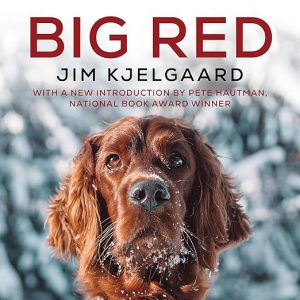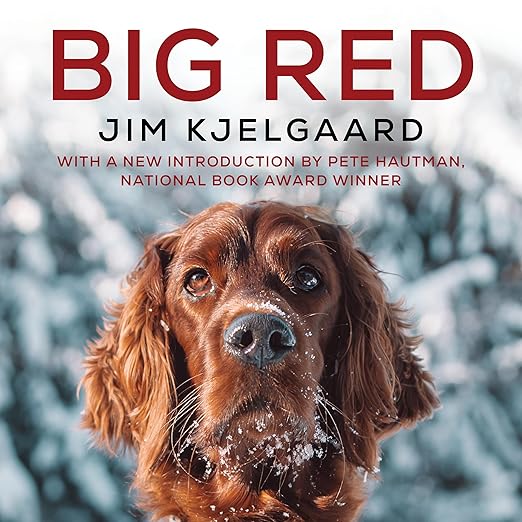
Danny Ormond sees the big Irish setter at once for what he is: the most beautiful dog he has ever encountered, and the one he wants more than anything his life in the Pennsylvania mountains has given him. Jim Kjelgaard's Big Red, first published in 1945 and now marking its 75th anniversary in this audiobook from Echo Point Books and Media, is one of those books that earned its place in the canon not through critical promotion but through repeated discovery, eleven-year-olds finding it on a shelf and not putting it down, parents passing it to children who pass it to theirs. Paul Heitsch narrates this audiobook across six hours and eighteen minutes, with audio engineering by Sam Platt. Katherine Applegate, the Newbery Award-winning author of The One and Only Ivan, calls it a timeless, not-to-be-missed classic, and 492 reviews at a 4.8 rating suggest that assessment is widely and consistently shared.
Danny is a trapper's son who lives in a cabin on the mountain. Red is a champion show dog, owned by the wealthy Mr. Haggin. The social distance between a champion dog and a trapper's boy is the first tension Kjelgaard establishes, and he refuses to resolve it cheaply or quickly. The bond that forms between Danny and Red is earned through repeated demonstration, tested by real danger, and ultimately forged through the kind of shared experience that only wilderness survival can generate. Before Old Yeller and before Where the Red Fern Grows, there was Big Red, and the book they follow owes it more than its successors usually acknowledge.
Red Is a Character, Not Just a Symbol
Kjelgaard was writing boy-and-dog books in an era when the emotional honesty of children's adventure fiction was not taken for granted. What he understood that many imitators have missed is that the animal must be a full participant in the story, not a symbol, not a reward for the boy's good behavior, but a character with genuine traits and genuine agency. Red is fast and strong and smart and noble and incredibly loyal, and Kjelgaard demonstrates every one of those qualities through action rather than assertion. When Danny twists his ankle and cannot get home and Red stays by him all night keeping a wildcat at bay, the event does not feel contrived. It feels like the natural expression of a bond that has been carefully built over the preceding chapters.
An eleven-year-old reviewer articulated the premise with admirable precision: Danny lives on his neighbor Mr. Haggin's property with his father, running a trap line, and Mr. Haggin allows Danny to care for Red because their bond is undeniable. That clarity of premise is one of Kjelgaard's most reliable strengths as a children's author. The story knows what it is about and pursues that subject without distraction. The blizzard sequence, the wolverine confrontation, and the eventual reckoning with Old Majesty, the savage bear that threatens everyone on the mountain, each escalate the stakes in ways that feel earned by what has come before, never manufactured for the sake of incident.
One reviewer praised the book for its extremely good illustrations and its spectacular realistic values about the relationship between a young man and his dog, noting that the book had aged without feeling dated. Another identified Jim Kjelgaard as a really great writer of dog stories set in the outdoors, going on to name the full trilogy, Big Red, Irish Red, and Outlaw Red, as a sequence worth pursuing. That trilogy awareness among readers is a reliable indicator of the depth of attachment the first book produces.
Heitsch Honors an Oral Tradition's Unhurried Quality
The audiobook format suits Big Red particularly well because Kjelgaard's prose has the quality of oral tradition, it is descriptive in the manner of a storyteller rather than a writer for the page. Paul Heitsch's narration honors that quality, moving at a pace that respects the mountain setting and the characters without losing the forward pull of adventure. The production by Echo Point Books includes an interview with Kjelgaard and an appreciation by National Book Award winner Pete Hautman, both of which provide genuine historical and literary context for a book that has been in print for eighty years.
For families listening together on long drives or during extended travel, Big Red is close to ideal audiobook material. The episodic adventure structure means each chapter brings its own incident and resolution, building toward the larger confrontation without requiring the sustained narrative tension that some younger listeners find difficult to hold across long listening sessions. Heitsch's consistent warmth serves the material well throughout.
One Reviewer Calls It Gory in Places
One reviewer specifically noted the book is gory in places, which is accurate in the sense that wilderness adventure in the 1940s was not sanitized for protective purposes. The wolverine confrontation and the bear conflict involve genuine violence, animals are injured, and the threat of death is real. Parents listening with very sensitive younger children at the lower end of the ten-and-up range should be aware of these sequences. The emotional realism that makes Big Red durable also means it does not shield its characters from real danger and real loss.
The social dynamics of the story reflect 1945 sensibilities in some respects, the relationship between Danny as a poor trapper's son and Mr. Haggin as a wealthy landowner operates without the critical framing a contemporary author might apply. For most readers this will not be a barrier; the book is too focused on the boy-and-dog bond to dwell on class dynamics. But adults discussing the book alongside younger children may find it worth a brief contextualizing conversation.
Skip It for Modern Social Perspectives Instead
Children aged ten and up who love animals, wilderness adventure, and stories with genuine emotional stakes will find Big Red as compelling now as it has been for eight decades. The audiobook is a particularly strong pick for family listening on long drives or during school breaks, given Heitsch's storytelling narration and the episodic structure. Adult readers who encountered the book in childhood will find it holds up fully, with the anniversary material adding historical value. Skip it if you are looking for contemporary children's fiction with modern social perspectives, Big Red is a classic in the specific sense of the word, meaning its virtues and its period sensibilities both belong to the era that produced it.
In Brief
- Performance: Paul Heitsch brings a steady, storytelling warmth to Jim Kjelgaard's prose that suits the Pennsylvania mountain setting and the boy-and-dog bond at the story's center.
- What it covers: loyalty between humans and animals, coming of age in the wilderness, courage under genuine threat
- Feel: Adventurous and grounded, with emotional stakes that have kept the book in print for eight decades
- Our call: Big Red holds up across seventy-five years for the same reason it always did, Jim Kjelgaard understood dogs and wilderness and the specific longing of a trapper's son who wants something beyond his station.
A Few Questions About Big Red (75th Anniversary Edition)
Is this audiobook appropriate for children who are sensitive to animal peril or animal death?
Big Red contains genuine wilderness violence, animals face injury and death in several sequences, including the wolverine confrontation and the bear encounter. The emotional stakes are real, and parents of sensitive younger listeners should be prepared to contextualize those passages.
Does this audiobook include any bonus material from the anniversary edition?
Yes, the 75th anniversary edition includes an interview with author Jim Kjelgaard and an appreciation by National Book Award winner Pete Hautman. Both are incorporated into the Echo Point Books and Media production and add genuine historical and literary context.
How does Paul Heitsch's narration handle the adventure sequences versus the quieter character moments?
Heitsch maintains a storytelling warmth throughout and shifts pace effectively between the quieter scenes of Danny and Red bonding and the more intense sequences involving the blizzard and animal encounters. The narration is consistent and accessible for the full age range.
Is Big Red the first book in a series, and does this audiobook work as a standalone?
Big Red is the first of Jim Kjelgaard's three Irish Setter books, followed by Irish Red and Outlaw Red. The story is fully self-contained and works without the sequels, though readers who love Danny and Red typically seek out the rest of the trilogy.