Quick Take
- Read by: Wesleigh Siobhan carries both leads alone, and the opening hours give a single voice unusually little dialogue to shape
- At its heart: Faith versus desire, church expectation and family failure, redemption after prison, good-girl exhaustion
- Vibe: Warm and confrontational by turns, with real heat and real grief
- Short version: A strong pick for contemporary Black romance listeners, a poor one for anyone shopping by the title.
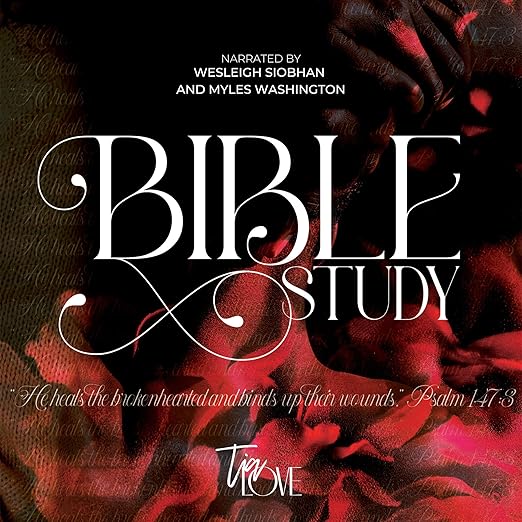
A title like Bible Study sets an expectation this audiobook has no intention of meeting. Tia Love has written a romance, shelved under fiction and romance on the listing, and the study group of the title is simply where a man fresh out of prison walks in looking for peace and finds Genesis Walker instead. Wesleigh Siobhan reads it across eleven hours and forty-five minutes. Anyone arriving in search of devotional material will work that out inside the opening chapter.
Genesis has spent years trying to be the woman her faith, her family and her own conscience keep describing to her, and failing at it privately. Algernon is safe, stable and everything she has prayed for. Preston Nash is fresh out of prison, rebuilding his father's business, and entirely uninterested in pretending he wants anything other than her. That triangle is old machinery. What Love does with it is not.
LJB's three-star response, posted in March 2026, describes the real spine better than the publisher copy does: Genesis was failed by her parents and by the church, and the satisfying part of the book is watching her find the nerve to confront her mother and say all of it out loud. The same account notes with some regret that only one parent ever gets addressed. That gap is deliberate and it is the book's most honest structural choice, since the confrontation people rehearse for years rarely arrives complete.
Preston is drawn with an unusual amount of directness for the reformed-bad-boy role. No mixed signals, no strategic distance, no misunderstanding stretched over four chapters: he states what he wants early and does not move off it, which removes the most tired engine in the subgenre and forces the tension to come from Genesis instead. The question stops being whether he means it and becomes whether she can accept being wanted without earning it first.
Genesis's Story Gives Faith Real Nerve
Recognition is what this book trades in, and it lands hard for the readers it is aimed at. Eliane Anita, five stars in August 2025, describes crying through it and seeing so much of herself in Genesis that the experience became uncomfortable, and credits Love with writing down what a great many good Christian girls have thought and never said. That is a specific readership being addressed precisely, and reading the responses it becomes obvious the book found them.
Faith material is handled with more nerve than the setup implies. Love is not writing a church-approved parable in which desire gets punished and then forgiven; the book is interested in the gap between doctrine as taught and faith as lived, and in the particular exhaustion of performing goodness for an audience that is not living by the same standard. Grace arrives through a man who has actually been to prison, which is a pointed piece of theology to build a romance around.
At just under twelve hours, the pacing gives the interior work room. Genesis's second-guessing, her negotiations with herself, the slow reordering of what she believes she is allowed to want: all of that needs time, and a shorter book would have to summarize what this one lets you sit inside. The romance beats arrive when they should, but the reason to stay is the argument Genesis is having with herself.
Siobhan's Single Voice Meets a Dialogue Gap
Sahara's account is the one to read before buying, and it is also the strangest thing on the page: it files five stars while opening with the words four stars only, because the reviewer nearly abandoned the book. The reason given is a lack of character dialogue in the early chapters. That matters more in audio than on paper. A single credited voice has considerably less to work with when a romance opens on interior monologue rather than on people talking, and the first hour or so is exactly that.
Two further complaints from the same response are worth weighing: a wish for more character depth, and the observation that Preston's troubles become repetitive. The second is accurate. His obstacles cycle through similar shapes, and by the back third you can anticipate the category of the next setback even when you cannot predict its content. Nothing here is fatal, but it does mean the second half leans on Genesis to carry the surprises.
Star ratings and written bodies pull against each other on this listing. The account quoted above carries five stars while opening with a self-assessed four, which means the number attached to it never described the reading experience underneath. Read the writing rather than the star line here, because the 4.5 average across 137 ratings smooths over genuinely mixed reactions instead of reflecting a settled consensus, and the written responses tell you far more than the aggregate ever will.
Two listing details deserve a mention as well. The synopsis on the product page stops mid-sentence, breaking off in the middle of the line about salvation and sin colliding, so anyone relying on it for the premise gets an incomplete one. The publisher name also carries a stray character at the end. Neither affects the recording, but both suggest the page was assembled quickly, and several of the visible responses were posted months before the audio edition existed.
WellReadRuby Draws the Boundary on Genre
WellReadRuby's four-star response draws the boundary that matters. This is not a Christian romance, that account says plainly, but it does capture what young women face when they try to live for themselves, satisfy the church and hold on to their relationship with God at the same time. If that three-way pressure is familiar to you, the book is speaking your language and will probably hurt in the useful way.
Contemporary Black romance listeners are the core audience, particularly those who want faith treated as a live tension rather than as set dressing. The heat level is real, the language is unguarded, and the redemption arc runs through a man with a criminal record rather than around him. Anyone who enjoys that combination will find this a fuller book than the title suggests.
Devotional listeners expecting scripture study will be in the wrong room within twenty minutes, and so will anyone who needs their inspirational fiction free of explicit content. The mismatch is not the book's fault, but the title, the cover context and the shelving all conspire to produce it, and it is the single most likely source of disappointment here. Check the genre tags before you buy this one for a relative.
Before You Listen
Is the Bible Study audiobook actually religious content?
No. It is a contemporary romance in which faith is a central pressure on the heroine rather than the subject of instruction. One reviewer states outright that it is not a Christian romance. Expect explicit content, church politics treated critically, and a redemption arc rather than any form of scripture teaching.
Why do several reviews predate the audiobook's release date?
The listing gives a February 2026 release, yet three of the five entries visible here were posted between August 2025 and January 2026, including one calling it a favorite of 2025. Those accounts are grading the written edition, which circulated first. Only the two most recent could have been written after the recording appeared.