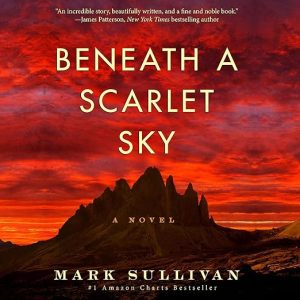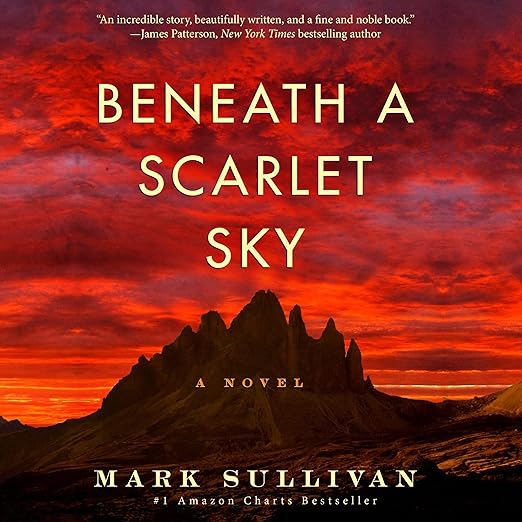
Pino Lella is, at the start of this audiobook, an ordinary Italian teenager the synopsis describes as 'obsessed with music, food, and girls', right up until Allied bombs destroy his family's home in Milan and his days of innocence run out for good. Beneath a Scarlet Sky earns its standing as one of the strongest true-story audiobooks in the WWII historical fiction category honestly, not through marketing copy. He joins an underground railroad smuggling Jews over the Alps, falls for Anna, a widow six years his senior, and then, after his parents force him into the German army to keep him out of combat, ends up recruited at eighteen as the personal driver for one of the Third Reich's most powerful commanders in Italy. Will Damron narrates all seventeen hours and forty-three minutes of it.
Pino Drives a Reich General, Feeds the Allies
Mark Sullivan built this novel from a real, largely forgotten wartime story, and the scale of what Pino actually did, spying on the German High Command from inside Hitler's own operation in Italy while still a teenager, gives the book a different kind of gravity than most invented WWII romances. It's a USA Today and number-one Amazon Charts bestseller, and it's soon to become a television production from Pascal Pictures starring Tom Holland, which tells you something about how cinematic the underlying material already is without any embellishment needed.
Damron has built a real track record narrating long-form nonfiction and journalism with a calibrated pace for sustained tension, never reaching for melodrama the material doesn't need, and that restraint matters enormously here. A story with this much built-in incident, Alpine escapes, a doomed love affair, a teenager driving a Nazi general around occupied Milan while feeding intelligence to the Allies, could easily tip into overplayed narration. The instinct to let genuinely dramatic events carry their own weight rather than pushing every scene toward maximum intensity is exactly what a seventeen-hour, single-narrator historical epic needs to stay listenable start to finish.
Pino's specific position, driving a Third Reich general around occupied Milan while quietly feeding intelligence to the Allies, is what separates this from a more conventional resistance narrative. He isn't hiding from the German High Command; he's embedded directly inside it, which means the tension runs through nearly every scene involving General Leyers rather than building toward occasional set-piece confrontations. That structural choice, keeping the protagonist in constant proximity to real danger rather than in hiding, is a large part of why reviewers describe getting pulled through the book's full length quickly.
Decades Later, a Forgotten Hero Gets His Due
Reviewer Capricorn One almost skipped this one over its price point and admitted as much, writing that 'for some illogical reason I thought this book wouldn't be great, since it was priced at $1.99,' before adding that 'the author's background comments prompted me to download it, and boy am I glad I did.' That reversal is worth noting for any listener doing the same mental math off a low price tag or an unfamiliar author name; the reviewer went on to call it 'a whale of a book,' the kind that pulls you in for a long haul rather than a quick listen.
The synopsis explicitly points toward All the Light We Cannot See, The Nightingale, and Unbroken as comparison points, and that's a fair map of the territory: occupation-era Europe, a forbidden romance under threat, and physical endurance pushed to an extreme, all filtered through one specific, verifiable young life rather than a composite character. Debbie Bowen's short, blunt review, 'best book I have read in a long time, could not put it down well worth the read', captures the pull of the pacing better than a longer plot summary could; this is a book reviewers describe finishing in a hurry, not one they set down between chapters.
The 'forgotten hero' framing in the synopsis is doing real work, and it's worth taking seriously rather than reading as marketing shorthand. Pino Lella's actual wartime actions, per Sullivan's account, went largely undocumented in mainstream WWII history for decades, which is part of why the book's popularity and the upcoming television adaptation feel less like another entry in an oversaturated genre and more like a genuine correction to the historical record.
Only Two Honest Voices Carry This Review
Seventeen hours and forty-three minutes is a real commitment, closer to a full historical doorstop than a breezy listen, and the emotional register stays heavy for most of that runtime. This is occupied Italy under Nazi command, and the story doesn't soften the war's darker mechanics just because its protagonist is a teenager; listeners should go in ready for genuine wartime brutality alongside the romance and the espionage.
One of the three attached reviews largely restates the book's own publisher description rather than offering an independent reaction, so the real critical texture here comes from just two voices, Capricorn One and Debbie Bowen, both enthusiastic, both short on specific craft critique. That's a thinner independent review base than the 241-rating, 4.6 average would suggest at a glance, though the consistency of the praise across every source, including the synopsis's own framing as a 'forgotten hero' story, points to a book whose reputation is genuinely earned rather than inflated by marketing copy alone.
Anna, the widow Pino falls for, is specifically six years his senior per the synopsis, an age gap the book treats as one more complication layered onto an already impossible wartime situation rather than a plot point that gets resolved and forgotten. Readers drawn in primarily for the espionage and survival elements should know the romance carries real narrative weight throughout, not just as a subplot bookending the war story, and that the emotional stakes of that relationship are inseparable from the larger historical drama surrounding it.
Save Seventeen Hours for a Serious Mood
Fans of All the Light We Cannot See or The Nightingale have an obvious next stop here, and so does anyone who gravitates toward WWII fiction rooted in a real, documented life rather than an invented composite. The upcoming television adaptation makes this a good pre-emptive listen too, for anyone who likes to know the source material before a screen version arrives and reshapes how they picture Pino and Anna.
The seventeen-plus-hour length and the sustained wartime intensity mean this isn't a casual pick for a short commute or a lighter mood; save it for a stretch of listening where a long, emotionally demanding historical arc is actually what you're in the market for. Listeners specifically wanting a fast-paced thriller structure over a patient, character-first unspooling of one young man's war should recalibrate expectations, since Sullivan takes real time to build Pino's ordinary life before the destruction of it begins.
Good to Know
How long is the Beneath a Scarlet Sky audiobook, and is that runtime worth the commitment?
It runs seventeen hours and forty-three minutes. Reviewers consistently describe getting pulled through the full length quickly, calling it a book they read in a hurry rather than set down.
Does Will Damron's narration handle both the wartime espionage and the romance well in this audiobook?
Yes. His established restraint on tense, high-stakes material suits a story with this much built-in incident, letting the real drama carry itself rather than overplaying it.