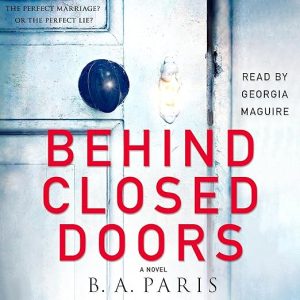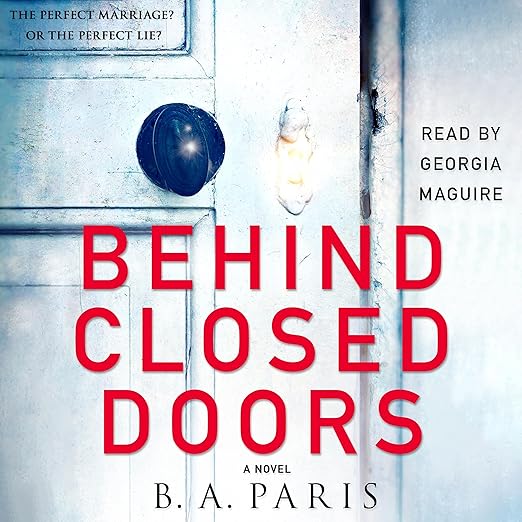
What kind of woman never picks up her own phone? Behind Closed Doors, B.A. Paris's debut psychological thriller, opens on Grace Angel, whose life looks immaculate from the outside: a successful attorney husband, a beautiful home, dinner parties that run without a visible seam. This audiobook works because Paris builds the gap between appearance and reality slowly enough that the dread accumulates before you can name its source. Georgia Maguire's narration is essential to that effect, keeping the surface pleasant just long enough for the underneath to register at full force.
The Review
At eight hours and forty minutes, the audiobook is tightly constructed. Paris does not waste the format. The novel alternates between past and present, and Maguire handles both timelines with clear differentiation, marking the shift without announcing it. The past sections build Jack Angel as a figure who is charming, precise, and gradually, unmistakably wrong. The present sections operate under sustained pressure, with Grace navigating a set of restrictions that reveal themselves one by one as the full architecture of her situation becomes clear. Paris has a gift for the telling domestic detail: the high-security shutters, the absence of a pen when Grace leaves the house, the elaborate meals that never produce any visible enjoyment. These accumulate into something more unsettling than any explicit scene of violence could produce.
The Associated Press observed that the sense of believability and terror that engulfs Behind Closed Doors does not waver, and that accuracy is largely due to Paris's understanding of coercive control as a system rather than a series of incidents. Jack is not a chaotic abuser. He is methodical, intelligent, and socially fluent, which makes him far more frightening than a less disciplined antagonist would be. The way he engineers Grace's isolation while maintaining the outward performance of a loving husband is what gives the book its psychological weight, and Maguire never lets you forget the performance is always running.
Maguire is the key variable here. Psychological thrillers of this kind live or die on whether the narrator can sustain tension across a full-length production without collapsing into either monotone or melodrama. Maguire finds a register that is controlled without being cold. She gives Grace's internal narration a quality of brittle composure, as if the character herself is working hard to hold her voice steady, which is exactly right for the material. One reviewer described feeling physically anxious throughout, reporting sweaty palms and a stomach that refused to settle. That kind of visceral response is a credit to Paris's construction, but it is also a testament to how completely Maguire inhabits the role.
The novel's treatment of Grace's disabled younger sister Millie adds a dimension that elevates it beyond the standard domestic thriller template. Millie is not a prop. She is a full character whose vulnerability creates genuine stakes, and the relationship between her situation and Grace's decisions is one of the most affecting elements of the plot. Paris uses Millie to raise questions about protection, sacrifice, and complicity that a simpler book would not bother with. These questions do not resolve tidily, which is part of what makes the ending linger well past the final chapter.
Reviewer Susanne S. described the book as "one frightening and super creepy psychological thriller" that made her stomach queasy and her palms sweaty, noting she tore through it quickly to escape the feeling of unease. That response is not uncommon. Paris engineers the specific discomfort of a closed system where the reader knows more than the characters outside the marriage do, which creates a particular kind of dread that is difficult to put down even when sitting with it becomes uncomfortable.
Before You Commit to Behind Closed Doors
Some readers have found the villain's intelligence slightly too total, his ability to control circumstances slightly too comprehensive, for the story to feel fully grounded in realistic probability. This is a fair observation. Jack operates with a precision that occasionally strains plausibility, and certain plot mechanisms require a willingness to accept that he has anticipated outcomes that would seem difficult to foresee. Paris is more interested in the horror of the system than in the logistics of how one man sustains it indefinitely, and that choice produces a compelling psychological experience at the occasional cost of strict realism.
Listeners who are themselves survivors of coercive relationships may find certain passages harder to sit with than a standard thriller would be. The portrayal is honest rather than sensationalized, and that honesty is a strength from a craft perspective, but it also means the material does not hold the comfortable distance of purely genre fiction. If this is a sensitive area for you, factor that into your decision before beginning.
Mary Kubica described the novel as hair-raising, both unsettling and addictive, which captures something specific about the experience of reading it. The addictive quality is strange to account for, given that what you are following is not a mystery in the conventional sense. Paris gives readers enough information early on to understand roughly what is happening. The compulsion to continue comes from watching Grace navigate an impossible situation with incomplete resources, and from the question of whether any escape is available to her at all.
Who It's For
Fans of psychological domestic fiction who have read Liane Moriarty's Big Little Lies or Lisa Jewell's The Family Upstairs will find B.A. Paris operating in recognizably similar territory, though with a somewhat darker and more claustrophobic register than either. This audiobook rewards listeners who like their tension slow-built and their reveals earned rather than telegraphed. If you prefer thrillers that are clean, fast, and action-driven, the sustained interiority of Paris's approach may feel slow, though most readers find it anything but once they are fully inside the story.
At a Glance
- Narration: Georgia Maguire delivers controlled dread throughout, finding the small domestic details that make the horror of Jack and Grace's marriage feel unbearably real.
- Themes: coercive control, the performance of a perfect marriage, family loyalty under threat
- Mood: Suffocating and relentless, with a slow-burn dread that builds to something sharp
- Verdict: B.A. Paris's debut is an uncommonly effective domestic thriller that makes its central horror feel disturbingly plausible rather than sensational.
Common Questions
Does Georgia Maguire's narration work well for the dual-timeline structure of this audiobook?
Yes, Maguire handles the alternating past and present timelines clearly without over-signaling the transitions. Her tonal register shifts subtly between the timelines, giving the earlier sections a more open quality that gradually closes down as the present narrative's full pressure becomes apparent.
Is this audiobook appropriate for listeners who find coercive control themes disturbing?
The portrayal of Jack's control over Grace is realistic and detailed rather than romanticized, which is part of what makes the book effective but also means it does not maintain the comfortable distance of pure genre fiction. Listeners for whom this territory is personally sensitive should be aware that the material engages it honestly without sanitizing it.
At eight hours and forty minutes, does the audiobook sustain its tension or does the pacing lag in the middle?
Most listeners report that the pacing holds throughout. Paris structures the reveals to maintain a steady drip of new information rather than front-loading the suspense, which means the middle sections deepen the dread rather than diluting it. The final third moves faster as the pressure on Grace becomes unsustainable.