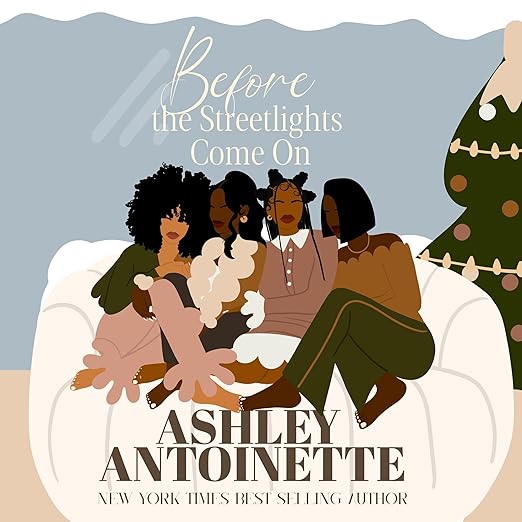
Wesleigh Siobhan's narration of Before the Streetlights Come On is one of the reasons to choose the audiobook version of Ashley Antoinette's novel about four Black women friends navigating their forties together. At 11 hours and 11 minutes, this is a substantial listen, and Siobhan earns every minute of it. The novel follows Ellie, Sloan, Courtney, and Shy from their teenage years through to their current lives as mothers, wives, and career women, and their annual Friendsmas reunion sets the stage for the confrontations and confessions that the novel has been building toward.
Antoinette is a New York Times bestselling author who has built a devoted audience under the Ash Army banner, and the affection in the material is palpable. This is a book about friendship as a long-term practice rather than as a feeling, about what it looks like to have known someone through every season of your adult life and to still be choosing them. The title comes from the parental directive many of these women grew up hearing: be home before the streetlights come on. As one reviewer noted, that phrase carries a specific nostalgia, the safety of a certain kind of childhood and community, and Antoinette deploys it as both frame and aspiration.
Siobhan Keeps Four Women's Voices Distinct
The audiobook's most impressive quality is how Siobhan handles the group dynamics. Four distinct women with four distinct voices is a significant challenge for any narrator, and Siobhan does not blur the edges to make her job easier. Ellie, who is returning home for Friendsmas and whose arrival acts as the catalyst for the reunion's emotional turbulence, is immediately distinguishable from the more guarded Sloan, the outwardly composed Courtney, and the intuitive Shy. When the four women are in a room together, the audiobook does not lose track of who is speaking, which is no small accomplishment over more than 11 hours.
Antoinette's prose is frank in a way that demands a narrator who is not squeamish. One reviewer described their experience as getting all the ratchet they'd been missing, channeling their inner ghetto in the most affectionate sense possible, and that quality is genuine: the novel does not sand off the rougher edges of how these women actually talk to each other. Siobhan delivers those scenes with the same investment she brings to the quieter emotional passages, and the consistency is what makes the listening experience feel true.
Antoinette's Oral Rhythms Suit This Audio Format
The argument for audio over print here is primarily about character texture. Antoinette writes in a voice that is already oral in its rhythms, with the energy of storytelling that has been shaped by years of direct engagement with her readership. Siobhan picks up that orality and extends it into a full performance. The novel is also fundamentally about how these women sound to each other, the specific vocabulary and frequency of a decades-long friendship, and the audio format brings that dimension forward in a way the page cannot replicate.
Several reviewers noted the deep nostalgia the novel provokes, particularly for readers who grew up with the phrase before the streetlights come on as a familiar boundary. That nostalgic register is also one of the audiobook's pleasures: Siobhan's performance in the flashback sequences, which carry the women back to their teenage years, has a lightness that contrasts effectively with the gravity of the adult present tense. The structure rewards the full 11-hour commitment.
Confessional Scenes Earn the Audiobook's Emotional Depth
The novel's confrontational scenes are where the writing is most precise, and they are the sequences that reward close attention in audio. When the reunion opens old wounds, Antoinette does not write around the injuries; she writes directly through them, and the specific nature of each woman's wound is different enough that the confrontations never feel generic. Siobhan navigates the emotional temperatures of those scenes with care, finding the exact register between anger and love that long friendships operate in.
The supporting cast of husbands, children, and careers functions as backdrop rather than as parallel storyline, which is a deliberate choice. Antoinette is not writing about how these women relate to the men and institutions in their lives; she is writing about how they relate to each other, and that focus keeps the audiobook from spreading across too many threads. The single throughline of the Friendsmas weekend and what it forces into the open is what gives the novel its coherence.
Siobhan's handling of the individual confessional scenes, the moments when each of the four women moves from the group dynamic into private reckoning, is where the audiobook earns its emotional depth. Those scenes are distinct in register from the raucous group sequences; Siobhan drops the energy and finds a quieter, more exposed vocal quality that makes the contrast between the women's public and private selves legible in audio in a way that the prose alone can suggest but the performance confirms. Listeners who arrive expecting a comedic girls-weekend novel will find themselves in more complicated emotional territory by the midpoint.
Skip This for Plot, Stay for Friendship
This audiobook is best suited to listeners who are drawn to contemporary fiction centered on female friendship, particularly Black women's friendship as a specific cultural form. Fans of Ashley Antoinette's previous work will find this a natural addition to their listening library. It will also resonate with listeners who grew up in communities where the phrase before the streetlights come on carries specific meaning. Skip it if you want a tightly plotted novel with external stakes; this is character- and relationship-driven, and its pleasures are emotional rather than narrative.
Key Details
- Narrator: Wesleigh Siobhan's narration brings full vocal range to Ellie, Sloan, Courtney, and Shy; she handles the shifting tones from raucous group scenes to quiet individual reckoning with equal facility.
- Subjects: Female friendship, midlife reckoning, Black womanhood and sisterhood
- Tone: Warm, frank, and emotionally charged with frequent laughter
- Bottom line: Ashley Antoinette's celebration of grown female friendship is best experienced in audio, where Siobhan's performance gives each of the four women a fully distinct presence.
Common Questions
Does the Before the Streetlights Come On audiobook require familiarity with Ashley Antoinette's previous novels?
No. This is a standalone novel with no connection to her Cartel series or other previous work. The characters, setting, and story are entirely self-contained. New listeners to Antoinette's writing will find the audiobook a complete and self-sufficient introduction.
How does Wesleigh Siobhan handle the four main characters across the full audiobook runtime?
Siobhan maintains distinct vocal identities for all four women throughout the 11-plus hours, which is the audiobook's most significant technical achievement. Ellie, Sloan, Courtney, and Shy remain individually recognizable even in group scenes, and her tonal range between the comedic and the emotionally intense sequences serves the material well.
Is this audiobook appropriate for listeners who are not Black women or who did not grow up with that specific cultural reference point?
Yes. While the novel is specifically rooted in Black women's experience and friendship, the emotional core of long-term female friendship, midlife reckoning, and the work of staying connected across decades of changed circumstances is broadly resonant. Antoinette writes with specificity rather than universalism, but that specificity is inviting rather than exclusionary.
Is there significant explicit content in the Before the Streetlights Come On audiobook?
The novel contains frank language and adult content consistent with its New York Times bestselling author's established voice. It is not explicit in the way an erotic novel is, but it does not censor itself in dialogue or in the portrayal of adult relationships. Siobhan's narration handles those elements with the same directness the writing employs.