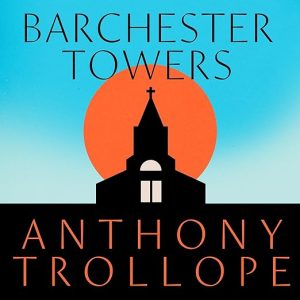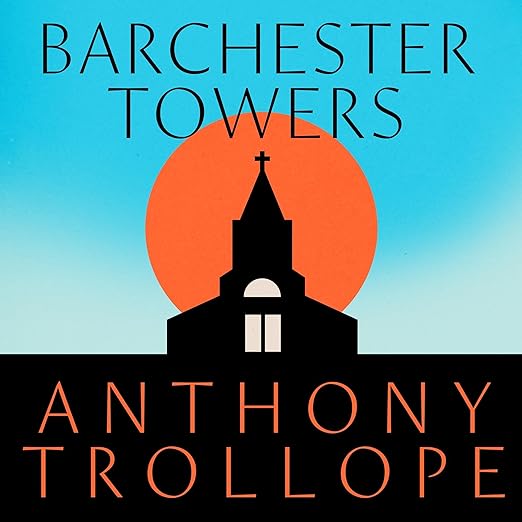
Church politics in a small cathedral town should be the least dramatic subject anyone ever built a long novel on. So why does the Barchester Towers audiobook run twenty-two hours and twenty minutes without a slack stretch in it? Because Trollope understood that an argument about who gets an appointment is really an argument about who gets to decide what a place is, and he was funnier about it than almost anyone since.
What Anthony Trollope Delivers
A vacancy at the top of the diocese sets everything moving. A new bishop arrives, the existing Barchester establishment closes ranks, and the town divides into factions that conduct their warfare through dinner invitations, sermons and marriage prospects. Nobody draws a sword. Everybody is fighting. The stakes look absurd from outside and are absolute from inside, which is the joke Trollope keeps making for twenty-two hours without ever saying it out loud.
Here the listing needs a correction, because its own most careful response contradicts the description printed above it. The publisher summary states that the archdeacon dies, that the vacancy created is the bishop's post, and that Reverend Mr. Slope is the liberal progressive opposed by traditionalists including Eleanor Bold and her father, described as the dean. A June 2019 five-star lays out a different arrangement entirely: the archdeacon, named as Rev. Grantly, is alive and leading the Barchester faction alongside Rev. Harding, while the opposing group is headed by the newly appointed Rev. Proudie together with his wife and Rev. Slope.
Both accounts cannot describe the same book, and the response is the one that reads like somebody who finished it. That same response places the novel as the second of the Chronicles of Barsetshire, following The Warden, and calls it the most widely read of its author's works. Anyone buying on the strength of the publisher blurb should know that the blurb has the sides mixed up, which matters because the sides are the plot.
What Makes Barchester Towers Worth Hearing
Trollope wrote for a reader who could hear him. The comedy lives in the authorial asides, in the gap between what a character says and how the sentence around it is framed, and in a running commentary that never quite tips into open mockery. Barnaby Edwards has to carry that authorial voice as a character in its own right, on top of a clerical cast in which four of the principal men are introduced as Reverend and speak in the same professional register. Keeping Grantly, Harding, Proudie and Slope distinct across twenty-two hours is the job this recording is actually being paid for.
The satire has aged strangely well, and a July 2024 five-star filed in the United Kingdom makes the case sharply: a comedy of manners about snobbish men feathering their own nests, in which institutional corruption exists to protect a power base insulated from every reality but its own. That reading is available in the text and audio brings it forward, because tone is exactly what a printed page leaves to the reader to supply.
Twenty-two hours is a feature here rather than a cost. This is a book to live inside for two weeks rather than to consume, the chapters are short and self-contained, and the plot advances through conversation, which is the material audio handles most naturally. Listeners who have bounced off classic novels in print because the paragraphs looked forbidding often find the same prose entirely manageable when someone else is doing the parsing.
Things to Know Before Starting Barchester Towers
Two of the five visible responses grade a physical printing rather than a book. One four-star from January 2025 confirms the text is complete and then deducts for a rather small typeface. The page's only one-star, filed in December 2017, calls the product not a real publication at all, describing what looks like an e-book reduced to six-point type, printed, and given a cover, and concluding that the author deserves better. Both complaints are entirely legitimate and neither is about this recording.
Those verdicts are also the strongest argument for buying the audio. Type size does not exist when a book is read aloud, and a public domain classic sold cheaply in print is exactly the case where production quality varies wildly between sellers. The 243 ratings behind the 4.4 average are pooled across editions of every kind, so the lowest grade on the page is measuring paper stock and the highest are measuring the novel itself.
Chronology completes the picture. This recording was published on February 27, 2025, and all five written responses predate it, the most recent by four weeks and the oldest by nearly eight years. The listing also leaves its series fields empty, despite the novel being the second volume of a sequence, which means nothing on the page tells a buyer that another book comes first.
Who Should Pick Up Barchester Towers
Anyone who has been meaning to get to Trollope and never found the entry point can begin here, since the novel establishes its own factions from scratch and the comedy never depends on the earlier volume. A July 2017 response supplies an unusually concrete recommendation: a book club that has worked through more than 235 titles graded this one an A and ranked it their nineteenth best read, which is a serious placement in a list that long.
Impatience is the disqualifier. Nothing explodes, the stakes are appointments and engagements rather than lives, and the pleasure comes from watching self-interest dress itself up as principle for hours at a stretch. Listeners who need contemporary pacing or who dislike an author interrupting to comment on his own characters should choose a different classic. Stay for a comic novel that has outlived every institution it was mocking, in a recording long enough to make the town feel like somewhere you have lived.
Quick Take
- Narration: Barnaby Edwards is credited on a 2025 recording of a novel whose cheap printed editions the page's own reviewers keep complaining about.
- Themes: Ecclesiastical politics, social climbing, marriage as strategy, institutions protecting themselves
- Mood: Dry, sociable, quietly merciless
- Verdict: The best door into Trollope, and a case where audio solves problems the printed editions created.
A Few Questions About Barchester Towers
Is the Barchester Towers audiobook a satire or a romance?
Both at once, which is the pleasure of it. Courtship plots run alongside the ecclesiastical warfare and the two keep interfering with each other, since every engagement rearranges a faction. Expect social comedy with real feeling underneath rather than a love story with jokes attached.
Is the Barchester Towers audiobook hard going if you rarely read classics?
Less than you would expect. The sentences are long but conversational, the chapters are short, and the humor is continuous rather than reserved for set pieces. Having the prose read aloud removes most of the friction people associate with long paragraphs from this period on the page.
How much religious knowledge does the novel assume?
Very little doctrine, quite a lot of hierarchy. The plot turns on who outranks whom inside a cathedral establishment, so a rough sense of where a bishop, an archdeacon and a dean sit relative to one another carries you through. Religious debate features, but the theology stays in the background.
Twenty-two hours is a long haul. Does it hold up across the whole run?
The middle stretch is the test. The opening establishes the factions quickly and the closing stretch resolves the romantic entanglements, while the center consists of social maneuvering that rewards attention. Short chapters make it easy to take in half-hour pieces over a couple of weeks.