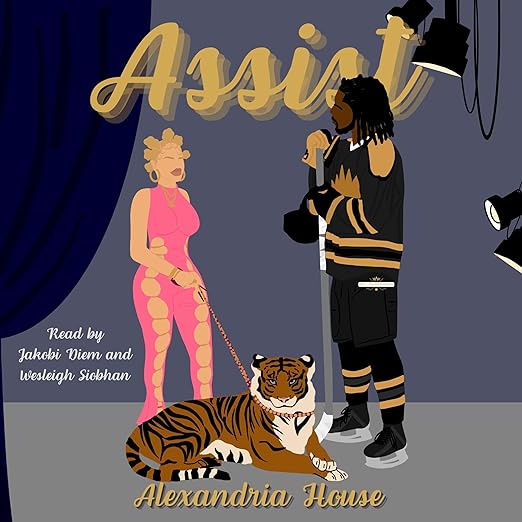
I picked up Assist on a Tuesday evening with no particular expectations. I knew Alexandria House by reputation, she has an unusually devoted readership in contemporary African American romance, but I had not followed the St. Louis Sires series from the beginning. What I found in these six and a half hours was something more structurally interesting than the average sports romance, and I mean that in the best possible way.
The premise is simple on the surface: a basketball center for the St. Louis Sires has everything externally but wants a family, and a successful rapper who seems to have everything wants something real, a genuine connection rather than the performance of friendship that fame tends to produce. A random phone call puts them in each other's orbit. That is a clean setup, and House deploys it efficiently. But reviewers are correct that there is considerably more going on beneath that surface.
The connection between Jah and Ishima, the center and the rapper, begins as friendship, and House takes her time letting that friendship develop its own weight before allowing it to become something else. This is a structural choice that pays off substantially in the second half of the audiobook, because by the time the romantic stakes arrive, the listener has accumulated real investment in both people as individuals rather than as romantic positions waiting to be filled. Jah's longing for family is not treated as a quirky character note; it is traced back to specific absences that the book handles with a sensitivity that several reviewers flagged as the emotional core of the story.
Ishima's arc is equally specific. Her fame and talent are real, but House is careful to distinguish between the public version of Ishima and the person she actually is, and the gap between those two things is what drives her desire for genuine connection. The abandonment themes that one reviewer identified as running through both characters create a kind of structural resonance: two people who have been left in different ways, finding each other and deciding, with real effort and real fear, to stay.
What Makes Assist Worth Hearing
Part of what makes Assist work so well for dedicated House readers is the appearance of characters from elsewhere in her extended fiction universe, particularly members of the Mitchell family from another series. For newcomers like me, these cameos register as warm without being fully legible, they clearly mean something significant to returning readers in ways that the text itself does not fully decode for those without the prior context. One reviewer noted she stopped reading just to react to finding the Mitchell brothers in Jah's pages. That is the kind of reading experience that a well-maintained fictional universe can produce, and House clearly knows how to generate it.
For first-time House readers, this is not a barrier. The book works on its own terms. But it does suggest that Assist, despite being a series finale, might function better as a doorway into House's larger body of work than as a conclusion to a story arc. The cameos serve as invitations as much as reunions.
The Caveats
House is deliberate about not rushing the transition between Jah and Ishima's friendship and the romantic dimension of their relationship. There is a passage in the second third of the book where both characters are clearly aware that something has shifted, but neither names it, and House holds that ambiguity for long enough that the listener feels the weight of it. That restraint is harder to sustain than it looks in genre fiction, where the pull toward forward momentum can cause writers to collapse transitions that deserve to breathe. The patience House brings to this moment is one of the reasons the romance lands with the force it does when it arrives.
Should You Listen to Assist?
Diem narrates with an ease that suits the contemporary sports romance setting well. His voice carries warmth without saccharine, and he handles the emotional heaviness of the abandonment and trauma material with enough restraint that it does not tip into melodrama. The pacing is smooth through the friendship-development sections and tightens appropriately as the romantic stakes rise. The scenes involving secondary characters, particularly the cameos that dedicated House readers will recognize, are handled with affection rather than perfunctory fulfillment of fan-service obligations.
At 4.6 stars from nearly 800 listeners and with reviewers calling it the strongest entry in the series, Assist arrives with genuine community validation behind it. For a series closer, that is a difficult thing to earn, the pressure of delivering on accumulated investment is real, and House appears to have delivered on it in ways that have left her readership both satisfied and already asking for more. One reviewer's request for a St. Louis Mitchell holiday reunion suggests a fanbase that is not quite ready to leave this world, which is probably the best thing a series finale can aspire to produce.