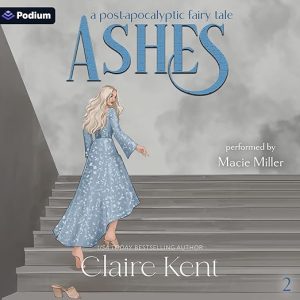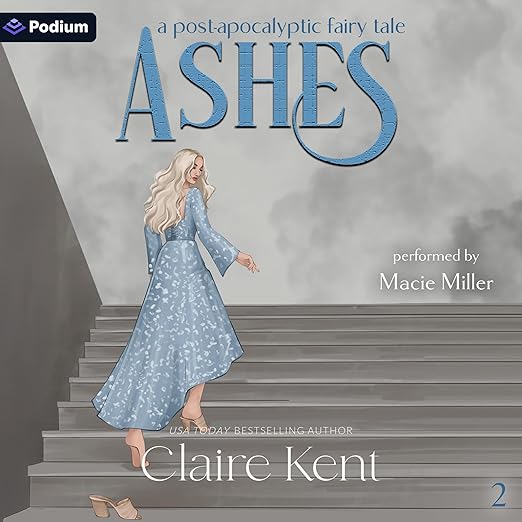
I came to Ashes without having read the first book in Claire Kent's Post-Apocalyptic Fairy Tales series, and it took me about twenty minutes to decide I needed to go back and find it. That is not because Ashes is confusing as a standalone - it reads cleanly without the prior context - but because Kent builds her post-collapse world with enough texture and internal logic that you immediately want more of it. Year 39 after The Fall, the Central Cities as a governing authority, the particular economic pressures that make marriage a survival calculation rather than a romantic choice: these details accumulate into something that feels genuinely inhabited.
The Cinderella structure is present but worn lightly. Teresa is not a Disney archetype. She is twenty-five years old, practically minded, quietly exhausted by six years of servitude to a stepmother and stepsister who never quite cross into cartoonish villainy - they are simply selfish, which is more tiring and more believable. Her prince is Mason, a village man who qualifies as local royalty mostly by virtue of having a stable income and a decent house. He is odd. He does not say much. He is not trying to sweep her off her feet, and she is not waiting to be swept. They are two people trying to solve a practical problem together, and the romance that develops between them is built out of careful observation and small kindnesses rather than grand gestures.
Our Take on Ashes
What Kent does exceptionally well in this series is make the fairy tale resonance feel earned from the bottom up rather than imposed from the outside. She does not dress Teresa in a ball gown or manufacture a missing shoe. Instead she finds the emotional truth of the Cinderella story - the longing to be seen by someone, to be chosen, to escape circumstances that diminish you - and locates that truth in a world where the logistics of survival make it feel genuinely fragile. When Mason offers Teresa a way out of her stepfamily's household, it carries real weight because we have been inside the texture of that household long enough to understand what she is escaping.
The novella format suits the material. At four and a half hours, Ashes does not overstay its welcome. Kent knows exactly what this story needs to do and confines herself to it. There is no inflated subplot to pad the runtime, no manufactured secondary drama to fill space. The Central Cities governance system and its rules about property and value give the characters just enough external pressure to keep the internal romance from feeling inert. Reviewers have noted that both Teresa and Mason are exceptionally likable protagonists, and that observation holds - but more importantly, they are specific in ways that generic romance protagonists often are not. Mason's social awkwardness is presented as just that: a personality, not a mystery to be solved.
Why Listen to Ashes
Macie Miller's narration is quiet and earned. She does not push Teresa's emotion ahead of where the character would actually be, which is exactly right for a story about a woman who has learned to manage her expectations carefully. The moments where Teresa allows herself to want something - the scenes with Mason where the possibility of happiness becomes real enough to be frightening - land because Miller has kept the temperature low enough that any warmth registers clearly. Podium Audio has produced this cleanly, and the runtime sits in the ideal zone for a novella listen: long enough to settle into the world, short enough to finish in an evening.
One reviewer described Kent as having put them under a spell, and another noted that the story is "simple but in the best ways." That is fair, but I would push back gently on the word simple. The emotional precision here is not simple - it is disciplined. The difference matters. Kent is not writing a thin story. She is writing a contained one, where everything present serves the emotional arc and nothing is left in because it seemed like it should be there.
What to Watch For in Ashes
If you are reading this as your introduction to Kent's post-apocalyptic world, you will pick up the rules of the Central Cities as you go, but some of the governance details remain slightly opaque. The world-building rewards rather than requires familiarity with the first book. The story's resolution also moves quickly once the central obstacle is removed, which has divided some readers. The pace of the ending mirrors Teresa and Mason's personalities - practical, not drawn to ceremony - and whether that reads as satisfying or slightly abrupt depends on what you were hoping for from the final quarter.
This is also firmly a romance with a happy ending. Kent operates with full transparency about that contract with the reader. The tension is not in whether Teresa and Mason will end up together, but in watching two introverted, careful people learn to trust each other enough to try. If you need genuine uncertainty about the central pairing to stay engaged, the novella format and fairy tale premise may not provide enough suspense.
Who Should Listen to Ashes
Romance readers who are tired of extroverted protagonists and melodramatic conflict will find Teresa and Mason a genuine relief. This is a book for people who find the quiet version of love more convincing than the loud one. Fans of cozy post-apocalyptic settings - a niche that Claire Kent has largely defined for herself - will slot comfortably into the world. The lack of graphic violence or sexual content makes it broadly accessible, though the romance contains adult situations. New readers to the series can start here; longtime fans of Kent's earlier post-apocalyptic work will recognize the mode and the warmth immediately. If you need high action or plot complexity, look elsewhere - but if an autumn evening and two awkward people figuring out how to be kind to each other sounds like enough, Ashes delivers exactly that.
In Brief
- Performance: Macie Miller brings a quiet intimacy to Teresa's voice that suits the novella's tone - understated and a little weary, exactly right for a character who has learned not to hope too much.
- What it covers: Fairy tale inversion, survival in aftermath, marriage of convenience romance
- Feel: Low-key and cozy with a post-apocalyptic chill just beneath the surface
- Our call: A lean, emotionally precise Cinderella retelling that rewards patience - Claire Kent keeps the sweetness earned rather than given.
Good to Know
Can Ashes be read as a standalone without the first book in the Post-Apocalyptic Fairy Tales series?
Yes, Ashes works fully as a standalone. The characters are entirely new and the central plot does not depend on events from the first book. Some background about the Central Cities governing system and the world post-Fall will feel slightly compressed if you are new to the series, but it does not create confusion. Multiple reviewers confirmed they came to this book without reading the first and had no issues following the story.
How explicit is the romantic content in Ashes?
The romance is present and emotionally central but not graphically explicit. Kent focuses on emotional intimacy and the gradual process of trust-building between two introverted characters. The physical relationship is acknowledged but not depicted in detail. This is firmly a romance, but one that prioritizes feeling over content.
Does Macie Miller's narration capture both the Cinderella fairy tale elements and the post-apocalyptic setting?
Miller's approach is grounded rather than stylized, which suits the story's tone well. She does not lean into fairy tale whimsy - the narration treats the world as a real place where survival pressures matter, with the fairy tale resonance operating as emotional architecture rather than genre signaling. The result feels consistent and honest to the material.
Is Mason's social awkwardness portrayed sympathetically, or does it become a source of frustration in the story?
Sympathetically, without question. Kent is careful to establish Mason as someone with a clear and consistent personality rather than a character flaw to be overcome. His quietness and social distance are respected by the narrative and eventually by Teresa herself. Reviewers consistently describe both protagonists as likable, and Mason's particular brand of reserve is central to what makes the slow-burn romance work.