Before You Press Play
- What it covers: Literary archaeology of Dungeons and Dragons, pulp SF and fantasy's cultural legacy, the gap between past and present genre sensibilities
- Feel: Intellectually engaged and sometimes combative, with the energy of genuine critical enthusiasm
- Our call: Johnson's essay collection is essential for anyone who wants to understand where Dungeons and Dragons came from and what that origin means for the genre's present tense.
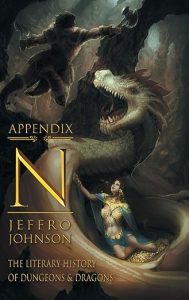
Jeffro Johnson's Appendix N is built around a single document: the list of science fiction and fantasy works that game designer Gary Gygax declared to be the primary literary influences on Dungeons and Dragons, published in the first edition Dungeon Master's Guide. That list, which runs from Edgar Rice Burroughs's A Princess of Mars through Fritz Leiber, Jack Vance, Michael Moorcock, and beyond, is both a bibliography and a manifesto. This audiobook, running just under eleven and a half hours, works through all forty-three works and authors on the list and uses them as the basis for an extended argument about what the current genre has lost by forgetting its pulp inheritance.
Johnson is a three-time Hugo Award finalist, an experienced Dungeon Master, and someone with strong and carefully reasoned opinions about where fantasy fiction went wrong after the pulp era. Those opinions are not hidden. Appendix N is as much criticism as survey, and the argument, that the literary gap between the 1970s works Gygax loved and the fantasy fiction of the present represents a genuine cultural loss rather than mere stylistic evolution, runs through every chapter. Johnson is not interested in neutral assessment; he is interested in recovering what was lost and explaining why it matters.
Recovering Forgotten Authors Like Leigh Brackett
The book succeeds most fully as literary archaeology. Reviewers have called it one of the most important things to happen to science fiction and fantasy in decades, which invites skepticism, but the underlying claim is defensible. Johnson has recovered significant critical attention for authors who were genuinely influential on the development of modern fantasy and role-playing gaming but who had been largely forgotten by the time he wrote these essays. E.R. Eddison, Leigh Brackett, Clark Ashton Smith, and others in Gygax's list were not household names in contemporary fantasy circles, and Johnson's essays argue convincingly that this represents a real impoverishment of the genre's engagement with its own past.
The critical method is consistently applied: Johnson reads each work on the list, situates it in its literary and historical context, draws out the specific qualities that would have appealed to Gygax, and extracts conclusions about how those qualities could be applied to both gaming practice and contemporary fiction. The gaming applications are specific enough to be immediately useful for working Dungeon Masters who have been wondering why their campaigns feel different from the implied world of the original rules. The literary analysis is sharp enough to be interesting for readers who have never played a role-playing game and are simply interested in the pulp tradition as literature.
The chapter on Leigh Brackett is a good example of the book at its best. Brackett, who wrote both the original Star Wars screenplay and a significant body of pulp science fantasy, represents exactly the kind of mid-twentieth-century author the book is trying to recover. Johnson reads her closely enough to make her genuine qualities visible: the planetary romance conventions she worked within and against, the specific kind of hero she built, the way her narrative economy creates a sense of a larger world behind the story rather than a world that exists only where the plot requires it. After the Brackett chapter, readers are equipped to read her with more comprehension and more pleasure, which is the most useful thing literary criticism can do.
Eleven Hours Let Each Chapter Breathe
At just under eleven and a half hours, the audiobook gives Johnson's argument enough room to build properly. The structure mirrors the list itself, sequential chapters each devoted to a specific author or work, accumulating into a larger picture of what the pulp tradition actually contained and why it mattered to Gygax as the intellectual foundation of the game he was building. The audiobook format suits this kind of essay collection particularly well. Each chapter can be absorbed and allowed to settle before moving to the next, rather than being skimmed as physical text sometimes invites. The argumentative accumulation Johnson is building requires that consecutive attention.
The prose is direct and argumentative rather than academic in register. Johnson writes as someone who cares deeply about these books and wants to communicate that care to readers who may not yet know them, which is the right approach for recovery criticism. The energy of genuine enthusiasm sustains the runtime without difficulty, and the passages where Johnson is visibly angry about how the pulp tradition was edged out of the genre conversation are among the most engaging in the book.
Combative Conviction Divides Genre Loyalists
Johnson's argument is made with conviction and sometimes with combativeness toward contemporary fantasy publishing that readers with different genre loyalties may find overdrawn. The claim that modern fantasy has systematically devalued the pulp tradition is presented as established fact rather than as one critical position among several, and readers who disagree with the premise will find the book's tone more assertive than they prefer. For readers who are sympathetic to the recovery project, that assertiveness reads as appropriate critical confidence.
The book also functions as a reading list in its own right. Listeners who work through Appendix N and then go back to the source texts Johnson discusses will find the essays serve as genuinely useful critical preparation. The value of the book compounds with each original text you subsequently read, and Johnson clearly intends it to function that way.
Essential Listening for Working Dungeon Masters
Tabletop RPG players and Dungeon Masters who want to understand the literary DNA of the game they play will find this essential. Fans of classic pulp SF and fantasy who enjoy sustained critical writing about the genre will get significant value across the full runtime. Literary historians interested in the pulp era's underexamined influence on contemporary popular culture will find Johnson's case well argued and his evidence specific. Readers who are deeply invested in contemporary mainstream fantasy as it currently exists may find his critique of it more challenging than comfortable. This audiobook is for active listeners who enjoy argumentative critical engagement; it is not casual background listening.