Key Details
- Read by: Jay Aaseng sustains the series' energy across a demanding 26-hour runtime, distinguishing the expanding cast of the Onslaught Jubilee arc and keeping the LitRPG mechanics from turning into a recitation.
- At its heart: Power escalation and its costs, system manipulation from the inside, loyalty under impossible stakes
- Vibe: High-octane and relentlessly forward-moving, with humor used to ventilate the tension rather than deflate it
- Short version: Apocalypse BREAKER 3 delivers everything established fans expect from this series and raises the stakes in ways that make the fourth volume genuinely hard to wait for.
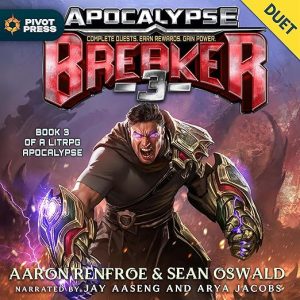
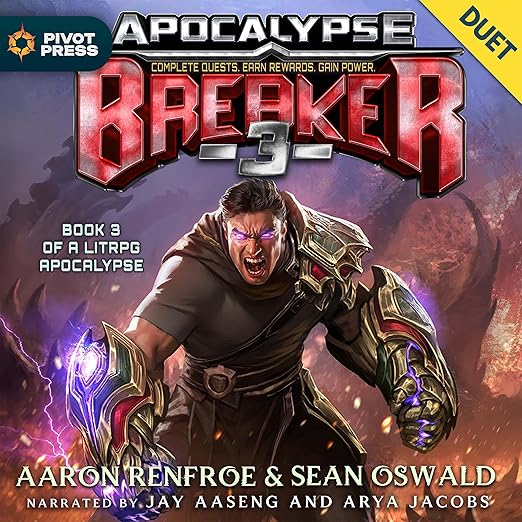
Apocalypse BREAKER 3 by Aaron Renfroe and narrated by Jay Aaseng is the audiobook where the series earns the investment its first two entries asked for. At 26 hours and 43 minutes, this is not a casual listen. It is a sustained commitment to a world where the rules keep expanding, the stakes keep escalating, and the protagonist Dean Williams keeps finding ways to be simultaneously more powerful and more cornered than anyone around him expects. The craft question for a volume this long is whether the pacing can sustain itself across the full runtime without losing coherence or tonal consistency. Based on reviewer consensus from people who have lived in this world since the beginning, it does, and then some.
The setup for this installment is efficient and well-managed. Dean has full admin access to the System at the start of the Onslaught Jubilee, which sounds like an overwhelming advantage until he realizes that if anyone figures out what the System has actually set him up to do, disrupting the proceedings that would drag Earth into an unwinnable war, the consequences will be immediate and severe. Renfroe uses this information asymmetry well: Dean spends much of the first half maneuvering in plain sight among the highest-level System participants, aided by the Jade Queen, Steward, and Necromancy-Specialist Cruz, while keeping his actual mission concealed from exactly the people most capable of recognizing it.
Dean's Admin Access Turns the Jubilee Chaotic
The third volume in this series occupies the position where LitRPG narratives most commonly struggle: Dean has been established as overpowered, so the standard difficulty escalation of earlier volumes is no longer a credible source of tension. Renfroe's solution is to make the threat architectural rather than combat-based. Dean cannot simply fight his way through the Jubilee. He has to navigate politically, socially, and informationally through an environment where his power level is matched by beings with centuries of experience in exactly this kind of arena. That shift from combat-first to strategy-first is what the confirmed beta reader reviewer Zaralith highlighted as the defining quality of this entry: Dean's unlimited growth is real, but the abilities earned through previous sacrifice are now being tested against opponents who have had far longer to develop their own.
The Jubilee arc itself is the production's centerpiece. Reviewer Bayou Shaman called it a delightful mass of chaos, and that captures the first half's energy accurately. Renfroe packs the Jubilee with incident, character, and LitRPG spectacle without losing coherence. The humor, which is a load-bearing element of the series' identity, serves a structural purpose here: it releases pressure in a narrative that would otherwise become suffocating given the stakes involved. Aaseng calibrates these tonal shifts in real time, moving from comedic sequence to life-or-death scenario without jarring the listener or losing momentum.
Jay Aaseng Anchors a Story Split in Two
The 26-hour runtime demands justification. For series fans, the length means Renfroe can develop the Jubilee world fully rather than rushing through it, and the second half of the audiobook shifts direction significantly, which both reviewer Star and reviewer Bayou Shaman reference without spoiling. That structural ambition, the willingness to divide the book almost into two distinct arcs with different priorities and textures, is the mark of a writer who is building something with deliberate shape rather than simply generating content at volume.
Jay Aaseng has been with this series since the beginning, and the accumulated familiarity shows in every chapter. He has developed distinct characterizations for the major players over hundreds of hours of narration, the Jade Queen in particular benefits from a consistent vocal identity that has evolved across volumes, and the LitRPG status-screen sequences that can be monotonous in lesser productions are delivered with enough variation to remain engaging. For a genre where audio narration is often the deciding factor in whether a series retains listeners across multiple entries, Aaseng's consistency is a significant part of what makes Apocalypse BREAKER work as a long-form audio commitment.
Grimdark Readers May Need to Adjust to the Humor
This is emphatically not a starting point for new listeners. Reviewer Star advises explicitly that newcomers should go back and begin with volume one for the full character and world-building context, and that advice is worth taking seriously before you spend 26 hours with a story whose emotional stakes depend entirely on investment built across two prior entries. The Jubilee arc assumes familiarity with Dean's power history, his relationships with Cruz, Steward, and the Jade Queen, and the broader stakes of the System as established across those earlier books.
The humor may also require adjustment for listeners who came to the series from harder science fiction or grimdark fantasy. Renfroe writes with genuine comic intention, and some of the series' funniest moments are deployed in its tensest sequences. Those who find humor in high-stakes settings tonally dissonant should calibrate expectations accordingly: the comedy is not a tonal error in the construction of this book, it is a deliberate and central feature of the series' identity that has been present from the very first volume.
Ready for the Series' Most Ambitious Installment
Listeners who have finished the first two Apocalypse BREAKER audiobooks and are ready for the series' most ambitious installment to date belong here immediately. If you have been holding off while waiting for confirmation that the series maintains its quality across multiple entries, every available review suggests it does and improves. New LitRPG listeners should start at volume one rather than trying to enter here. Those who want standalone action-adventure science fiction without series investment should look elsewhere, as this entry makes no accommodations for readers outside the established fanbase and is far richer for those who arrive with the full context already in place.