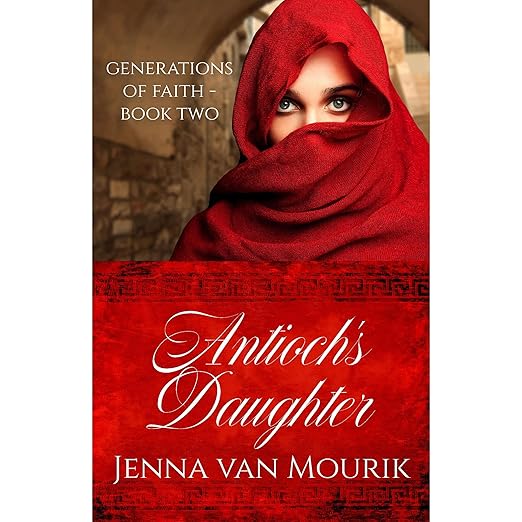
- What it covers: Early-church persecution, grace and forgiveness, an enemy of the faith drawn toward one of its own, family under pressure
- Feel: Devout and emotionally direct, hardship well before comfort
- Our call: A strong second volume for inspirational fiction listeners, provided machine-generated narration is something you can live with.
Anyone weighing this one deserves the headline fact first: the audiobook edition of Antioch's Daughter is read by Virtual Voice, the machine-generated narration option, rather than by a hired performer. That single line in the credits will settle the decision for some listeners before Libi, Cassius or first-century Antioch enters the conversation at all. What makes the call harder than it looks is the rest of the record, because 319 ratings averaging 4.6 sit above a novel that readers describe in unusually emotional terms.
How Antioch's Daughter Holds Up
Libi and her family were driven out of Jerusalem after the stoning of Stephen and the persecution of believers, and the book finds them rebuilt, more or less, in Antioch. Days fill quickly in a community where the oppressed outnumber the resources, and Libi throws herself into service partly because service leaves no room to count what she has lost. Jenna Van Mourik gives that displacement a texture inspirational fiction usually skips: exhaustion, scarcity, and a longing for something she cannot name yet. Refugee life gets written as noble suffering often enough that a version built out of chores and shortages counts as a small corrective.
Mesu Andrews came to the novel without having read the first book and found it worked anyway. That four-star review describes caring deeply about Cassius, "the tormented-child-turned-terrified-deserter," and being drawn in by the "loving and sacrificial dynamic" of Libi's family. It grants that both leads stay true to character "for the most part," while singling out the intensity of Libi's reaction to her own past. Coming from a reader with no investment in volume one, that reads as the most useful assessment on the page.
Cassius carries the other half of the book. A deserter from the Roman Army who walked away after witnessing something he could not explain, he lives in the shadows and blames the followers of The Way for a military career that ended years ago. Staying in Antioch would let him settle that score; it would also put him in front of the one person capable of dismantling the defenses he spent years assembling. As romance engines go, that is sturdier than this category usually bothers to build.
Why Antioch's Daughter Works as an Audiobook
Scripture opens every chapter, and an April 2025 five-star review singles that out as one of the real pleasures of the book. On the page those epigraphs are a visual pause. Read aloud they turn into something closer to a liturgical beat, a repeated shift of register that marks each chapter break more clearly than a number ever would. Across an eight-hour novel that structure earns its keep, because it hands you a clear place to stop.
Antioch after the ascension is a setting listeners rarely get. Most fiction about the early church stays inside Jerusalem, and the congregations that formed elsewhere seldom get a novel of their own. Van Mourik puts a working community on the page instead: people distributing what little they have, absorbing refugees, and arguing over how far grace extends when the person asking for it once helped drive them out. The historical texture does real work rather than decorating the romance.
Everything narrows to the question the description ends on: "How far does grace go, and will they have the strength to find out?" The plot answers it literally, by putting a persecutor from Libi's past back in front of her. Forgiveness stops being an abstraction the moment the person who needs it has a face and a history. Whether that lands as moving or as schematic depends on your appetite for fiction that argues its theology through the plot rather than around it.
Weak Spots in Antioch's Daughter
Virtual Voice is the thing to understand before anything else. It is narration generated from the text rather than recorded by a performer, which means no casting decision, no interpretive choice about a line of dialogue, and no second take. A conversation between two characters in open conflict is produced by the same process as a paragraph of description. Some listeners genuinely do not mind on a plot-forward novel. Others should decide about it before buying rather than twenty minutes in.
Dates matter in this pool. Two of the five reviews on display went up in June and July of 2023, more than a year before this recording arrived in September 2024. They are responses to the book, not to the audio edition, and the ratings gathered alongside them work the same way. That does not make them less useful about the story, and both are detailed and specific. What the 4.6 actually grades, then, is Van Mourik's writing, with the production folded in silently.
Continuity is the other thing to sort out in advance. BMBWriter's five-star review points out that readers will already know Libi from the first volume, Jerusalem's Daughter, and the description confirms this is book two of Generations of Faith. The entry point is forgiving enough that volume two can serve as a first encounter. Even so, Libi arrives grown and already shaped by events you did not witness, and her sharpest reactions are rooted in that earlier book.
The Right Listener for Antioch's Daughter
Readers who want the early church as a lived place rather than a painted backdrop will get the most out of this. It suits anyone who comes to inspirational romance for the faith thread as much as for the couple, and Deb K.'s five-star reaction, that it reads like a story straight out of the Bible and was hard to put down, describes the intended experience accurately. Anyone who likes characters who suffer visibly and recover slowly will find both leads built for exactly that.
Machine reading is a genuine dealbreaker for part of the audience, and if you belong to that part, no amount of praise for the writing will move you. Explicit romance is not on offer either: nothing in the description points that way, and the central conflict resolves in terms of grace rather than heat. Nor does this novel keep its theology in the background, which will make some listeners restless long before Antioch itself does.
Grace is the word the book keeps circling, and the description asks the right question about it. A novel that answers by placing a deserter, a persecutor and a believer inside the same city, then refusing to let any of them off easily, is doing more than most titles filed under this heading. What it lacks is a human voice reading it aloud. Weigh those two facts against each other, because the record around it is otherwise strong.
Before You Listen
Who narrates the Antioch's Daughter audiobook?
The credit reads Virtual Voice, so the audio was produced automatically from the manuscript instead of performed by a person. No human reader is listed anywhere on the page. That is worth knowing up front, since it affects dialogue and emotional scenes far more than it affects straightforward description.
How explicit is the romance in this audiobook?
Nothing in the description or in the visible reviews points toward explicit content. This is Christian historical fiction where the obstacle between the leads is guilt, revenge and faith rather than circumstance, and readers keep describing the payoff in terms of forgiveness rather than passion.