At a Glance
- Narrator: Karen Cass is a steady, warm presence across nearly twelve hours - she handles the Regency register naturally and gives Anne de Bourgh a quiet dignity that the character requires.
- Subjects: Friendship as the center of a life, illness and mortality, the Bennet-Darcy courtship reconsidered
- Tone: Warm and emotionally generous, with real grief underneath
- Tone: Warm and emotionally generous, with genuine grief threaded through the friendship at its center
- Bottom line: A Pride and Prejudice variation that earns its emotions - best for JAFF readers who want friendship at the story's center rather than romance.
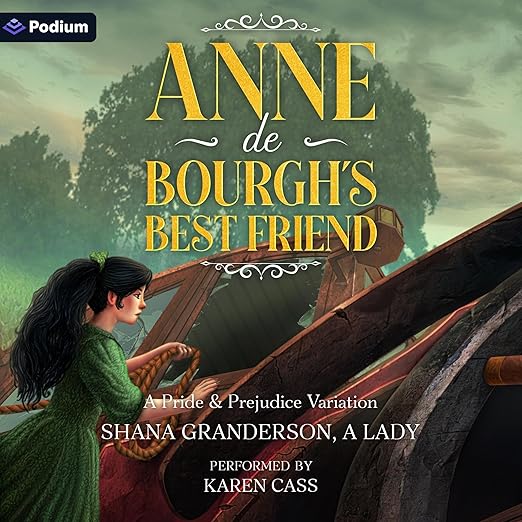
Jane Austen fan fiction occupies an enormous range of quality, and experienced readers of the genre know immediately within the first few chapters whether a variation is going to treat its source material with care or simply use it as wallpaper. Anne de Bourgh's Best Friend, by the author who writes as Shana Granderson A Lady, is in the former category. I came to it expecting something pleasant and predictable. What I got was something that made me unexpectedly emotional during a Tuesday afternoon walk - somewhere around the section dealing with Sir Lewis and Anne's end - which is not a sentence I anticipated writing.
The premise departs from canon in a specific and meaningful way. In Austen's original, Anne de Bourgh is sickly and silent, a minor character used mostly to illustrate Lady Catherine's ambitions. Here, her condition has a cause: childhood scarlet fever that has severely weakened her cardiovascular system. She is not expected to live a long life, and everyone who loves her knows it. The story begins when a young Elizabeth Bennet saves Anne and Sir Lewis from an accident, creating the friendship that will define both girls' lives. That friendship - not the Darcy-Elizabeth romance - is the structural and emotional center of the book.
Where This One Lands
The author makes a choice that some readers will resist: the Darcy-Elizabeth romance is present but not foregrounded. Darcy is largely absent for extended stretches of the narrative. One reviewer gave it three stars specifically because of this, noting that the connection between Elizabeth and Darcy never fully convinced her. Another described it as "the best P&P variation" she had encountered, with "more excellent storylines than in most other variations." Both responses are reading the same book accurately - the romance is subordinate to friendship, and your satisfaction with the story depends on whether you can accept that prioritization.
What the author does exceptionally well is the Bennet family, which is described as "very different from those in canon." This is not the chaotic Longbourn household of the original. The Bennets here are more unified, more capable, and the sisters have stronger defined presences. Sir Lewis de Bourgh is alive and developed as a full character - his complicated marriage to Lady Catherine, his efforts to protect Anne legally, and his relationship with the Bennets are all rendered with more texture than the source material grants him. Lady Catherine functions as a genuine antagonist. Wickham and Mrs. Younge are present in their familiar roles. The villain machinery of the Austen universe is deployed with care.
Why Listen to Anne de Bourgh's Best Friend
Karen Cass is the right narrator for this material. At nearly twelve hours, the audiobook needs a voice with both stamina and emotional range, and she provides both. The Regency diction and vocabulary she handles naturally - there is no sense of a contemporary narrator wrestling with period language. Her Anne de Bourgh is the performance highlight: quiet, dignified, and genuinely moving as the character's condition deteriorates. The friendship scenes between Elizabeth and Anne, which are the emotional engine of the entire book, land because Cass allows them to breathe rather than rushing through them. At 4.3 stars across nearly 700 ratings, this has a broad and appreciative audience, and the narration is a significant reason why.
What Gives Us Pause
The book is long and episodic in the way that JAFF variations tend to be - it covers a significant span of time and follows multiple characters through their own arcs. The pacing is generous rather than propulsive, which is appropriate to the genre but can feel slow to readers expecting a tighter plot structure. Anne's illness and mortality are handled directly and honestly; the emotional weight of knowing her life will be short is not softened, and the sections dealing with her decline carry real grief. Readers who find illness narratives difficult may want to know this is integral to the story rather than peripheral. The two footmen-guards that the author mentions as popular characters are exactly the kind of detail that longtime JAFF readers will find delightful and new readers may find slightly puzzling at first.
The Right Listener for Anne de Bourgh's Best Friend
This is squarely aimed at dedicated Jane Austen fan fiction readers who have appetite for variations that recontextualize the secondary characters rather than simply retelling the main romance. If you read variations specifically for Elizabeth and Darcy courtship scenes with the usual beats, this will frustrate you - Darcy is genuinely sidelined for long stretches. If you are curious about Anne de Bourgh as a character who deserves her own story, or if the premise of friendship surviving mortality appeals to you, this is one of the stronger entries in the variation genre. It was described by one reviewer as the author's best work, and given its emotional ambition, that assessment holds up.
Frequently Asked Questions
Is Anne de Bourgh's Best Friend primarily a romance or is the friendship genuinely the focus?
The friendship is genuinely the focus. The Elizabeth-Darcy romance is present but deliberately subordinated - Darcy is absent for long stretches, and some reviewers found the romantic connection underdeveloped as a result. Readers coming for a JAFF romance should calibrate expectations accordingly.
How does Karen Cass handle the large cast of Austen characters in the narration?
Well. She differentiates the characters clearly across a nearly twelve-hour runtime and handles the Regency register naturally. Her performance of Anne de Bourgh is particularly strong - the character's quiet dignity and the weight of her illness are conveyed with real care.
Does the story deal seriously with Anne de Bourgh's illness, or is it background detail?
Seriously and honestly. Anne's shortened life expectancy is structural to the story - it drives the friendship at the center, shapes the decisions of multiple characters, and the sections dealing with her decline carry genuine emotional weight. Readers who find illness narratives difficult should know it is central rather than peripheral.
Do I need to be a longtime Austen fan fiction reader to enjoy this, or does it work for general Austen fans?
General Austen fans who are open to major departures from the source material can enjoy it. The book makes the Bennet family and the Darcy-Elizabeth relationship significantly different from canon. Familiarity with the original helps, but longtime JAFF readers will get more out of the variations from Austen's baseline.