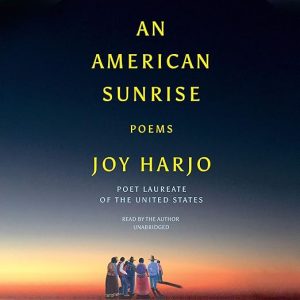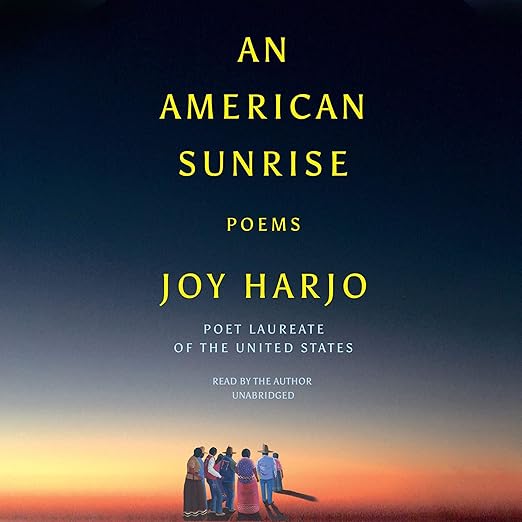
There is a particular quality that arrives when a poet reads their own work aloud. It is not about performance, though some poets perform with great skill. It is about the gap, or the absence of a gap, between the sound of a poem and the intention behind it. Joy Harjo has spent decades speaking her poems in contexts that range from classroom to ceremony, and what you hear in An American Sunrise is not a reading in the conventional audiobook sense. It is something closer to testimony.
Harjo is the first Native American Poet Laureate of the United States, and this collection, released in 2019, is rooted in a specific historical rupture: the forced removal of the Mvskoke people from their original lands east of the Mississippi in the early 1800s. Harjo returns, two centuries later, to her family's lands and opens what she calls a dialogue with history. That dialogue is what the poems conduct, and it is neither simple grief nor simple celebration. It is the kind of reckoning that takes the full span of a poet's career to become capable of.
Where This One Lands
The Trail of Tears is not a metaphor in this collection. It is a literal historical event whose consequences Harjo traces through her own life, her mother's death, her beginnings in the native rights movement, and the specific geography of lands that were taken and then returned to in some form. Poems like Directions to You, Washing My Mother's Body, and Advice for Countries, Advanced, Developing and Falling are among the collection's most discussed pieces, and they work because Harjo never allows the historical weight to flatten the personal. The public and the private are in constant, careful conversation.
One reviewer described the collection as an homage to Creek heritage and history while also being about diaspora and pain, and then asked whether sorrow and beauty can exist simultaneously. The answer the poems give is yes, and the manner in which they give it is the central achievement of the book. Harjo writes, as the Los Angeles Review of Books noted, as one of the finest and most complicated poets in contemporary American literature. The complication is earned and productive rather than obscuring. These poems are difficult in the way that true things are difficult: they require your full presence.
Why Listen to An American Sunrise
Poetry on the page is a visual as well as a sonic experience. The line breaks, the white space, the way the eye travels across a poem are all part of how it means. Poetry in audio is something different, and not every collection makes the translation gracefully. An American Sunrise does. Harjo's voice contains something that print cannot carry, a kind of oral tradition inheritance that makes the act of listening feel like participation rather than reception. The one hour and forty-one minutes move at a pace that is neither hurried nor drawn out. The collection ends before you are ready for it to end, which is the right kind of length for this kind of listening.
The prose sections that the collection includes, which one reviewer noted illuminate history and localities of Native American groups oppressed and forcefully removed, are also heard to good effect. Harjo's voice handles the shift between poetry and prose without losing authority or register. The overall arc of the listening experience mirrors the arc of the collection itself: grief entering, beauty persisting, something like renewal possible without denying what was lost.
What Gives Us Pause
At under two hours, this is one of the shortest audiobook experiences in any batch I listen through in a given month. But brevity here is not limitation. The compression is part of the work's formal argument. These poems say a great deal in small spaces, and the listening experience rewards the same quality of attention. This is not a collection you put on in the background while doing something else. Even at ninety minutes, it asks for your full presence, and the request is reasonable given what it offers in return.
Listeners who come to poetry audiobooks only occasionally, or who are uncertain whether poetry in audio form works for them, should consider this a strong test case. Harjo is not an obscure or academically forbidding poet. Her work is formally accessible while being emotionally and historically complex, which is a combination that rewards the general listener as much as the specialist. The collection has a 4.7 rating from over eight hundred listeners, which is unusually high for poetry in any format. That rating reflects what you are likely to feel by the final poem: that you have been in the presence of something that matters, and that the hour and forty-one minutes were not nearly enough.
Should You Listen to An American Sunrise?
An American Sunrise is an excellent entry point for listeners new to Joy Harjo's work. It is also a meaningful continuation for those who know her earlier collections, Crazy Brave, She Had Some Horses, or Conflict Resolution for Holy Beings. The collection stands alone, though its emotional and historical dimensions are enriched by familiarity with the arc of Harjo's career. For listeners interested in indigenous American literature, contemporary poetry, or writing that treats historical injustice without reducing it to polemic or sentiment, this is required listening. The fact that Harjo reads it herself is not a bonus feature. It is the work.
At a Glance
- Voice: Joy Harjo reading her own poetry is not a secondary option, it is the primary way this work was meant to be received. Her voice carries a quality of ancestral transmission that no other narrator could replicate.
- Big ideas: Forced removal and its generational weight, the coexistence of grief and beauty, the Mvskoke people's history and the poet's personal reckoning with that history
- Atmosphere: Grave and luminous, moving between elegy and something closer to prayer
- Worth it?: At under two hours this is a compact and profound listening experience, and Joy Harjo's own voice makes it one of the most essential poetry audiobooks available from a living American poet.