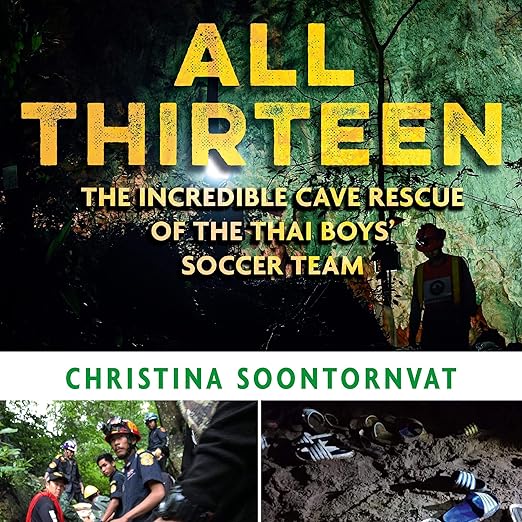
In the summer of 2018, twelve boys and their soccer coach walked into a cave in northern Thailand and did not come back out for seventeen days. This audiobook, All Thirteen by Christina Soontornvat narrated by Quincy Surasmith, provides the detail underneath that story that news coverage never reached: the engineering decisions, the psychological strategies, the religious practices that kept the boys calm underground, and the web of relationships among rescuers from dozens of countries working in impossible conditions. The result has the rigor and emotional precision of excellent journalism.
This is a Newbery Honor book and winner of the 2021 Kirkus Prize for Young People's Literature, among several other recognitions, which speaks to how the children's literature community has evaluated its qualities as writing. The audiobook version received its own recognition as a 2022 YALSA Amazing Audiobook for Young Adults, which is worth noting separately because it confirms that Surasmith's narration and the audio format itself are central to the work's effectiveness rather than incidental to it.
Soontornvat Was in Thailand When It Happened
What Soontornvat has done here that most crisis journalism does not accomplish is to treat the Thai cultural and religious context not as local color but as essential structural information. The Wild Boars' ability to remain calm in the cave, the coach's decision to have the boys meditate, and the specific way the community gathered around the families during the wait are all rooted in cultural and religious traditions that the book explains with genuine care. Soontornvat was visiting family in northern Thailand when the boys went missing, which gives her access to cultural understanding that a journalist parachuted in for the event would not have.
Quincy Surasmith's narration handles this material with notable cultural fluency. The Thai names, the Buddhist terminology, and the technical rescue language all receive the precision they require, and Surasmith navigates the shifts between the boys' experience underground and the engineering operation above without losing the tonal thread. The book is not simply a rescue story; it is a study in how knowledge, community, and engineering problem-solving work together under extreme pressure.
The firsthand interviews with rescue workers that Soontornvat weaves into the account give the book a texture that secondary sources cannot replicate. The perspectives of the international divers, the Thai navy SEALs, the volunteers who showed up without being asked, and the families who waited on the surface add dimensions to the story that the news coverage could not convey in real time. The meticulousness of the research, documented in detailed source notes and a bibliography, is what earns the tension its right to feel as immediate as it does.
You Can't Skip Ahead in This Audiobook
The audiobook format is particularly effective for a narrative driven by timeline and tension. Soontornvat structures the account around the seventeen-day arc of the rescue, and the forward momentum of that structure plays better in audio, where the listener cannot skip ahead, than on the page. Surasmith maintains the propulsive quality of the storytelling without rushing through the detailed scientific and cultural content that gives the book its substance.
The book also succeeds at something rare in children's nonfiction: it trusts its young audience with genuine complexity. The science of cave diving, the physics of water pressure, the logistics of anesthesia administration in an underwater cave, and the ethical debates among the rescue divers about risk are presented in enough detail to be intellectually satisfying rather than simplified into obstacle and triumph. Reviewers describe it as a page turner and a harrowing story that kept them at the edge of their seats, which suggests the combination of rigorous reporting and narrative structure is working as intended across a wide range of listeners.
Thirteen Lives Viewers May Feel Less Tension
Listeners who already know the outcome of the rescue in detail, particularly those who have seen the Ron Howard film Thirteen Lives or read Rick Stanton's Aquanaut, may find some of the tension diminished by prior knowledge. Soontornvat provides context and detail that neither film nor adult memoir necessarily covers, so the experience remains valuable even for well-informed listeners, but the dramatic momentum of the audio experience works best for those who are less familiar with the specifics of the rescue operation.
The four-hour runtime is short for an audiobook of this kind, though it is well-calibrated for the middle-grade audience. Adult listeners who want comprehensive coverage of the engineering challenges and international coordination involved in the rescue may find the treatment selective. The bibliography and detailed source notes referenced in the print edition are useful for listeners who want to go deeper after the audio experience concludes.
YALSA Recognition Argues for the Audio Edition
Middle-grade and young adult listeners who want nonfiction that reads with the momentum of fiction, and who are ready for material that takes their intelligence and emotional capacity seriously, are the primary audience. This audiobook works particularly well for young listeners interested in science, engineering, survival stories, and other cultures. Teachers and parents looking for audiobook nonfiction that can spark discussion about community, courage, and what people are capable of under extreme pressure will find it reliable and substantive.
Adult listeners who enjoy narrative nonfiction will also find this audiobook fully satisfying. The writing is too good and the research too solid to be dismissed as children's content by adults who give nonfiction for young readers a fair hearing. If you followed the cave rescue in 2018 and want to understand what you were actually watching, this audiobook is the right place to start. The YALSA audiobook recognition alone is reason enough to seek out the audio version specifically rather than the print.