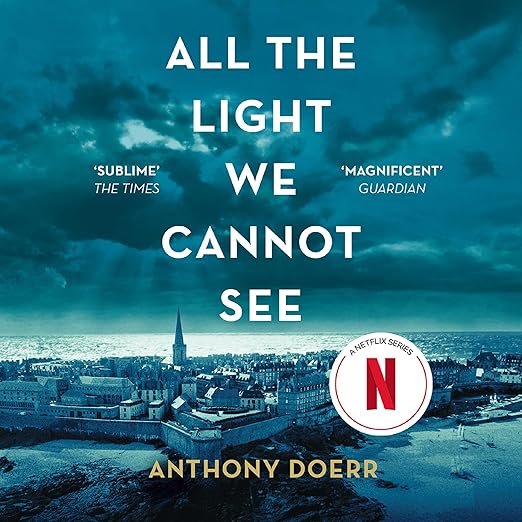
Would Marie-Laure have survived Saint-Malo without the miniature city her father carved for her blind fingers to memorize? This audiobook spends seventeen hours answering that question sideways, weaving her story with Werner's, a German orphan whose gift for fixing radios pulls him toward the same coastal town from the opposite, far more dangerous direction. Anthony Doerr's Pulitzer Prize winning novel follows Marie-Laure, blind since six and living within walking distance of the Museum of Natural History where her father works, and Werner, whose talent for radios earns him a place at a brutal military academy and eventually makes him a tracker of the French Resistance. Julie Teal narrates, guiding listeners between Marie-Laure's tactile, sound-oriented Paris and Saint-Malo, and Werner's brutal ascent through Hitler Youth to the war's eastern front and back again.
What We Made of It
Teal's narration has to hold two entirely different emotional registers steady across a long dual-timeline structure, Marie-Laure's sensory, present-tense intimacy and Werner's colder, more historically expansive arc, and that balance is what makes seventeen hours feel purposeful rather than padded. Reviewer Larry Hoffer admits 'I don't know why I waited so long to read Anthony Doerr's All the Light We Cannot See.' Hoffer points to Doerr's earlier 2010 story collection Memory Wall as evidence this book's reputation was well earned in advance. Reviewer DragonCeres, who says this is 'not my usual read,' still calls it 'a book filled with beautiful prose and imagery and poignant emotions.' That kind of praise shows up even from listeners who came to it skeptical of literary fiction generally. Reviewer Kuipistina keeps it simple, describing a story that 'carries you away to another world in a different time as only excellent books can.' That is a fair summary of how thoroughly Doerr's occupied France and Germany get rendered in sensory detail. The title itself operates on two levels at once: radio waves, the literal light no one can see that Werner spends the novel mastering, and the deeper implication that the most important human connections in the book, Marie-Laure and Werner's brief convergence chief among them, happen through channels other than sight, a fitting structural idea for a novel with a blind protagonist at its emotional center.
Why Listen to All the Light We Cannot See
The novel's real accomplishment is refusing to let either Marie-Laure or Werner become purely a victim or purely a villain's tool, and Teal's narration resists any temptation to flatten either character into a simple moral position. Marie-Laure's father building her a scale model of their neighborhood, every house, every manhole, so she can memorize the streets with her fingers before losing her sight entirely, sets up one of the novel's most sustained metaphors: knowledge built patiently, piece by piece, as a form of both survival and love. Werner's radio expertise, first a source of wonder for him and his sister Jutta, later becomes the exact skill the Reich weaponizes against people like the ones sheltering Marie-Laure, and Teal handles that slow moral curdling with restraint rather than melodrama. Ten years in the writing, by Doerr's own account, and that patience shows in how deliberately the two timelines are built to collide only in Saint-Malo, after the reader already understands everything both characters stand to lose there. Saint-Malo's own wartime history adds real weight to the novel's climax: the walled city was one of the last German strongholds in Brittany to fall, besieged and heavily bombed in August 1944, and Doerr's fictional convergence of Marie-Laure and Werner is staged against that genuinely catastrophic historical backdrop rather than an invented setting. Marie-Laure's father working as the master of the locks at the Museum of Natural History, responsible for thousands of keys across the building, gives the novel's obsession with hidden mechanisms and careful, patient craft a literal anchor before it ever becomes a metaphor for Marie-Laure's own way of navigating a world she cannot see. Doerr builds outward from that very concrete job description into everything the novel later does with puzzles, protection, and the specific kind of care a parent shows a child by building her a way to be safe alone.
What Might Not Land
Plot-first listeners may find the pace demanding, since this is a novel built on accumulation and sensory detail rather than fast incident, and Teal's measured, unhurried delivery matches that structure rather than trying to inject urgency the prose itself is not reaching for. DragonCeres puts it plainly: this is a book that you have to take time to savor and enjoy and not rush through, which is accurate but also a fair warning for anyone expecting a conventional wartime thriller rather than a slow-built literary novel. The dual-timeline structure, alternating between Marie-Laure and Werner across years and locations, asks listeners to hold two separate threads in mind simultaneously, which works better across sustained listening sessions than in scattered five-minute increments. At seventeen hours, this is a genuine time commitment, and the emotional payoff in Saint-Malo depends entirely on having stayed with both characters' slower, earlier chapters rather than skipping ahead. Secondary figures like Marie-Laure's agoraphobic great-uncle and Werner's sister Jutta matter enormously to both protagonists' emotional arcs but get proportionally less runtime than the two leads, so listeners hoping for the same depth of interiority extended to every named character may find a few relationships feel sketched in rather than fully explored by the novel's end. Doerr wrote the novel in famously short chapters, some barely a page or two on the printed page, and that structure translates into an audio rhythm of frequent small stopping points rather than long unbroken stretches, which makes the seventeen hours easier to break into manageable listening sessions than the runtime alone might suggest. Teal uses those chapter breaks as natural breathing room, a small pause before shifting between Marie-Laure's and Werner's perspectives, rather than rushing straight through them.
Who Should Pick Up All the Light We Cannot See
Literary fiction listeners with a taste for slow-build World War II narratives are exactly who this was written for, and the novel's Pulitzer Prize, National Book Award finalist status, and Carnegie Medal all point toward the same audience: readers who value prose and structure as much as plot. Fans of dual-timeline historical fiction that eventually converges, rather than alternating chapters that stay separate throughout, will find the eventual meeting in Saint-Malo genuinely earned rather than a coincidence dropped in for convenience. Listeners newer to literary fiction who enjoyed DragonCeres's entry point, curious after seeing the book everywhere despite normally reading elsewhere, should trust that curiosity here too. Anyone who needs a brisk, plot-forward thriller to stay engaged during a commute should know this is closer to a novel meant for sustained attention than for background listening.
- Read by: Julie Teal balances Marie-Laure's sensory intimacy against Werner's colder historical arc without flattening either character.
- At its heart: war and moral complicity, blindness and perception, the patient accumulation of knowledge as survival
- Vibe: Lyrical, patient, and quietly devastating
- Short version: A demanding but richly rewarding listen for literary fiction fans willing to sit with a slow-build structure.
Questions Listeners Ask
Do I need to have read Anthony Doerr's earlier work before this audiobook?
No. It stands alone as a complete novel, though reviewer Larry Hoffer notes Doerr's earlier story collection, Memory Wall, as evidence of a track record worth trusting going in.
Is this audiobook appropriate for listening during short, scattered commute segments?
Not ideally. Its dual-timeline structure and accumulation of sensory detail reward sustained listening sessions more than the scattered five-minute increments a commute often allows.