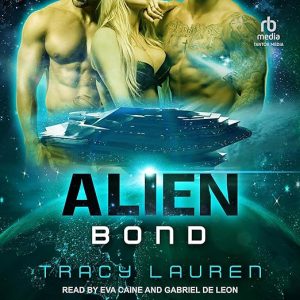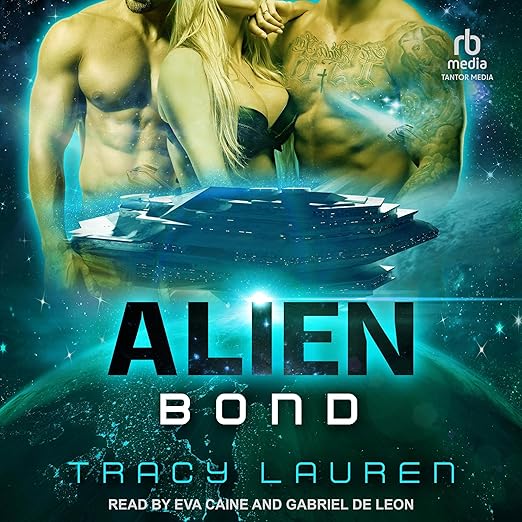
How do you write a love triangle in which nobody is actually competing? Alien Bond spends seven hours and twenty-six minutes answering that, and it answers early enough to reframe everything after: the heroine assumes she is trapped in a triangle, the two brothers who want her assume nothing of the kind, and the distance between those two understandings is the real plot. Tracy Lauren wrote it, Gabriel De Leon narrates this audiobook, and 445 ratings put it at 4.4, which for a fifth series entry is a settled and reasonably informative number.
Our Take on Alien Bond
The premise front-loads a surprising amount of grief for a romance. The heroine lost her mother to what she calls "a short and sudden battle with cancer" and was still recovering when her husband announced he was leaving her for another woman. Then she was abducted by aliens, which she presents as the punchline to a bad run rather than as the inciting incident. Rescue follows. She and the other women are relocated to a planet she describes as beautiful, deep inside an uninhabited rainforest, and the story properly begins with someone attempting a fresh start while still carrying every piece of what came before.
That opening is why the book has more emotional grip than the setup would predict, and Perri Emory's review identifies the mechanism precisely: "Her character's are tough, intelligent and believable survivors." Survivors is the operative word. Tracy Lauren is writing women who have already lost things, which gives the romance stakes that abduction premises usually skip past entirely. A third reviewer supplies the series reader's angle, greeting the book as "Mire's and Gile's story" at long last, which tells you the two brothers had been visible in earlier volumes long enough for readers to start wanting this one specifically.
The setting deserves a mention, because it does quiet structural work. These women are not confined to a ship or held in a facility. The rainforest is somewhere they live rather than somewhere they are kept, which turns the usual abduction aftermath into something much closer to a resettlement story. Nobody is escaping. Everybody is building. That single choice strips out the low-grade dread running under most captivity romance and swaps in the ordinary anxiety of starting over somewhere unfamiliar, which suits a heroine whose actual problem is that her previous life ended badly rather than that her current one is dangerous.
Why Listen to Alien Bond
The structural choice deserves real credit. Most love triangles run on scarcity, and this one removes scarcity in the first act. The heroine states her position flatly: "I'm not looking to enter a love triangle." She has been on the receiving end of a broken heart and refuses to inflict one. Then the brothers turn out not to mind sharing at all, and the description is direct that sharing is in fact their goal. That converts a jealousy plot into a question about whether she can accept an arrangement her own assumptions rule out, which is a more interesting conflict, and one located inside the protagonist rather than strung between two suitors.
Gabriel De Leon carries the entire production alone, and in this subgenre that is a design decision rather than a default. A single reader has to hold a first-person heroine, two brothers who must never blur into one another, and intimate scenes involving all three, which is a harder differentiation problem than a standard two-hander romance sets. Perri Emory's praise names the immersion at stake: "From the scenery to the intimate moments I totally got sucked in." Solo narration either sustains that or breaks it, and none of the three reviews attached here separates the writing from the reading. If single-voice narration of multi-partner scenes has pulled you out of a book before, that is the risk to weigh.
What to Watch For in Alien Bond
Two practical notes. This is the fifth book in The Alien Series, and that same series reader explicitly values "the overlap with the other books in this series." That is a generous way of saying that some of the pleasure on offer here is cumulative. The plot stands on its own. The satisfaction of these particular brothers finally getting a book does not. The second note concerns heat. The description closes on sharing as an explicit goal, and Perri Emory's reference to intimate moments confirms the scenes happen on the page rather than behind a closed door, so approach this as open-door romance heading toward a multi-partner resolution.
Jennifer Rockafellow supplies the most useful reservation, and it sits inside genuine praise: "Good pacing, intriguing story line. Occasional odd transitions but overall an excellent book." Odd transitions are precisely the flaw audio magnifies, because a scene break a reader absorbs visually on the page arrives instead as an unexplained shift in a single continuous voice. Across seven and a half hours that will register a handful of times rather than constantly. It is worth naming because it is the only craft criticism anywhere in this listing, and a rating base this size suggests something mild and widely tolerated rather than something disqualifying.
Who Should Listen to Alien Bond
Point this at readers who like science fiction romance emotionally grounded and multi-partner arrangements resolved happily rather than agonized over at length. If you have followed The Alien Series and been waiting on Mire and Gile, the recommendation writes itself. Newcomers who want the subgenre without the captivity dynamics that usually come with it should also look, because the abduction is finished before the romance starts and the setting is a rainforest the characters live in freely rather than a ship they are held on. The title's promise of a bond, set against a heroine who spends the book refusing to be the cause of anybody's broken heart, is the tension worth buying it for.
Avoid it if a why-choose resolution is not what you want out of a triangle, since the book commits to that ending and signals it early rather than teasing. Avoid it too if solo narration across intimate multi-partner scenes is a persistent problem for you. What strikes me as genuinely well judged is the grief. A heroine arriving with a dead mother and a collapsed marriage already behind her, who then has to decide whether to accept a shape of happiness she never once considered, is a stronger foundation than this premise required. The series reader who welcomed this one is already asking for Allison's book, which is the most reliable endorsement a series entry can collect.
Questions Listeners Ask
Do I need the earlier Alien Series books before this audiobook?
The plot stands alone, but the emotional payoff does not. One reviewer greets the book as finally being Mire and Gile's story, and another values the overlap with the other titles. Newcomers get a complete romance; series readers get a resolution they have been waiting for.
Does a single narrator work for an audiobook with two male love interests?
That is the main question for this audiobook. Gabriel De Leon carries a first-person heroine plus two brothers who need to stay distinct, including in shared scenes. None of the attached reviews comments on the narration, so weigh your own tolerance for solo multi-partner readings.