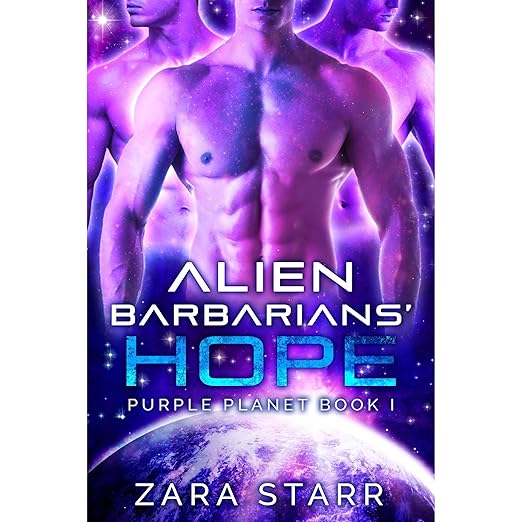
Ella wakes up convinced she has walked onto a film set, because the alternative is that the giant purple men standing over her are real and that they intend to keep her. Zara Starr builds the first Purple Planet book on that refusal to believe, and the audiobook runs just under six hours, short enough to finish across two evenings and long enough to feel the pacing problems the written record keeps circling. What the record cannot tell you is anything at all about this particular recording, and that turns out to be the first thing a buyer needs explained.
Where This One Lands
The premise is carrying real weight, and it holds. Strange storms have been battering Earth for months. Ella, already stretched thin by work, by her health, and by a car that has just died on her, gets hit by lightning and wakes on a world where the population problem runs in the opposite direction: too few females, so the men live in family groups of three. Lisa Boyce, at five stars, described the appeal without dressing it up, noting that waking on an alien planet was not something Ella had ever considered possible. That gap between an ordinary bad day and a wholesale relocation drives the opening stretch of the book.
Starr also commits to the consequences instead of waving them through. The aliens do not speak English. Nobody produces a translation device in chapter two. Ella's health problems cross over with her, and the local wildlife is a genuine hazard rather than set dressing. A romance willing to keep its language barrier standing for real pages is rarer than the shelf suggests, and it is the reason this reads as something more considered than a delivery mechanism for three purple love interests. The trade-off is that the barrier has to be dramatized somehow, and how Starr chose to dramatize it is exactly where the objections start.
Pause on the social arrangement too, because it is doing more than supplying a body count. Three men to one woman is presented as a response to scarcity rather than as a fantasy premise, which gives the trio a reason to exist beyond the obvious one and gives Ella something to negotiate rather than simply accept. Whether that holds up over the course of the book is a fair question, and the written record splits on it. What it does buy Starr is a first act with a genuine problem in it: not whether these men want her, which is settled almost immediately, but whether any of them can explain themselves.
Why Listen to Alien Barbarians' Hope
Before anything else, the reading. No performer is named anywhere on this page. Virtual Voice occupies the reader slot, which is a brand of synthetic narration and not a person in a booth, and the substitution lands harder here than it would on a straightforward contemporary romance. Shirley Ngapo-Simpson's five-star account describes Ella caught in the storm, dropped into the middle of a lake, pursued by a water creature, and hauled out by a giant purple alien called Karr, who then has to work out how to make himself understood to someone who shares no words with him. Scenes built on mutual incomprehension need a voice that can play bewilderment, hesitation, and the comedy of getting it wrong. Synthetic delivery is at its thinnest precisely there.
What survives that limitation is the architecture. Each entry in the series is built as a standalone with a different woman and a different trio, and Starr states the terms up front: no cheating, no cliffhangers, a happy ending guaranteed. You can start here owing nothing to a backlist and leave owing nothing to the next volume, which is not how most reverse harem series are constructed. The world itself is also economical. One planet, one social arrangement, one heroine trying to learn a language while her body keeps failing her. Nothing needs a glossary. For listeners who bounce off series fiction because volume one is really a prologue, that self-contained shape is the strongest argument on offer.
What Gives Us Pause
The written record is unusually precise about what goes wrong, and it does not contradict itself. Lil Red, at four stars, objected to scenes being played through more than once to demonstrate the communication barrier and the thought process on both sides, and added that the pace was off and the relationships never fully develop. That is a structural complaint rather than a matter of taste, and repetition of that kind punishes a listener far more than a reader, because an eye can slide down a paragraph it has effectively already absorbed while an ear has to sit through every word of it a second time.
Spinneretta, at three stars, offers the closest thing to a diagnosis. The praise goes to the construction: the storms battering Earth are somehow replicated on the new planet and are somehow responsible for moving the heroine there, which ties the opening chapters to the setting rather than leaving the transport arbitrary. The reservations gather around daily life once she arrives, where language barriers, cultural friction, and health concerns make simply existing difficult before the dangerous wildlife is even counted. Whether that reads as texture or as drag depends entirely on what you arrived wanting.
Then the chronology, which nobody flags on the page. The five written responses here are dated between February 2020 and April 2022. The audio edition arrived on the twenty-second of May, 2025. Not one person who wrote a word on this listing had access to this recording, so the 3.8 average sitting above 334 ratings is a verdict on a text, not on a performance. The five visible accounts run five, four, three, five and four stars, which is a noticeably warmer spread than the aggregate, and neither number describes what your ears will actually receive.
Should You Listen to Alien Barbarians' Hope?
This suits listeners who want science fiction romance where the alien part is not cosmetic. Purple skin, a three-to-one mating structure, a language nobody shares, a heroine whose chronic problems do not evaporate on contact with a new sky: the setup earns its shelf placement. It also suits people who like a compressed romance they can finish in an evening or two, who do not mind long stretches inside a heroine's own head, and who want the landing guaranteed before takeoff.
Skip it if repeated scenes are the thing that ends a book for you, or if you need a performed reading rather than a delivered text. osprey92, at four stars, wanted more interaction with the trio and less time in Ella's interior monologue, which is a fair description of where the balance sits. Treat the compact runtime as the deciding variable here: at this length the structural flaws stay irritations rather than deal-breakers, and the machine reading has less time to wear a groove.
Good to Know
Does the Alien Barbarians' Hope audiobook work as a standalone?
Yes. Zara Starr states that every Purple Planet book pairs a new heroine with a new trio, with no cheating, no cliffhangers, and a guaranteed happy ending waiting at the close. This is the opening volume, so nothing precedes it, and the final chapters resolve instead of handing you off to the next release.
Who narrates the Alien Barbarians' Hope audiobook?
Nobody. Virtual Voice sits where a performer's name would go, meaning software generated the reading. Worth knowing before you commit, because a plot built on two people failing to understand one another asks a great deal of vocal timing, and a synthetic reader supplies none of it.
How explicit does Alien Barbarians' Hope get?
The description sells it as a reverse harem romance in which three aliens want the heroine as their mate, so intimacy is structural rather than incidental. Zara Starr also promises no cheating and a guaranteed happy ending, which sets the boundaries of the arrangement. Nobody in the visible record complains about heat level in either direction.
Why does the 3.8 rating look low for a romance with this many enthusiastic reviews?
Three hundred and thirty-four ratings sit above just five pieces of writing, and those five average out well ahead of the aggregate. The written objections are consistent and structural: replayed scenes, uneven pacing, relationships that never fully develop. The silent majority is evidently harder on the book than the visible sample.