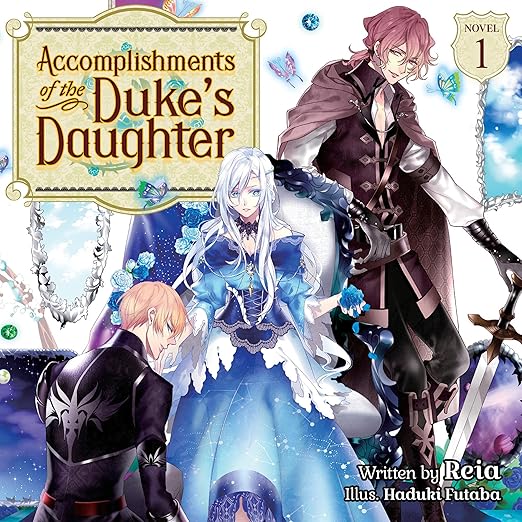
The otome game isekai subgenre has a clear and well-worn formula: girl wakes up in the body of the game's villainess, recognizes the script she is trapped in, and begins making different choices to avoid the bad ending. Accomplishments of the Duke's Daughter (Light Novel), Vol. 1 is an audiobook that follows that blueprint, but what distinguishes it from the crowded field is how seriously author Reia takes the administrative and economic mechanics of actually governing a territory. Iris Almeria does not just choose not to be evil - she builds something real and lasting. She reforms tax structures, improves agricultural yields, stabilizes trade routes, and treats the people of her fief as constituents with legitimate interests rather than as backdrop scenery. Anjali Kunapaneni's narration captures that competence with the right tone of quiet, settled determination.
The isekai villainess setup is familiar enough that genre-savvy readers can predict the broad strokes before the first chapter ends. What separates this volume from comparable entries is its willingness to slow down and show the actual unglamorous work of governance. When Iris escapes exile by fast-talking her way out of Prince Edward's rejection scene - a moment she recognized because she had lived through its equivalent in her previous life, playing the game this world is based on - she does not retreat to romantic scheming or magical power fantasy. She rolls up her sleeves and makes herself politically indispensable through competence and practical reform rather than charm or supernatural advantage. The fief management sections are more detailed than most isekai light novels bother with: tax reform, agricultural policy, trade route logistics, and institutional relations with the church and the regional nobility all receive genuine attention and specific solutions. These sections are the book's strongest material, and they signal what kind of story this actually is. Iris is interesting not because she is secretly special in some magical sense but because she is practical, well-read from her previous life as a game player and reader, and willing to do the unglamorous institutional work that her survival requires. That is a more interesting foundation for a character in this genre than the alternatives typically offer. The slow-burn romantic thread exists and has clear future potential, but it takes a definite backseat to the political and economic narrative in this first volume, which will be a feature or a limitation depending entirely on what you came for.
Why It Works in Audio
One reviewer notes they loved the story enough after reading the first manga volume to hunt down the novel online before it was published in English - that level of dedication says something real about the material's pull. The light novel covers the first three manga volumes, which means this audiobook carries a substantial amount of narrative for its six-and-a-half-hour runtime. Kunapaneni's narration suits Iris with precision: the character needs to sound like someone who is always thinking, always calculating her next move without appearing to do so, and the performance threads that needle throughout. The voice does not make Iris cold - there is genuine warmth in her relationships with her household staff, her subjects, and the handful of allies she carefully builds - but it makes her feel like the most capable person in whatever room she occupies. Reviewers who came from the manga confirm the light novel tracks closely with few meaningful variations, so this functions as a companion listen for existing fans as much as a discovery for newcomers to the story. The audiobook offers a different rhythm than manga pages - more interiority, more room for the economic reasoning that makes Iris's choices feel earned.
Weak Spots in Accomplishments of the Duke's Daughter (Light Novel), Vol. 1
The first act moves quickly through the rejection scene and its political fallout, and the book assumes from that point forward that you find administrative detail as compelling as the romantic thread. If your appetite for isekai stories is primarily for romance escalation or fantasy spectacle, this volume will feel slow in its longest stretches. The fief management segments are thorough enough that listeners coming primarily for the love interest subplot may find the pacing uneven. The villainess-to-protagonist arc is also familiar enough in the genre that readers who have spent time with similar titles will recognize the structural beats. What lifts this above comparable entries is the conviction with which it executes its specific angle. This is not a story about a woman becoming good after being bad - it is about a woman using her second life to build real, lasting institutional change in a world designed to limit her. That is a more interesting story, and the audiobook tells it with genuine patience and respect for the listener's ability to find economics as compelling as romance.
Who Will Get the Most From It
Listeners who enjoy isekai and villainess-reinvention stories but want more political and economic substance in the worldbuilding will find this audiobook genuinely satisfying. If you have already read the manga and want the novel version in audio form, this is a smooth and enriching transition. Skip it if you want fast romantic escalation or action-heavy fantasy sequences - the first volume is primarily setup, governance detail, and the careful establishment of Iris's political position, and it is entirely comfortable with that slower pace. The slow-burn designation in reviews is accurate, and readers who love that rhythm will be in their element here.