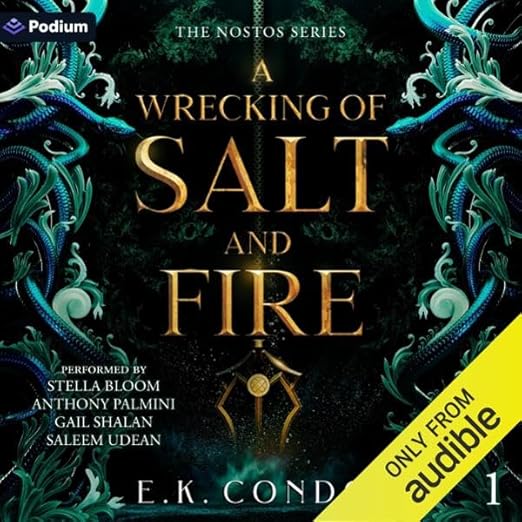
I came to A Wrecking of Salt and Fire with slightly skeptical expectations. Greek mythology as romantic fantasy backdrop has become so common in the genre that I sometimes feel I can predict the emotional beats before the first chapter ends. E.K. Condos surprised me. Not because she reinvents the structure, but because she uses it to do specific work around trauma and recovery that most books in this space treat as a secondary concern.
Katrin Drakos is approaching her coronation as Queen of Alentus, engaged to her Fated match, and living five years of relative peace after something the synopsis describes only as what the vile King Nikolaos of Nexos had done to her. The book does not initially specify what happened, and that restraint is purposeful. The reader spends the early chapters understanding Katrin through the shape of what she is protecting herself from before they understand the event itself. That is a craft choice, and it works.
How A Wrecking of Salt and Fire Holds Up
Condos has built a world called Odessia that sits adjacent to classical Greek mythology without being a straight adaptation. The gods are present and consequential, the concept of Fated bonds operates as a recognized social institution with significant stakes for those subject to it, and the maritime geography of the world shapes both the political conflicts and the romantic possibilities. One reviewer described the vivid world of shipbound voyages and ward-crossings as pulsing with mythic allure, and that is an accurate characterization of the atmospheric ambition. The world feels inhabited rather than sketched.
The pirate who captures Katrin midway through the first act, and who claims to have saved her from the lies woven into the kingdom's history, is Ander, a character whose backstory multiple reviewers described as compelling even at this early stage of the series. Ander is the MMC who drew the most passionate responses in the review section, including one reader who described him as spectacularly drawn while acknowledging his backstory is incomplete in this installment. That is the right structure for a series opener: give readers enough of a character to invest in without exhausting the material.
One of the more thoughtful choices Condos makes is that the Fated bond system in Odessia is not presented as inherently romantic or benign. It is a social institution with legal and political implications, and characters relate to it with the full range of responses that any coercive social institution would generate: genuine belief, strategic compliance, open resistance, and quiet grief over the options it forecloses. That texture is what keeps the world-building from functioning as mere decoration for the central romance.
The most interesting structural choice in A Wrecking of Salt and Fire is what Condos does with Kohl, Katrin's Fated. The Fated bond convention in romantic fantasy usually operates as a given: the destined match is the correct match, and the story is about the characters accepting that. Condos complicates this by making Kohl a character whose actions could easily read as villainous, but whose interiority, accessed through multiple perspectives, reveals the moral messiness that produces bad behavior from people who are not simply bad. One reviewer specifically praised how his inner turmoil and motivations reveal a flawed, human soul, wrong, yet not wholly sinister.
That complexity is what keeps the love triangle from feeling like a genre obligation. Stella Bloom's narration navigates the shifts between Katrin's perspective and Kohl's without losing the emotional logic of either, which is a non-trivial performance task when the characters have such different relationships to what they know about each other.
Weak Spots in A Wrecking of Salt and Fire
What distinguishes this from the majority of romantic fantasy with a traumatized heroine is that Katrin's recovery arc is not accelerated by the romance. The relationship with Ander does not function as a cure or a rescue. It functions as a context in which Katrin encounters people who extend her different forms of trust, and in which she slowly permits herself to make different choices. The healing is incremental and sometimes reversible, which is a more honest treatment of trauma's actual movement than the genre usually provides.
The content warnings noted on the author's website are real, and listeners who are sensitive to certain types of historical violence in backstory should check those before beginning. The book handles them with care rather than shock value, but they are present and consequential to the character work. Stella Bloom's handling of the more difficult emotional terrain is steady throughout, which matters across eleven hours of material that asks you to stay close to a character in genuine distress.
Should You Listen to A Wrecking of Salt and Fire?
This is a series opener, and the ending makes that clear. The central conflict reaches a resolution, but Ander's full story and several significant political threads are explicitly continuing. Listeners who prefer completed arcs within single volumes should wait until more of the series is available. Those who are comfortable beginning a series with genuine confidence in the first installment will find A Wrecking of Salt and Fire a substantive start. Romantic fantasy readers who want mythology woven into the world rather than applied as decoration, and who have patience for slow-burn tension calibrated across a full length, should find this debut worth the commitment.
What the Nostos Series sets up in this first volume is a world in which divine intervention is real but not benign, in which the gods of Odessia have their own politics and their own failures, and in which the Fated bond system that structures romantic and social life is more complicated than its name suggests. Condos drops enough hints about the larger stakes to make the second book feel necessary without making this one feel incomplete, which is the hardest balance a series opener must strike.