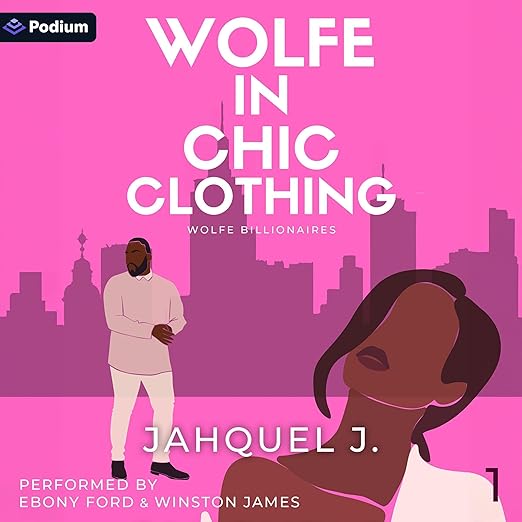
Key Details
- Voice: Winston James delivers the Brookwood world with a smooth, character-driven performance that suits the contemporary romance register without overselling the emotional beats.
- Big ideas: Creative ambition and compromise, stolen designs and corporate accountability, second-chance homecoming
- Atmosphere: Warm, low-drama, and feel-good
- Worth it?: Jahquel J. opens the Wolfe Billionaires series with a romance that keeps the tension in the characters rather than manufactured melodrama, which is exactly the right call for an author whose Brookwood world has real staying power.
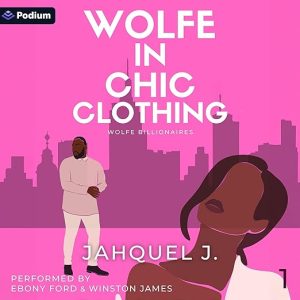
I started A Wolfe in Chic Clothing on a Friday evening when I was specifically in the market for something that would not require me to manage anxiety on behalf of the characters. I have a tolerance for fictional drama that fluctuates with the week, and by Friday I am firmly in the low-turbulence zone. Jahquel J. delivered exactly what the moment required: a romance with genuine chemistry, a protagonist whose professional frustrations feel real, and a love interest who is competent rather than controlling. By the time I finished, I understood why readers keep returning to Brookwood.
The setup is tighter than many contemporary romances give themselves credit for being. Iesha Chic returns home to Brookwood after four years in New York, failed relationship in tow, no career breakthrough to show for the sacrifice. She takes a job at Fashion Don, a company with a documented history of stealing designs from smaller creators. Then one of her personal designs ends up in mass production without her consent. Wes Wolfe, the incoming CEO trying to clean up his father's mess, takes the situation seriously not primarily for Iesha's sake but because he cannot afford the bad PR. That initial motivation is honest, and the book trusts the reader to watch the shift from strategic to genuine happen organically.
Brookwood Feels Populated, and Fashion Isn't Decorative
Jahquel J. has built something unusual in the Brookwood universe: a fictional space that feels populated and consistent across books, where characters from other titles show up, where returning home means returning to a community rather than a setting. Reviewers who came to A Wolfe in Chic Clothing through the Delgados series described a seamless transition, which is the mark of a world-building instinct that most romance authors do not cultivate to this degree. The Brookwood setting does actual work in this book. It provides the social texture that explains why coming home is both a defeat and a possibility for Iesha, and why the stakes of being seen in her hometown matter more than they would in an anonymous city.
The fashion industry backdrop is also more functional than decorative. The plot mechanics, stolen design, corporate settlement culture, the PR calculation behind Wes's initial approach to Iesha, are grounded in how the industry actually operates. This gives the romance a professional antagonist, Fashion Don's toxic legacy, that is more interesting than the usual third-party interference from jealous exes or disapproving parents. When Wes decides to make things right, the action he takes has to navigate real institutional inertia, which is a more adult version of romantic conflict than the genre often bothers with.
Winston James Grounds a Low-Drama Romance
Low-drama romance is harder to narrate than high-octane drama. Without the peaks and valleys of manufactured conflict, the narrator has to sustain reader engagement through character presence alone, which means differentiating between how the same situation reads in Iesha's voice versus Wes's, even when the book is primarily in one perspective. Winston James manages this well. His Iesha is grounded rather than performance-anxious; his Wes is direct without tipping into the coldness that can make billionaire love interests feel like caricatures. The warmth reviewers associated with the book, multiple people describing it as sweet and light, is partly the writing and partly James making choices about how much emotional temperature to carry in any given passage.
At six hours and forty-five minutes, this is a comfortable contemporary romance runtime. There is no inflation here, no subplot dragging out the inevitable conclusion. One reviewer noted a lingering question about whether Wes stays in Brookwood after the year is up, which suggests the HEA lands satisfyingly but leaves room for the series to develop.
Wes Breaks the Billionaire Wish-Fulfillment Mold
Billionaire romance as a subgenre has a reputation for flattening its male leads into wish-fulfillment constructs whose wealth functions as a personality substitute. Wes Wolfe is more interesting than that. He did not choose his role at Fashion Don; it was handed to him by a father whose choices he is actively trying to remediate. His arrival in Charlotte from New York is a demotion of a kind, or at least a complication, and he approaches it with the competence of someone who takes the work seriously regardless of how he got there. The power differential between Wes and Iesha is real, but Carroll does not romanticize it. Iesha's anger about the stolen design is legitimate and treated as legitimate. The resolution has to earn itself.
This Romance Moves Efficiently, Angst Kept Minimal
Listen if you are looking for a contemporary romance with a grounded protagonist, professional stakes that feel real, and a love interest whose decency is shown through action rather than declaration. Listen if you are already invested in the Brookwood universe and want to add a billionaire romance arc to a fictional world you already care about. Skip if you need high-conflict drama and prolonged romantic tension to stay engaged; this book moves efficiently toward its conclusion and keeps the angst minimal by design. Skip if the fashion industry setting holds no appeal for you, since the professional backdrop is integral rather than incidental.
The HEA is satisfying and earns itself without requiring the characters to behave in ways that contradict their established personalities, which is more difficult to achieve than it sounds. Jahquel J. has a strong instinct for romantic resolution that feels like the characters arriving at something real rather than the author tidying up the plot, and that instinct is on full display in the closing chapters of this first Wolfe Billionaires entry.
Do you need to have read Jahquel J.'s other Brookwood books before starting A Wolfe in Chic Clothing?
No prior Brookwood reading is required. The book stands as an introduction to the Wolfe Billionaires series and the Brookwood world. Readers who come in via the Delgatos series have noted a smooth transition, but newcomers will have full access to the story without prior context.
How much of the fashion industry detail in A Wolfe in Chic Clothing feels accurate versus romanticized for plot purposes?
The core mechanics, design theft, corporate settlement culture, the PR considerations around creative IP disputes, are grounded in how the industry actually functions. Jahquel J. uses the professional backdrop as a structural element rather than decoration, which gives the romance's central conflict more weight than most billionaire romances manage.
Is the romantic tension between Iesha and Wes gradual or does the book move quickly toward the relationship?
The book is relatively efficient in its romantic arc. Reviewers consistently describe it as low-drama and sweet. The tension comes from the characters' circumstances and professional dynamic rather than manufactured obstacles, and the HEA arrives without prolonged delay.
Does Winston James handle both Iesha's perspective and Wes's scenes with equal effectiveness?
James's narration gives both characters distinct emotional presence. His Iesha is grounded and credible, his Wes direct and warm without crossing into cold alpha-male territory. The low-drama register of the book requires the narrator to carry emotional texture through character differentiation, and James does that reliably.