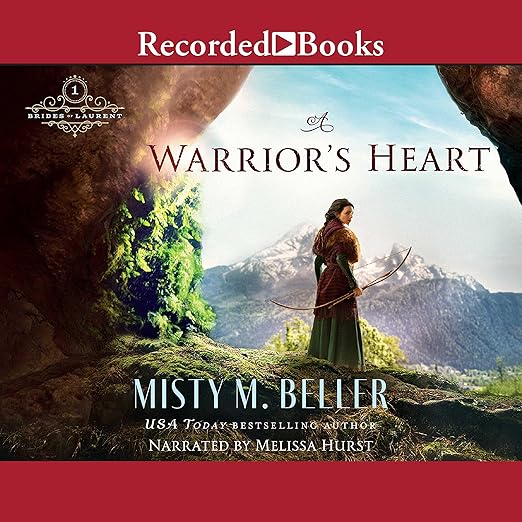
I finished A Warrior's Heart on a Thursday evening, having started it that same afternoon mostly on the strength of the setup: a female warrior-defender in a secret French settlement in the Canadian mountains in 1812, capturing an American soldier sent to find minerals for the war effort. That premise has enough moving parts to either become a genuinely interesting historical adventure or collapse under its own ambition. Misty M. Beller makes it work, and the reasons why are worth unpacking.
Brielle Durand is positioned from the first pages as something unusual in Christian historical romance: a woman whose competence is not eventually superseded by domesticity, whose role as her settlement's key defender and hunter is treated as the foundation of her character rather than a problem to be resolved. When she disarms Evan MacManus and takes him prisoner, she is not being transgressive. She is doing her job. The settlement of Laurent is built on the principle that everyone contributes to collective survival, and Brielle's skills are central to that contribution.
How A Warrior's Heart Holds Up
One reviewer flagged what she called a slight claustrophobia in the novel's settings, a good portion of the story takes place in the storage room where Evan is held prisoner. That observation is accurate, and it points to a deliberate structural choice on Beller's part. The confined space is where Brielle and Evan are forced to actually see each other, where the initial opposition between captor and prisoner starts to shift into something more complicated. Captivity narratives in romance fiction often use the constraint of proximity to accelerate intimacy in ways that feel forced. Here, the pacing is patient enough that the shift feels earned.
The wider geography of the Canadian mountains comes into play in the action sequences, which Beller handles with evident research and physical specificity. The novel's historical backdrop, the War of 1812 and America's interest in pitchblende as a potential strategic resource, is not common territory for Christian historical romance, and the specificity gives the external conflict a weight that distinguishes this from more generic frontier settings.
The spiritual dimension of A Warrior's Heart is described by multiple readers as flowing naturally with the plot rather than interrupting it. One reviewer noted that the kindness and compassion of Laurent's citizens could only come from the Lord, and that the settlement itself is described as a place many readers would want to live in even now. That idealized community, peaceful, faith-grounded, intentionally hidden from a world that might destroy it, is central to why Evan's mission creates such genuine moral difficulty.
Evan arrives with legitimate orders and professional obligations. He is not a villain. But the more time he spends in Laurent, the more those obligations sit uncomfortably against what he comes to value. Beller does not resolve this cheaply. The crisis the synopsis describes, either choice will spell death for someone, is not hyperbole, and the novel's middle section genuinely holds the tension of Evan's impossible position. The faith elements land because they are addressed through this moral difficulty rather than around it.
Weak Spots in A Warrior's Heart
At eight hours and forty-seven minutes, A Warrior's Heart asks for sustained investment, and narrator Melissa Hurst earns it. Her voice has the quality of someone telling a story they believe in rather than performing one they have been assigned, which matters considerably for material this dependent on emotional authenticity. She distinguishes Brielle's practicality from Evan's conflicted determination without caricature, and she handles the period-appropriate language with enough naturalness that it never calls attention to itself.
Series readers note that the audiobook leaves them eager for what comes next, specifically for the story of Audrey, another character whose situation is glimpsed in this installment. That is exactly what a series opener should accomplish: complete its own story while making the next one feel necessary rather than optional.
The Right Listener for A Warrior's Heart
A Warrior's Heart is the right choice for listeners who enjoy Christian historical romance with more adventure and moral complexity than the genre sometimes delivers. The faith content is present and substantive, not decorative, so readers who prefer their historical romance secular should look elsewhere. Listeners who find female warrior protagonists in historical settings implausible may struggle with Brielle's premise, though Beller handles her role with enough internal consistency to make it believable within the novel's world. For readers already invested in Beller's work, this is widely regarded as one of her best series starters.
Quick Take
- Narrator: Melissa Hurst brings a steady, faith-appropriate warmth to Beller's Canadian mountain setting, handling both the action sequences and the quieter devotional passages with equal conviction.
- Subjects: Duty versus conscience, faith tested by circumstance, loyalty across cultural divides
- Tone: Adventurous and warm, grounded in historical specificity and Christian moral framework
- Bottom line: A well-constructed series opener that gives readers Brielle and Evan as genuinely compelling characters before the romance between them fully ignites.
Does the romance fully develop in this first book, or does it carry into the series?
The romance between Brielle and Evan reaches a satisfying conclusion in book one. The series continues with other characters from the settlement of Laurent rather than extending the same central romance across multiple volumes.
Is the War of 1812 backdrop well-researched, or is it just window dressing?
Reviewers with interest in the period describe the historical context as well-crafted and specific. The mission to find pitchblende, a real mineral with strategic applications, gives Evan's presence in the mountains a concrete historical grounding that elevates the stakes beyond a generic frontier romance setup.