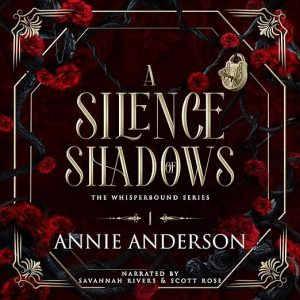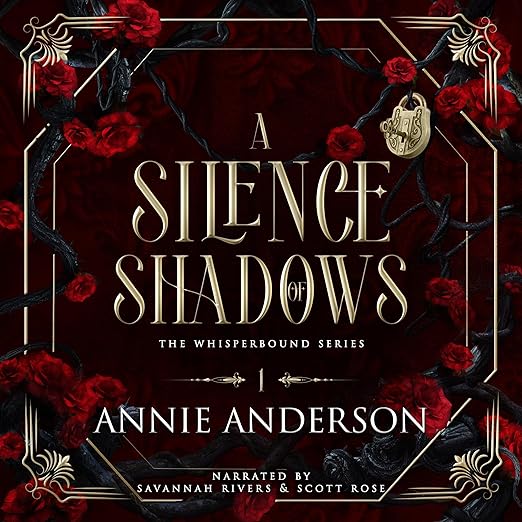
Merrit Locke runs a neutral bar called Lock & Key on the edge of vampire court territory, and the audiobook of Annie Anderson's A Silence of Shadows, narrated by Savannah Rivers, opens with that setup doing a lot of quiet work. Merrit is keeping three things secret: her past, her telepathy, and the fact that she has more power than anyone at the bar has reason to suspect. The novel's central situation kicks in when Prince Kieran Veyne walks through her door and she's forced to act in ways that reveal just enough. Kieran concludes she's a seer, not a telepath, and that distinction becomes the fulcrum on which the entire first book of the Whisperbound series turns.
This is the opening installment in a series described as interconnected standalone novels, which is a useful framing to have before you begin. A Silence of Shadows tells a complete story, but it's building toward a larger world. The series promise of "complete stories linked by blood, magic, and courtly deception" suggests each book will function on its own terms, which is a structurally generous choice from Anderson and one that listeners new to her work will appreciate.
Is A Silence of Shadows Worth Your Time?
The fake relationship architecture here is constructed with more care than the trope usually receives. Kieran doesn't simply announce that Merrit is his lover as a convenience; the lie accretes through a series of tactical decisions, each one narrowing the space between what's being performed and what's becoming real. Because Merrit can hear what people are actually thinking, she has an information advantage that the court doesn't know about, but that advantage cuts two ways. She also knows more about Kieran's interior state than he intends to reveal, and Anderson uses that asymmetry to generate genuine dramatic tension rather than cheap dramatic irony.
The mute heroine element is handled with more intelligence than readers skeptical of the conceit might expect. One reviewer specifically noted that the author avoided making the disability a distraction; Merrit communicates through text, gesture, and the occasional explosive telepathic impression, and Rivers finds ways to convey that the character is always present and always strategizing, even in silence. The mute-plus-mind-reader combination creates a character who is both more isolated and more connected than anyone around her knows.
The audiobook runs nearly eleven and a half hours, which gives the court scenes room to breathe. Anderson's palace of monsters and masks, to use the book's own phrasing, is populated with secondary characters who feel distinct enough to track across the political complications. The slow burn is real; the romantic escalation between Merrit and Kieran is measured, credible, and earns the eventual heat rather than front-loading it. Listeners who find fake-relationship arcs unsatisfying when the emotional foundation is skipped will find that Anderson spends real time on that foundation before the arc resolves.
Savannah Rivers is a strong casting choice for this material. Her interpretation of Merrit's interiority has a careful, watchful quality that suits a character who is always calculating the distance between what she knows and what she can reveal. The court scenes, which require a slightly different register, a sense of performance and social danger, are handled with enough tonal shift that the listener understands Merrit is operating in public mode versus private mode, even when the prose doesn't say so directly. For fans of romantasy narration, Rivers sits in the confident middle range: not the kind of performance that becomes the story itself, but not wallpaper either. That calibration matters in a series structured around interconnected standalone novels; a narrator who establishes tonal consistency in the opener makes each subsequent installment easier to inhabit from the first chapter. Rivers accomplishes that without drawing attention to the effort.
Before You Commit to A Silence of Shadows
The book includes a mature content advisory, and that's accurate. The romantic tension builds across the full runtime before it resolves, but when it does, it does so at a heat level that merits the discretion warning. Listeners who prefer their romantasy on the cleaner side of the spectrum should note that the content advisory is not decorative.
The ancient bond that awakens in the latter half of the book is the element readers either find satisfying or rushed, depending on their patience with destiny-driven romance mechanics. If fated-mate or bond magic is a trope that works for you, it lands with appropriate weight here. If it's a trope you find convenient rather than earned, you may find the final quarter moving faster than the careful setup justifies. The world logic is internally consistent, which helps; Anderson doesn't invent the bond as a plot shortcut so much as deploy it as a consequence of choices already made.
Should You Listen to A Silence of Shadows?
Romantasy listeners who enjoy their fake-relationship arc delivered through court intrigue rather than academy settings will find this one satisfying. The combination of a telepathic mute protagonist, a vampire prince who is more calculating than he initially appears, and a political conspiracy that runs deeper than either of them expected is distinctive enough to hold interest across nearly twelve hours. Listeners who need explicit romantic content to feel the heat will find enough here; those who prefer very slow burns with minimal payoff may feel the balance tips toward spicy toward the end. It works well as an entry point into Anderson's catalog if you haven't read her before.
Quick Take
- Read by: Savannah Rivers navigates the dual-POV structure with clear tonal separation between Merrit's guarded interiority and the wider court scenes; her pacing suits the slow-burn tension well.
- At its heart: Fake relationship turned real, court intrigue and survival, identity secrets in a world of supernatural hierarchies
- Vibe: Dark and atmospheric with sustained romantic heat
- Short version: A Silence of Shadows delivers on the fake-lovers-in-a-vampire-court premise with enough worldbuilding specificity and character friction to distinguish it from the crowded romantasy field.
Does Savannah Rivers narrate the whole audiobook, or are different voices used for the dual-POV sections?
Based on available information, Savannah Rivers narrates the full audiobook. The dual-POV structure is distinguished primarily through the prose register and Merrit's interior access to Kieran's thoughts, rather than through separate narrator casting.
Is this audiobook appropriate for listeners who are sensitive to content involving disability representation?
The mute heroine element is handled with consistent respect and narrative purpose throughout. Merrit's inability to speak is treated as part of her tactical identity rather than as an obstacle to be overcome or pitied. Reviewers who mentioned it specifically noted it was handled well.