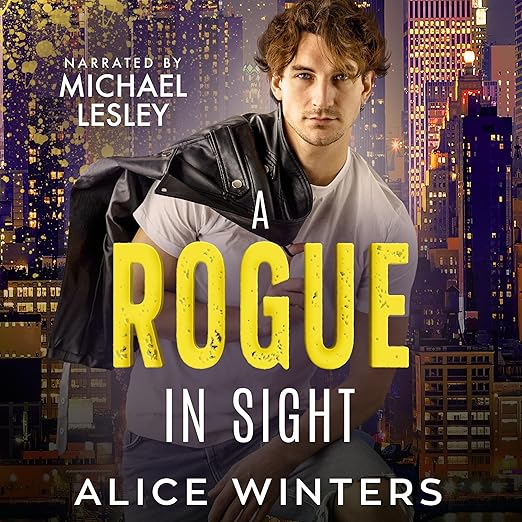
Asmodeus wants to be called a sexy beast. That single line, delivered early in this audiobook, tells you everything you need to know about whether Alice Winters's particular brand of absurdist M/M romance is going to work for you. Either you find yourself grinning at the audacity of it, or you set the thing down immediately. I was firmly in the grinning camp, and over eleven hours and twenty minutes I found myself completely invested in one of the more unexpectedly layered romances I have encountered in this genre in years.
A Rogue in Sight is the third installment in the Vexing Villains series, and I want to be direct about what that means practically: this is not an entry point. Ellison and Deus appear as beloved side characters in the earlier books, and their dynamic only lands with full weight if you have seen them orbit each other in those previous pages. The reviewer who mentioned rereading the first two books before diving in was not being precious about it. That investment pays off substantially when Deus's obsessive certainty about Ellison finally gets the full story it has been waiting for.
What We Made of It
What surprised me most about this book is how dark it gets underneath all the jokes. The synopsis pitches this as a story about a camping trip gone wrong and a target on Ellison's head, which is accurate as far as it goes. But what Winters actually delivers is a dual character study of two men shaped by histories they have spent years performing around rather than confronting. Ellison's aloof persona is not just a personality quirk; it is armor that took real damage to construct. And Deus, for all his performative confidence and hilariously itemized invoice for services rendered at exactly $62,332.69, carries his own weight of unresolved loss. One reviewer noted that the backstories run deep and that both characters went through so much it made you really feel for them. That observation lands accurately. The comedy is real, but it is not a buffer against the emotional content; it is the vehicle for it.
The plot, which involves an invisible assassin Deus genuinely cannot track and a threat that forces both men into sustained proximity, functions well as a mechanism for keeping these two characters in each other's orbit long enough for the walls to come down. The mystery of who has Ellison in their sights is engaging without being the point. The point is watching someone as capable as Deus encounter a problem he cannot solve alone, and watching Ellison learn what it actually costs him to accept help from another person.
Why A Rogue in Sight Works as an Audiobook
Michael Lesley's performance is a genuine asset here. The Vexing Villains series has always leaned on character voice as a primary source of entertainment, and Lesley understands Deus's register immediately: the comic exaggeration, the misplaced confidence, the specific kind of verbal chaos Winters writes for him. But the more interesting work is what Lesley does with Ellison. Prim and controlled on the surface, Ellison's interiority is more muted and harder to access, and Lesley finds a quieter register for those sections that contrasts effectively with Deus's constant noise. The dual-POV structure gives the audiobook format a natural rhythm, each perspective offering a genuinely different sonic texture.
The series has built a genuinely strong ensemble, and A Rogue in Sight benefits from the continued presence of characters readers already know and care about. When established figures from earlier books reappear, there is a warmth to those scenes that rewards accumulated investment. The humor in the dialogue, particularly the running bit about Landon and his dedication to books, operates on a level of silliness that should not work as consistently as it does. And yet it does, every time.
The found-family dimension of the Vexing Villains series is something Winters has built carefully, and this volume makes that community feel fully realized. When the group assembles around the threat to Ellison, the relationships between characters do not feel like plot architecture; they feel like history, which is the hardest thing to manufacture in a series and the thing that makes readers return.
What Might Not Land
One returning reviewer flagged that while the characters and dialogue are strong, the plot can feel thin in stretches. That observation is fair. Winters is fundamentally a character writer, and the narrative machinery of the invisible-assassin threat sometimes recedes into the background when the character work demands the spotlight. If you need your romantic suspense to keep the tension screwed tight throughout, you may notice the slack. But if the draw is watching two emotionally complicated men slowly dismantle their respective defenses around each other, the pacing serves that arc well.
The spice level here sits at a moderate-to-high register, consistent with the rest of the series, and the emotional resolution is fully satisfying. This is a book that gives you the HEA it promises. The humor is a constant presence but never a substitute for the emotional honesty the story earns by its final hours. At 4.7 stars across nearly five hundred ratings, reader consensus is strong, and based on this listening experience, that consensus is well justified.
Who Should Listen to A Rogue in Sight
Read or listen to books one and two in the Vexing Villains series first; the emotional payoff here depends entirely on that foundation. Once you have it, this is a deeply enjoyable eleven-hour experience that delivers on the series' promise of found family, earned romance, and the specific kind of humor only Alice Winters seems able to sustain at length. Listeners who want stripped-down plot efficiency over character richness may find themselves impatient during the slower middle sections. Listeners who love this particular author's brand of chaos held together by genuine heart will find this the best book in the series so far.
- Read by: Michael Lesley brings Asmodeus's absurdist bravado to life with genuine comic timing, and the shift into Ellison's quieter, more guarded register shows real range across dual POVs.
- At its heart: reluctant hero dynamics, found family, trauma and recovery through humor
- Vibe: Chaotic, warm, laugh-out-loud with genuine emotional depth underneath
- Short version: Fans of Alice Winters's particular brand of chaotic M/M romance will find this the richest entry in the Vexing Villains series yet, though newcomers need to start at book one first.