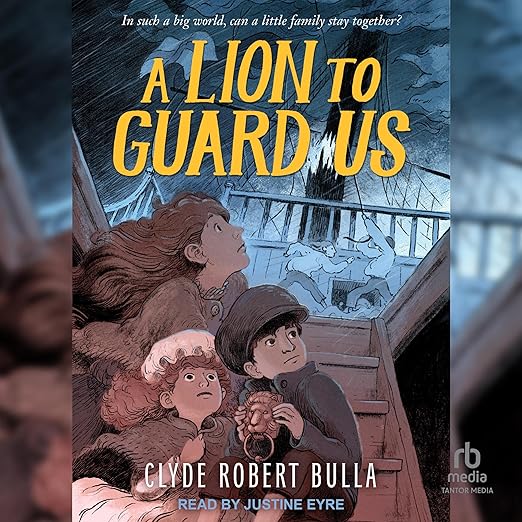
Amanda Freebold makes a decision in the opening pages of Clyde Robert Bulla's novel that most adults would hesitate to make: she resolves to take her two younger siblings across the Atlantic to find a father they haven't seen in three years, to a colony none of them have ever visited, in a world that offers them no guarantee of safe arrival. The audacity of that choice, set against the particular vulnerability of three children alone in 1609 England following the death of their mother, is what gives A Lion to Guard Us its quiet power. Justine Eyre narrates this audiobook, which runs ninety-five minutes and is ideal for family listening in a single sitting or across a few short sessions with younger children.
Bulla's prose was praised by The New Yorker as "top-notch writing," and the craft assessment is accurate. His sentences are short and declarative in a way that feels deliberately calibrated for both his young readership and the emotional uncertainty driving the plot. There is no ornamentation. The story moves like Amanda herself: forward, purposeful, without the luxury of sustained doubt. It is historical fiction stripped to the load-bearing elements, and those elements hold under the weight of real stakes.
Eyre Gives Amanda a Voice Older Than Her Years
Eyre's narration is one of the audiobook's real strengths. She understands that Amanda is not a typical child protagonist. Amanda carries the family after her mother's death, makes decisions about trust on the Atlantic crossing, and maintains composure when adults around her falter. Eyre conveys all of this without making Amanda sound precociously adult or emotionally flattened. The voice she gives to the character is thirteen in body but older in soul, which matches Bulla's characterization precisely. The younger siblings, Meg and Jemmy, receive distinct enough vocal inflections that listeners can track their emotional states without difficulty even at the audiobook's compact runtime. This kind of ensemble differentiation is harder to achieve in ninety minutes than it sounds, and Eyre handles it without drawing attention to the effort.
The brass lion's-head door knocker that gives the novel its title functions as more than a talisman. It is the last tangible connection Amanda has to her father before his absence becomes defining. Bulla handles the object with restraint, neither overloading it with symbolic weight nor letting it disappear between appearances. It surfaces when the story needs it, and Eyre marks those moments with a small but perceptible shift in tone that listeners will register even without being asked to pay attention. Reviewer Val noted that the father leaves his children "a door knocker" before departing for Jamestown, and that object carries the emotional logic of the whole novel compressed into brass.
The 1609 Third Supply Mission to Jamestown
The historical specificity here is genuine and instructive without being pedagogical. Bulla set the novel in 1609, the year of the Third Supply mission to Jamestown, and the conditions he depicts, the Atlantic crossing, the uncertainty of the colony's survival, the hierarchy aboard ship, reflect real circumstances of early settlement. Reviewer "Amazon Customer" described how the story "captures what travel would have been like and the separation of family hoping to make a new start," and that resonance is exactly what makes historical fiction useful for young audiences encountering the period for the first time. Reviewer Val noted that her daughter's third-grade reading project on this book sparked real engagement with Jamestown's history. The audiobook format serves that educational purpose well: Eyre's measured delivery gives young listeners time to absorb period detail without getting lost in it.
Families planning visits to Jamestown or studying the colonial period will find the audiobook a well-timed companion. The story does not romanticize the colonial enterprise or sidestep its hardships. The ocean crossing is frightening. The children do not always know whom to trust. The arrival in America does not deliver immediate resolution. Bulla is honest about difficulty in a way that respects young listeners' capacity to hold complexity, which is a rarer quality in historical fiction for children than it should be.
Emotional Beats Pass Without Much Dwelling Space
At ninety-five minutes, the audiobook moves quickly, and some emotional beats arrive and pass without much dwelling space. Listeners who want to process the children's grief over their mother's death, or the full weight of Amanda's responsibility as head of the family, may find the pacing a little swift. This is not a flaw of Eyre's narration, which is as thoughtful as a short runtime allows, but a feature of the source material. Bulla wrote a novel that trusts young readers to bring their own emotional weight to spare prose, and the audiobook preserves that trust rather than papering over it with interpretive performance.
The novel's third act, Amanda's arrival in the colony and the search for her father, moves with particular speed, and some listeners may find the resolution feels compressed relative to the buildup that precedes it. This is one of those audiobooks where the journey earns considerably more sustained attention than the destination, and setting that expectation appropriately before listening helps. The ending satisfies without fully elaborating, which is Bulla's consistent approach.
Built for Classroom Read-Alouds on Colonial History
This audiobook is the right choice for families with children in the eight-to-twelve range who are studying colonial American history or who enjoy clean historical adventure with a capable, emotionally complex female protagonist. It works well for classroom read-aloud contexts given its runtime and the clarity of Eyre's narration, which allows teachers to pause for discussion without losing the audiobook's momentum. Adult listeners with an interest in early American historical fiction will find it rewarding for the quality of Bulla's prose, even if the runtime leaves them wanting more depth. Those looking for sweeping historical epics or complex period worldbuilding should note that A Lion to Guard Us is short by design, focused tightly on Amanda's perspective and emotional experience rather than broad historical panorama. What it does, it does with real economy and craft.
- Performance: Justine Eyre brings warmth and quiet authority to Amanda Freebold's voice, navigating the dual register of a child narrator carrying adult burdens with sensitivity that serves the historical setting well.
- What it covers: courage under hardship, family loyalty, colonial-era survival
- Feel: Adventurous and emotionally grounded, with a gentle tension throughout
- Our call: Clyde Robert Bulla's lean storytelling and Eyre's steady narration make this a compelling listen for middle-grade audiences and families exploring early American history together.
Is this audiobook appropriate for young children, or is it better suited to older middle-grade listeners?
The novel is typically assigned in grades three through five, and the audiobook works well in that range. The themes of parental absence and the dangers of ocean crossing may require some conversation with younger listeners, but the material is handled with care and age-appropriate restraint throughout.
Does the audiobook version of A Lion to Guard Us add anything to the reading experience that the print version doesn't offer?
Justine Eyre's voice work brings meaningful dimension to Amanda's character, particularly in moments of fear or resolve where Bulla's prose is deliberately spare. Families who have read the print version often find the audiobook reactivates the story's emotional texture in a different and complementary register.