In Brief
- Read by: Sophie Amoss delivers a grounded, controlled performance that keeps Lily's spiral legible and sympathetic, she understands the character's fundamental groundedness even as things fall apart.
- At its heart: Trauma and recovery, community betrayal, the slipperiness of memory
- Vibe: Tense and emotionally immediate, with a domestic thriller undertow pulling throughout
- Short version: A women's fiction novel that earns its thriller elements through character investment, most powerful for listeners who want emotional depth alongside the suspense.
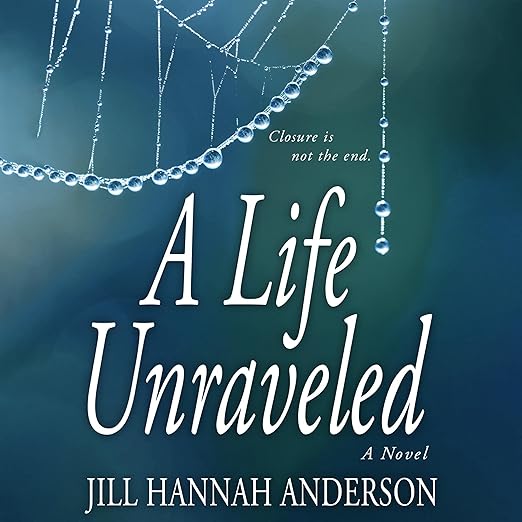
I finished A Life Unraveled on a weeknight, later than I had intended to be awake, because the final quarter of the audiobook made stopping feel genuinely difficult. That is not an automatic endorsement, plenty of books manufacture urgency through withheld information rather than earned character investment, but Jill Hannah Anderson manages something more honest here. By the time Lily Gallo's situation reaches its most precarious point, you care about her not because you do not yet know what happens, but because you have spent nine hours understanding exactly how she got there.
The premise locates itself in a very particular kind of American experience: small town, high school football hero, the ways in which community identity can calcify around a single family or a single narrative until anyone who challenges it pays a price. Lily is a kindergarten teacher and mother of three, happy by any reasonable account, until she is brutally attacked during a morning run. The local football hero is arrested and convicted. And then the community turns on Lily and her family in retaliation, which is where Anderson's novel moves from trauma narrative into something with more sociological bite.
Anderson Refuses to Romanticize Lily's Opioid Slide
Lily's slide into opioid dependency following the attack is the section of the book that could have gone badly wrong in less careful hands. Addiction narratives in popular fiction tend toward one of two failures: romanticization or cautionary moralization. Anderson avoids both. Lily is not glamorized in her dependency, but she is also not condemned, the novel understands that seeking relief from genuine, sustained pain is a human response, and that the specific vulnerability she faces (alone in her suffering, retaliated against by her community, misunderstood by her family) creates the conditions for that dependency with a clarity that feels observed rather than invented.
The moment when Lily endangers her daughters and recognizes what has happened is the novel's emotional hinge. Reviewer Carla S., who called this Anderson's best book, noted that the author "drew me in from the first page and never let go", which is particularly true of this section, where the narrative tension is not about what happens to Lily externally but about whether she can pull herself back from a place she got to through entirely understandable choices. That distinction matters. The stakes are internal and external simultaneously, which is harder to sustain than it sounds.
Amoss Embodies Lily's Controlled Uncertainty
The thriller machinery enters fully in the second half, when the clarity Lily expects from ending her opioid use is replaced by something more disturbing: memory lapses she cannot account for, unexplained events that blur the line between her own unreliability and external interference. Anderson is careful here not to exploit the ambiguity cheaply. The question of whether Lily can trust her own perception, given that she has just spent months altering her consciousness pharmacologically, is a genuine epistemological problem, and the novel uses it with discipline.
Reviewer Rockford's observation that Lily's behavior makes her family, and the reader, "wonder why she's behaving so irresponsibly" is precisely the effect Anderson is after. The reader occupies the same position as Lily's husband Luke: working with incomplete information, unsure how much to trust their own reading of the situation, aware that the truth is somewhere in what they are being shown but unable to locate it precisely. Sophie Amoss's narration is essential to this dynamic. She voices Lily's first-person account with just enough controlled uncertainty that the ambiguity feels embodied rather than imposed from outside.
Community Retaliation Gets Less Room Than It Deserves
The community retaliation element, which is perhaps the novel's most quietly radical move, does not receive as much space as it might, given how much it shapes Lily's situation. Anderson establishes clearly that the family of the convicted assailant has local influence and that the community closes ranks, but the social mechanics of that process could sustain considerably more examination than the novel gives them. This is a choice: Anderson keeps her focus on Lily's interior experience, and the community functions more as environment than subject. For readers who want that social analysis developed, it will feel like an underexplored thread.
Reviewer SexyBeast618, noting questions about whether Luke will ever believe Lily again and why Dalton hates Lily so much, identifies the novel's relationship and mystery threads as its primary engines, and those threads do carry through to an ending described as "surprising." Anderson delivers on the twist without sacrificing the emotional coherence she has built, which is the relevant test.
Moriarty Comparisons Fit This Domestic-Pressure Thriller
Listen if you want women's fiction that takes trauma seriously and embeds it within genuine thriller suspense, if you are drawn to stories about community accountability and what happens when institutions protect the wrong people, or if you enjoyed authors like Liane Moriarty or Lisa Jewell and want a comparable domestic-pressure register. Skip if you want a pure thriller without the emotional depth of the recovery narrative, the opioid arc takes considerable space and is not backgrounded. Skip also if unreliable narration is a dynamic that frustrates rather than engages you; Lily's perceptual ambiguity is central to the second half's effectiveness.
A Few Questions About A Life Unraveled
Is A Life Unraveled primarily a thriller or a character-driven drama?
It is both, with the balance shifting across the novel's length. The first half functions more as a trauma and recovery narrative following Lily's attack and opioid dependency. The second half leans harder into thriller mechanics as Lily's memory lapses and the disturbing events around her raise the question of external threat. Most reviewers find the combination effective.
How does Sophie Amoss handle the unreliable narrator dynamic in the second half?
Amoss keeps Lily's voice grounded and fundamentally rational even as the circumstances around her become harder to read. This is the right choice: an overly theatrical performance would undermine the ambiguity. She voices the uncertainty without performing it, which makes the listener's interpretive uncertainty feel natural rather than manipulated.
Does A Life Unraveled treat the opioid dependency sensitively?
Yes. Anderson avoids both romanticizing the dependency and moralizing about it. The novel presents Lily's slide into opioid reliance as a response to genuine, sustained pain in difficult circumstances, and the recovery is treated with similar honesty, as a process rather than a resolution.
Is this Jill Hannah Anderson's first novel, or part of a series?
A Life Unraveled is a standalone novel, and multiple reviewers note it as Anderson's third book. Several describe this as her strongest work to date, citing the combination of emotional depth and thriller tension as more fully integrated than her previous titles.