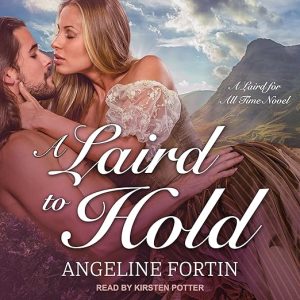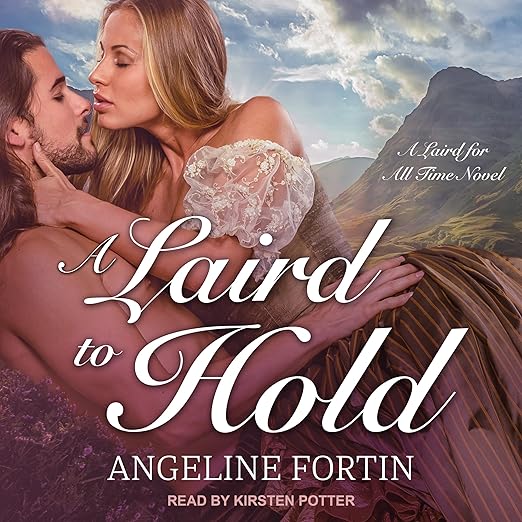
Angeline Fortin spends book five gathering everybody. A Laird to Hold pulls the couples from across A Laird for All Time into one plot, reveals that the meddling Scot called Auld Donell has been browsing through time and tweaking history on all their behalf, then drops the assembled cast into danger from an enemy none of them saw coming. Kirsten Potter reads the nine-hour-and-thirteen-minute audiobook for Tantor Media. The shelf calls this romance, the tag on the same page says Science Fiction, and only one of those is much use to a buyer.
A Closer Look at A Laird to Hold
Scarlett's problem is the practical one. She returns to a century she never expected to see again in order to save an unborn child, and the modern life she left behind was a celebrity life, so reappearing while inexplicably pregnant would set off a media circus she can neither want nor control. Fortin is good at this sort of logistics. The fantasy is time travel and the obstacle is publicity, which keeps the stakes recognizably human.
Running the other direction is the better half. Laird Hepburn spent years enjoying his wife's fantastic tales about the future and never once wanted to see it, and now he has to walk into that alien world to protect his family and his unborn bairn. A man out of his own century meeting this one is a comic engine and a surprisingly tender one, and the book gives it room rather than treating it as a gag.
The pool's most careful account, a five-star from August 2020, names the structural cost of a reunion premise: the first part runs slower because it has to keep everyone straight and show how they connect, and how Auld Donall fits into all of it. That same account reports no option of putting the book down once the critical action starts. Both halves of that judgment are worth carrying in.
What Makes A Laird to Hold Worth Hearing
Slow first act, large cast, one voice. Keeping everyone straight is a page problem and an audio problem, and they are not the same problem. A reader who flips back two chapters to check which Highlander belongs to which century manages it in seconds; a listener cannot. Separating the couples clearly enough that nobody needs to flip is the real assignment in the opening stretch, and it is what will make or break this reading.
Dialect is the second demand. Fortin writes the Scots into the prose, bairn and all, and the cast spans the century the lairds come from and a present-day world of cameras, so a single reader has to move between the two without letting either become a caricature. Nine hours and thirteen minutes is a manageable span for that kind of sustained switching, which matters more here than in a book with one couple and one century.
Ensemble payoff is the real argument for hearing it, though. One five-star, dated 31 January 2018, more than two months before this recording was published, describes a roller coaster of fear for each couple as an unrelenting nemesis works to eliminate them, and takes obvious pleasure in watching a set of historical men react to the twenty-first century. Braided storylines of that kind land differently heard in long sittings than read in fragments.
Things to Know Before Starting A Laird to Hold
Names wobble on this page in a way that will frustrate anybody searching. The description calls him Auld Donell. The longest response calls him Auld Donall. Another five-star calls him Donnell and wishes aloud for a book of his own. Three spellings of one character on a single product page is a trivial thing right up until you try to find out whether the meddling Scot ever got his own volume.
Category is the other oddity. The genre shelf reads romance, which is right, while the tag on the same listing reads Science Fiction, which is a stretch for a Highlander series whose time-travel mechanism is an enigmatic old man rather than any technology. Nothing here will satisfy somebody who arrived through that tag, and the mismatch is worth knowing before the filter does the choosing for you.
Reading order is not optional, and the responses say so without being asked. One five-star from December 2018 describes borrowing the first four volumes through a subscription library and then paying real money for this one because it is the finale, and the same account mentions abandoning an earlier book out of concern that the series was turning explicit before returning to report that it does not. That is a useful double signal about both value and heat level. A four-star from April 2018 carries no body text at all, only a headline calling this a wonderful end and a chance to revisit favorite characters.
Who Angeline Fortin Is Writing For
Readers already several volumes deep will get most from these nine hours, particularly anyone who has wondered how the separate couples relate to each other. The book answers that question directly and then spends its second half putting the answer under threat. A September 2020 five-star puts the appeal plainly: all of the characters come together, and the series has been full of feeling throughout.
Give it a miss if you are starting the series here. The reunion structure that makes this satisfying for returning readers makes it opaque for new ones, and the opening stretch is a roll call rather than an introduction. Nothing in it is difficult, but almost all of it assumes a history you would not have.
One practical note on format. This is a book about connections being revealed, and revelations land better in sequence than in snatches, so three or four decent sittings will serve you better than fifteen minutes at a time. Fortin has spent five books setting up a single answer, and the answer deserves to be heard while the question is still fresh.
In Brief
- Narration: Kirsten Potter takes on a five-couple reunion single-handed, with written Scots on one side of the plot and a modern celebrity world on the other.
- Themes: Time travel as second chances, a matchmaker with a master plan, family survival across centuries
- Mood: Warm, busy and slightly frantic
- Verdict: A satisfying finale for readers who already have the other four behind them, and a poor first meeting with the series.
Questions Listeners Ask
Can the A Laird to Hold audiobook stand alone, or do you need books one to four?
You need them. This is volume five and it works as a reunion, gathering couples from the previous books and revealing how Auld Donell connected them across time. Responses call it the culmination and the finale. Starting here means meeting a large cast mid-story, with an enemy whose grudge was established somewhere you have not been.
Is the Science Fiction tag on this listing accurate?
Not really. The genre shelf says romance and the tag says Science Fiction, but the mechanism moving people through time is an enigmatic old Scot rather than any technology. Expect Highlander time-travel romance with an ensemble cast, and look elsewhere if that tag is what brought you to the page.
Which stretch of the A Laird to Hold audiobook is the slow one?
The opening stretch is deliberately measured, because it has to place every couple before the plot can move, and the pace changes sharply once the threat arrives. Nine hours and thirteen minutes divides comfortably into three sittings, provided the first of them is long enough to get past the roll call.
Why is the matchmaker's name spelled differently in different places?
The description spells him Auld Donell, while two of the written responses spell him Auld Donall and Donnell. Nothing on the page reconciles the three. If you go looking for whether this character ever got a book of his own, search under more than one spelling before concluding that he did not.