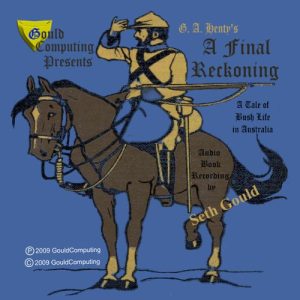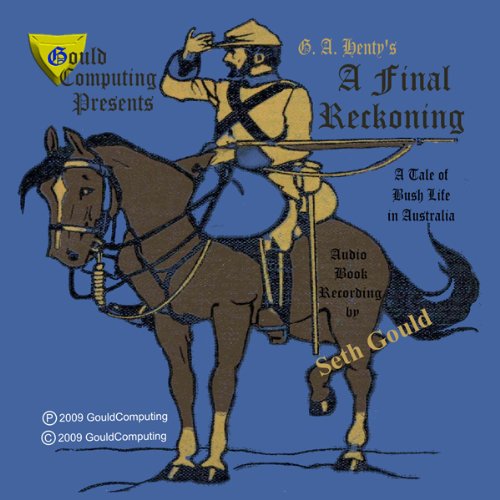
I came to A Final Reckoning the way I often come to older adventure fiction: sideways, through a recommendation from a reader who described it as exactly the kind of story that does not get written anymore. George Alfred Henty was one of the most prolific adventure writers of the Victorian era, producing over a hundred novels aimed primarily at boys but consumed by readers of all ages. This particular title takes his formula, the young Englishman of admirable character tested by frontier conditions, and transplants it to early colonial Australia, where bushrangers, hostile terrain, and unresolved grievances from home provide the obstacles. Seth A. Gould's narration, released through his GouldComputing label in 2010, brings the text to life with the care that this type of project requires.
Reuben is the young protagonist, and he arrives in Australia by way of what the synopsis politely describes as a rather stormy boyhood. He finds employment as an officer in the mounted police and spends the novel demonstrating the qualities that Henty prizes: selflessness, endurance, physical courage, and moral consistency. The adventure is genuine. The frontier conditions Henty describes, bushrangers, the complexity of relations with indigenous Australians, the sheer physical difficulty of colonial life, are rendered with the detail of someone who researched his settings seriously, even if the perspective from which that research is deployed reflects nineteenth century assumptions that contemporary readers will find troubling.
Reading This Aloud to Children Aged Six to Ten
That last point deserves direct address rather than euphemism. One reviewer who read the book aloud to her children, aged six, eight, and ten, was honest that the portrayal of Australia's indigenous people was depicted in a rather harsh and racist way, while noting that the situations of lawlessness described were likely accurate to the historical record. This is the fundamental tension in Henty: the adventure and the historical education are real, but they arrive wrapped in the imperial attitudes of their era. Listeners who approach Henty with this context in hand will find the novel instructive; those who expect a contemporary sensibility will be surprised. Gould does not editorialize, which is the correct choice for a production of historical fiction, but the reader brings their own judgment.
Reuben Is No Cardboard Hero by the End
The quality that multiple reviewers identify in Henty is the thoroughness of his character work. One reviewer noted that Henty develops his characters so thoroughly that the story literally pulled them in across a single reading session. That is the genuine achievement here: Reuben is not a cardboard hero. He has an interior life, his mistakes and hesitations are visible, and the final reckoning of the title, when he faces his old enemy and his own past, arrives with real weight because we have spent enough time with him to care about the outcome. The colonial Australia setting also gives the book genuine historical texture: the hazards of sailing from England, the particular dangers of mounted police work in the bush, and the social geography of a very young settler society are all rendered with specificity.
Clean and Competent Narration, Rooted in Public Domain
The language is Victorian, and the prose reflects the conventions of adventure fiction written for a late-nineteenth century audience. Henty's sentences are long, his moral framework is explicit, and his hero is virtuous in ways that contemporary fiction tends to complicate rather than embrace. Listeners who have made peace with those conventions, and who understand them as historically situated rather than naive, will find the novel engaging. Those expecting modern pacing or ambivalent protagonists will need to calibrate their expectations significantly. The production is clean and the narration competent, but this is not a glossy modern audiobook production; it reflects its origins as a recorded public domain text.
Good History Education, If You Discuss the Limits
This is particularly well-suited for listeners interested in the history of children's and adventure literature, or for families who read Victorian fiction together and have the context to discuss its historical assumptions. Reviewers who have used Henty with children describe it as excellent character and history education, and that framing is accurate if the accompanying discussion addresses the period's limitations. Adult listeners with an appetite for classic adventure fiction and an interest in early colonial Australia will find much to engage with. Those seeking modern action pacing, diverse representation, or morally complicated protagonists should look to other titles.
Common Questions
How does Seth A. Gould handle Henty's Victorian prose style in the narration?
Gould reads with measured clarity that makes the period language accessible without modernizing it. His pacing suits the longer sentence structures of Victorian prose, and he maintains consistent character voices throughout the nearly seven and a half hour production.
What age range is A Final Reckoning appropriate for?
Reviewers have shared it successfully with children from about ten years old, and one reviewer described reading it aloud to children aged six, eight, and ten with success. Adult engagement with the text is consistently reported as genuine rather than dutiful. The content involves frontier violence and the themes of colonial expansion, which benefit from parental accompaniment for younger listeners.