Key Details
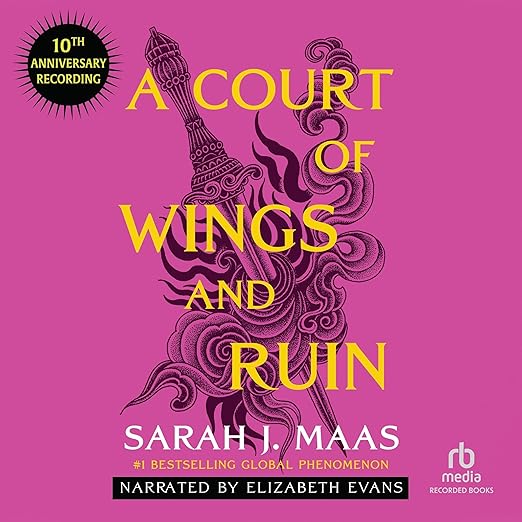
- Narration: Elizabeth Evans was handpicked by Maas for this recording, though not one written note on the page has assessed the result.
- Themes: Espionage inside a former home, fated bonds against chosen ones, war among the High Lords, power earned rather than granted
- Mood: Tense, romantic and increasingly political
- Verdict: The installment where the series turns political, sitting on a listing that cannot decide which book it is selling.
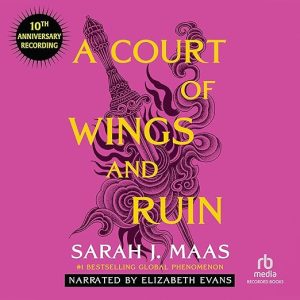
Whoever assembled this description stacked copy for two different novels on top of each other. The first block announces a tenth-anniversary recording of the first book in the series, handpicked narrator and all. The block directly beneath it announces the epic third novel, and everything after that is unmistakably book three: Feyre back at the Spring Court, Tamlin under watch, a war closing in. The series number reads three and the audiobook runs twenty hours and forty-nine minutes. You are buying the third one, but nothing on the page says so without contradicting itself first.
Feyre has returned to the Spring Court to gather information on Tamlin's actions and to learn what she can about the invading king threatening her land, and she has to play a deadly game of deceit to manage it. That premise is why this installment works. The middle stretch of a long fantasy series usually sags, and this one instead plants its protagonist undercover inside the place she spent an entire book escaping from.
Twenty hours and forty-nine minutes is a serious commitment, and the novel earns most of it. War bears down on everyone at once. Feyre works to take her place among the High Fae while balancing magical and political power she does not fully control, and she and Rhysand have to decide which of the cunning and lethal High Lords can be trusted and where allies might be hiding. The length is doing real work rather than padding.
Mates as a convention is where the single four-star note on this page pushes back, and the objection deserves hearing. Writing from a United States storefront in January 2025, that buyer says plainly they do not choose books for the romance and came to the series for the fantasy, admits to loving the central relationship anyway, and still dislikes being cornered by a bond rather than choosing and being chosen. On a series this romance-forward, that is a genuinely useful dissent.
War Politics Take Over, Romance Still Survives
War writing is where this book separates itself from the two before it. The stakes stop being personal and turn political, allies have to be found in unexpected places, and the fate of an entire world rests on control of a single object. Anyone who came to the series for court maneuvering gets more of it here than anywhere else in the run, and the romance survives the shift instead of being crowded out by the armies.
Only one of the five notes here postdates the recording. A five-star from a United States storefront dated October 13, 2025 describes having dismissed the series for years on the assumption it would be cliched, then finding the character work, the world building and the romance all landing at once, and reading far more afterward as a direct result. It is the sole response that could possibly concern this edition.
Elizabeth Evans is the credited reader, and the description makes an unusual claim on her behalf: Maas handpicked her as a friend, for what the copy calls her intimate understanding of the storytelling. Casting is rarely advertised this openly. It is also a real selling point for a series where one voice has to carry twenty hours of court politics, open warfare and intimacy without the register collapsing into any single one of them.
Untested Casting Behind Reviews from Years Earlier
Four of the five notes predate the May 30, 2025 recording. The oldest goes back roughly eight years, two more land one to two years ahead of the release, and the fourth arrives about four months early. Those grades were awarded to earlier editions of the novel and then pooled onto this listing, which means the 4.7 sitting above two hundred and seventy-six ratings is overwhelmingly a verdict on the book rather than on this production of it.
Nowhere in those five notes does anybody mention Elizabeth Evans, the reading, or the audio in any form. On a page that advertises its casting as the headline feature, the omission is worth naming out loud: the one thing this edition offers that an earlier recording did not is precisely the thing nobody writing here has evaluated. Two hundred and seventy-six ratings, and the performance remains completely untested in the visible evidence.
Australia supplied one of the notes and the United Kingdom another, with the remaining three filed from United States storefronts. The entry from Australia, five stars in May 2023, praises the world building as epic and credits the explanations with giving it a fair understanding of the lore and geography, then registers one memorable complaint about a recurring physical description that turned its writer's stomach. It also misspells the title, which hints at how much of this pool is writing from memory.
Evans' Casting Is the Reason to Rebuy
Committed series readers need no persuading and already know whether they are continuing. The more useful recommendation is aimed at readers arriving from adult fantasy who want political maneuvering with a romance threaded through it rather than the reverse arrangement. A five-star note from a United Kingdom storefront in March 2024 reports that the pace, passion and heart-stopping moments have intensified rather than faded by this third book, which is the right reason to keep going.
Purists who dislike the fated-bond convention should know it is load-bearing here rather than decorative. This is also not an entry point under any circumstances: beginning at the third book of a series carrying this much accumulated history would be a mistake, whatever the opening block of copy implies about first books and anniversaries. Anyone sensitive to explicit content should sample as well, because the romance does not recede as the war arrives.
Recorded Books released this in May 2025 with Evans reading, and if you are rebuying the series in audio, that casting is the whole argument for doing it. What I would not do is treat the 4.7 as a verdict on the recording, given that four of the five written notes were filed before it existed. Sample a chapter, decide whether the voice matches the Feyre already in your head, and ignore the muddle at the top of the page.