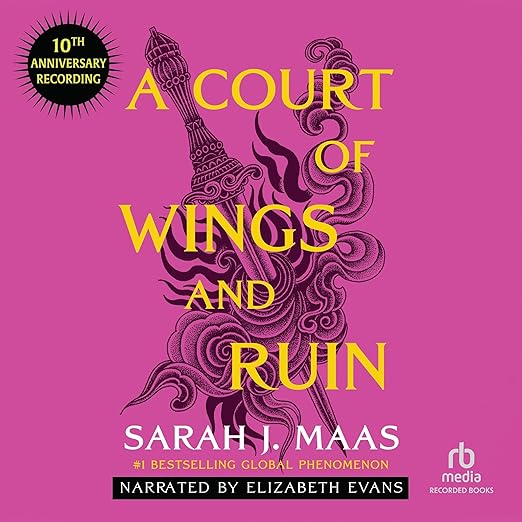
Quick Take
- Narration: Elizabeth Evans maintains the standard she set in Book 2, with the war-council scenes and Feyre’s undercover arc both handled with the control the material requires.
- Themes: war and its costs, political loyalty, the weight of power freely accepted
- Mood: Epic and relentless, occasionally breathless
- Verdict: A satisfying close to Feyre’s arc that expands the world significantly, delivered in the narration version the series now deserves, demanding but rewarding for listeners invested in the world.
There’s a particular kind of pressure that comes with being the third book in a beloved series. The emotional arc of the first two books has done its work: readers are invested, the relationships are established, and the central romance is no longer the unknown quantity it was. A Court of Wings and Ruin has to deliver something larger without undermining what made the earlier books feel intimate. It manages this, though not without cost, the scale necessarily sacrifices some of the personal immediacy that made A Court of Mist and Fury the series touchstone.
The setup deposits Feyre back in the Spring Court as a spy, a role that requires her to perform contentment while gathering intelligence for Rhysand and the Night Court. It’s a genuinely precarious position that Maas handles with more political complexity than the standard fantasy spy plot, partly because Feyre’s emotional history with this place and these people adds a dimension beyond mere information gathering. She knows what she lost here, and what she chose instead, and that knowledge makes every scene in the Spring Court carry weight.
Our Take on A Court of Wings and Ruin
This is a book about war, and Maas commits to treating that seriously. The High Lords’ summit, the alliance-building across hostile Fae courts, and the logistics of fighting an enemy who has already demonstrated the capacity to destroy everything, these occupy more of the narrative than they would in a more romance-forward series entry. Some readers who came primarily for the Feyre-Rhysand dynamic found the political machinery absorbing; others found it slowed the emotional momentum. Both responses are reasonable and reflect genuine differences in what readers want from this world.
One reviewer quoted the novel directly: To the stars who listen, and the dreams that are answered. The line has become associated with the series as a whole, and its presence in this book as a kind of thematic distillation is earned. Feyre’s arc across these three books moves from a girl who survived to a woman who chooses, and A Court of Wings and Ruin honors that movement even as it scales the threat to continent-level stakes.
Why Listen to the 10th Anniversary Recording
Elizabeth Evans’s continuity across the new recording is the central argument for choosing this version. The earlier recordings of this series used different narrators at different points, which created a jarring inconsistency for audiobook listeners moving through the series. Having Evans’s voice carry the full story from ACOTAR through ACOMAF and into ACWAR gives the listening experience a coherence that the previous recordings couldn’t provide. The war-council scenes in particular, dense with character voices, political positions, and emotional stakes, benefit from a narrator who has spent nineteen hours already inhabiting this world.
What to Watch For in A Court of Wings and Ruin
The mates trope comes in for some thoughtful pushback in this book from at least one reader who noted discomfort with the inevitability it implies. Maas is aware of this tension and addresses it through Feyre’s own interiority, though readers who find the concept of fated romantic partners philosophically uncomfortable will bump against it here more than in the earlier books. It’s the kind of narrative choice that asks readers to accept a premise, and those who can’t fully accept it will feel the seams.
Who Should Listen to A Court of Wings and Ruin
This is the third book in a series and functions as a conclusion to Feyre’s arc, start at Book 1 or don’t start at all. Listeners who reached the end of ACOMAF feeling hollowed out by what it demanded emotionally will find this a more expansive but somewhat less intimate experience, which is the tradeoff of scale. Returning series readers who experienced this in an earlier recording should consider the 10th anniversary version for the narration consistency alone. At almost twenty-one hours, it’s a significant investment in a story the series has been building across sixty hours of combined listening, which is exactly what it should be.
Frequently Asked Questions
Does A Court of Wings and Ruin wrap up the ACOTAR series or does it end on an unresolved cliffhanger?
It concludes Feyre’s central story arc satisfyingly. The series continues with additional books set in the same world with different characters, but ACWAR functions as the close of the trilogy that began in Book 1. Most readers consider it a proper ending to this arc.
How does the 10th anniversary Elizabeth Evans recording compare to the earlier ACWAR narration?
The previous ACOTAR series recordings used multiple narrators across different books, creating an inconsistency that audiobook listeners frequently cited as disruptive. Evans’s continuity across the new recordings is a significant improvement for the listening experience.
Does Feyre’s undercover arc in the Spring Court resolve quickly or does it extend through most of the book?
It resolves in the first substantial portion of the book before transitioning to the war-council and alliance-building narrative that dominates the second half. The spy plot is a setup mechanism rather than the book’s central structure.
Is the Rhysand-Feyre relationship still the emotional center of this book, or does the war narrative crowd it out?
The relationship remains present and important, but the war expands the frame significantly. Several reviewers who found ACOMAF overwhelming in its emotional intimacy found ACWAR more manageable; several who loved that intimacy found this one slightly more distant. The balance shifts toward the epic rather than the personal.