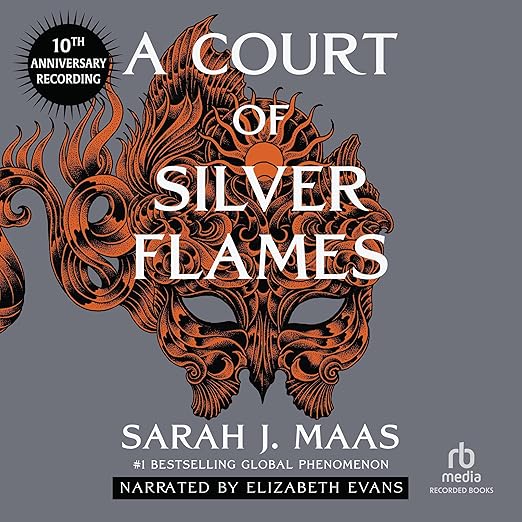
I remember when A Court of Silver Flames came out in 2021 and my social media feeds turned briefly into a wall of caps-lock reactions. Four years later, the 10th anniversary recording, timed to the decade since A Court of Thorns and Roses launched the series, gives it a second wave of attention, and this time with a narrator whom Sarah J. Maas personally selected. That detail matters more than it might initially seem. Elizabeth Evans was not assigned this project; she was chosen because Maas believed she understood the storytelling from the inside. That kind of specificity tends to produce something different from a standard audiobook production.
The story centers on Nesta Archeron, the fiercest and most abrasive of the three sisters whose fates are woven through the series. Where Feyre was the protagonist of the original trilogy, Nesta spent those books being difficult, withholding, and often unkind. A Court of Silver Flames asks why. It turns out the answer involves trauma, shame, grief, and a profound difficulty accepting love from people who refuse to stop offering it. Set against Rhysand and Feyre's Night Court, the book follows Nesta as she is essentially forced into training with Cassian, the battle-scarred Illyrian warrior whose feelings for her have been unresolved across the series, while a new political threat from the human queens of the Continent demands their attention.
Can a Disliked Heroine Earn Your Investment?
The central question this book poses is whether a character readers actively disliked can become a protagonist they invest in. Several reviewers admitted to starting the book with reservations about Nesta and finding themselves genuinely moved by the end. One described struggling with Nesta's behavior through the first half before beginning to understand why she acted the way she did, which is precisely the arc Maas constructed. This is a book about a character who has been using hostility as armor for so long that she has nearly forgotten what she was protecting underneath it.
Cassian, by contrast, had a devoted following before this book even began. Reviewers who described him as their favorite character in the entire series responded to the way he refuses to give up on Nesta when every rational calculation would say to let her go. What Maas does with that devotion, making it the emotional engine of a nearly 23-hour narrative, is ambitious. Whether it fully works depends on your tolerance for slow-burn emotional development over an extended format.
Evans Hears the Cracks in Nesta's Armor
Evans's narration is the primary reason to choose this recording over any previous version. The performance is clearly informed by a real understanding of the characters' emotional geography rather than a straight interpretive reading of the text. She distinguishes between Nesta's public armor and the moments when that armor slips, and she handles the Cassian sections with the warmth that reviewers attribute to the character on the page. At nearly 23 hours, this is a commitment, but Evans keeps the pace alive.
The book also delivers on its action sequences, which involve training montages, political maneuvering, and eventual confrontations with the human queens whose ambitions pose a threat to the fragile peace following the war with Hybern. Maas structures the external conflict to mirror the internal one, both Nesta and the broader world of the Fae are in a post-war state of trauma and reconstruction. That structural parallel gives the book more coherence than pure romance-with-action would.
Adult Romance Content Beyond the YA Shelf
This book is not a standalone. It is part of the ACOTAR series and rewards listeners who have followed the earlier volumes closely. Feyre, Rhysand, Elain, Azriel, and the wider Night Court appear throughout, and their dynamics carry weight that will be partially opaque to anyone who has not read the prior books. The relationship between Nesta and Feyre especially requires series context to land with its full emotional force.
Maas writes with explicit romantic content at certain points, which the audio delivers directly. This is a book that has been categorized as new adult and adult romance rather than young adult, and listeners who prefer a more restrained approach should account for that.
This Casting Choice Rewards Longtime Readers
For anyone who has already read or listened to the ACOTAR series, this is the recording to use. Evans's narrator selection is not incidental; it is a genuine creative choice that enhances the material. New listeners should start with A Court of Thorns and Roses rather than jumping in here. Listeners who want fantasy without explicit romantic content should look elsewhere in the genre.
A Few Questions About A Court of Silver Flames (10th Anniversary Recording)
What makes the 10th anniversary recording different from the original audiobook release?
The primary difference is the narrator. Sarah J. Maas personally chose Elizabeth Evans, described as a friend with an intimate understanding of the storytelling. This is a newly recorded performance, not a remastered version of an earlier production.
Is this book accessible without having read the earlier ACOTAR volumes?
Not really. Nesta's arc depends heavily on her established history across the prior books, and supporting characters like Feyre, Rhysand, Cassian, and Elain carry relationship dynamics that require series context to fully land.
How does Elizabeth Evans handle the dual POV between Nesta and Cassian?
Evans distinguishes between the two perspectives clearly, bringing a controlled edge to Nesta's chapters and more warmth to Cassian's. Reviewers noted the performance feels personally invested rather than professionally neutral.