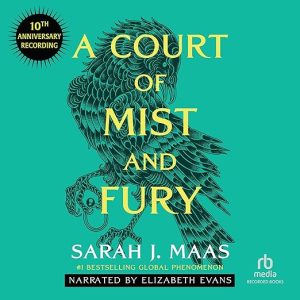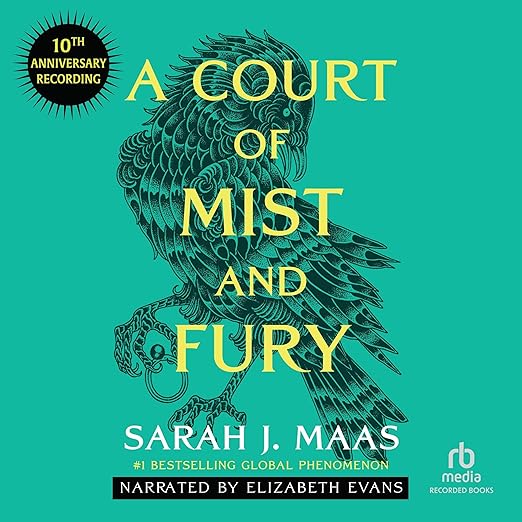
Recorded Books issued this new reading for the tenth anniversary of the series, and the audiobook's own description cannot decide which volume it is selling. Its opening line announces the anniversary edition of the first book in the Court of Thorns and Roses sequence. The very next line calls the same product the sequel. The listing says installment two, and the story underneath is unmistakably the second one: Feyre after Under the Mountain, a bargain owed to Rhysand, a wedding to Tamlin coming closer every chapter.
Ianthe Turns Irritant While Feyre's Damage Shows
Taylor Hathcock makes the strongest case anybody here makes, and it is the standard case among readers of this series: the opener is the perfect first book, but this is the best one. The reasoning is specific rather than enthusiastic. This volume is where the damage done Under the Mountain gets shown properly, with Feyre visibly struggling, a Tamlin who stays oblivious to it, and a newly arrived Priestess named Ianthe turning into an active irritant rather than a plot device.
Its own description does not disguise that shift. Feyre has the powers and the lifespan of the High Fae and is hollowed out by nightmares, split into two people: one honoring the bargain with the High Lord of the Night Court, the other performing a life in the Spring Court. That is a novel about aftermath, and aftermath is a genuinely different form from the trial narrative that preceded it. Readers expecting the same shape of story usually notice within an hour.
Where the series earns its reputation is in what the book does with that split. A dark web of politics and passion sits on one side, a greater evil gathering on the other, and the protagonist has to become powerful enough to matter to either without dissolving in the process. The romance is not decoration on that structure. It is the mechanism by which the loyalties get reorganized, which is why arguments about this installment run so hot among people who otherwise agree about everything else in the sequence.
Evans Was Handpicked as the Author's Friend
Ashleigh B's five-star, written in November 2025, describes exactly the effect the book aims for: a sequel that is darker and richer than the original, with everything the first volume did turned up several notches, and an atmosphere the response calls suffocating in the best possible sense. It also reports being unable to stop, which for a novel of this length is the practical recommendation most buyers are looking for.
Unusually, the sales copy explains its own casting. Elizabeth Evans was handpicked by the author, described there as a friend, chosen for an intimate understanding of how these stories work. Product pages almost never tell you why a particular reader got a particular book, and knowing it is genuinely useful. It is also worth naming precisely what that information is: an account of how the voice was selected, not an assessment of what she does across nineteen hours and thirty-five minutes.
A re-recording exists for a specific buyer, and it helps to know whether that buyer is you. Nobody commissions a new reading of a ten-year-old novel for people who have never read it, because the story has been available all along. The pitch here is the performance, aimed squarely at readers who already own the paperback, have reread it more than once, and want a reason to go through it again with something new attached.
Nine-Year-Old Reviews Rated on a New Recording
Read the dates before you read the reviews. Tracy @ Cornerfolds posted a glowing five-star in May 2016, and it describes preordering a copy, receiving it in the mail, and deliberately reading slowly to make it last, with a full year still to wait for the final volume. That is a review of a printed copy that arrived in the mail nine years before this recording existed. The pool attached to this listing was inherited wholesale, so the average speaks to the novel and says nothing whatsoever about the production you would be buying.
Two more of the five responses have nothing to do with the story. A January 2026 note filed from Japan reports that the item was in good condition and that the buyer will order again. A November 2025 note filed from Sweden is a single line explaining, in Swedish, that it was bought for a daughter who is pleased with it. Both carry five stars, and both feed the 4.8 average across 294 ratings. Subtract them and three responses remain that engage with the book at all.
Then a shelving note worth a moment. This listing sits under teen and young adult as well as romance, while the copy sells the sequel as seductive and the series as sexy without qualification. Those two signals point in different directions, and a page that markets on heat while filing under adolescent readers is not giving a gift buyer enough information. Check the content level against the recipient rather than trusting the category.
Filed as Teen Fiction, Sold as Seductive
The natural audience is returning readers: people who finished the first book, know what happened Under the Mountain, and want the aftermath delivered in a voice the author selected for the purpose. It also suits anyone who prefers romance that rearranges a character's allegiances over romance that simply resolves them, and anyone who enjoys watching a protagonist rebuild after the plot has broken her. Listeners who came to the series through recommendations rather than through the first book should still go back one step, because this is the volume that converts casual readers into the kind who argue about it for a decade, and the conversion only works if the groundwork is already in place.
Do not start here, whatever the first line of the description implies, because half the emotional weight depends on knowing what was survived before page one. Give it a pass if the trial-and-quest energy of the opener was the appeal, since this volume trades that for politics and interiority. And weigh the explicit content honestly before buying it for a younger reader.
Ten years on, the reason to choose this particular recording is the voice the author picked personally, and this page explains that decision more thoroughly than it explains anything else about the edition.
In Brief
- Narration: Elizabeth Evans was handpicked by the author for this anniversary re-recording, described in the copy as a friend with an intimate grasp of the storytelling.
- Themes: Trauma and its aftermath, a bargain that splits a life in two, power rearranging where loyalty sits.
- Mood: Feverish, seductive, wounded.
- Verdict: The installment most readers call the best in the sequence, in a reading commissioned specifically to do it justice.
Before You Listen
Is this audiobook the first book in the series or the second?
The second, without ambiguity. The description opens with a line written for the anniversary edition of the opening novel, which appears to be boilerplate pasted above copy for the sequel. Everything below it, the plot summary, the series numbering and the events referenced, belongs to the second installment.
Why was this novel recorded again after ten years?
It was produced to mark the sequence turning ten, with a reader chosen personally by the author rather than assigned by a studio. That makes the edition a proposition aimed at people who already know the book: the story is unchanged, and the reason to buy is the specific voice attached to it.
Do you need to have read the first book before this audiobook?
Yes. The novel opens with its protagonist already damaged by events that happened in the previous volume, already bound by a bargain made there, and already engaged to a character whose behavior only makes sense with that history. Starting here means watching consequences without having seen any of the causes.
How explicit is the content?
The publisher's own language is the clearest guide: the series is marketed as sexy and this volume as seductive, and passion is named as one of its three organizing elements. Expect romance written for adult readers, and treat the young adult classification on this page as a filing convenience rather than a content rating.