Quick Take
- Narration: Elizabeth Evans was personally selected by Sarah J. Maas and it shows, her intimate understanding of the material translates into a performance that feels authored rather than hired, with the Feyre-Rhysand dynamic landing with particular force.
- Themes: trauma and recovery, the difference between safety and love, finding power in unexpected places
- Mood: Emotionally consuming and expansive
- Verdict: Widely considered the strongest book in the ACOTAR series, now in a narration that honors what the text demands, this is the definitive way to experience it for both returning readers and newcomers.
I came to A Court of Mist and Fury having already heard from approximately everyone who reads romantasy that it was the best book in the series, possibly the best book in the genre, certainly the book that changed how they thought about certain things. This level of accumulated expectation usually guarantees disappointment. It didn’t, which tells you something about what Sarah J. Maas achieved in this second volume.
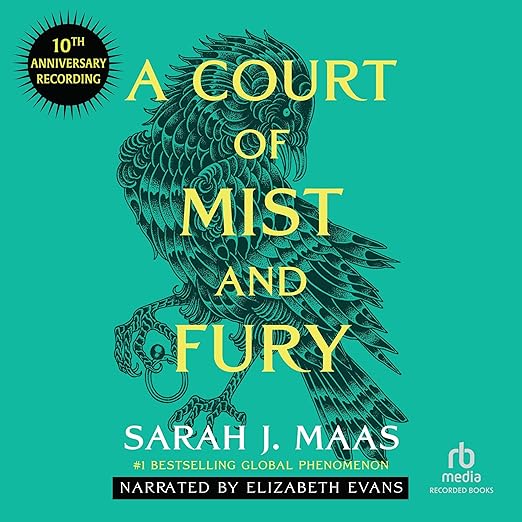
The setup requires some knowledge of Book 1, which is why this 10th anniversary recording matters doubly, it pairs with the newly recorded A Court of Thorns and Roses edition that uses the same narrator, creating a consistent listening experience across the full series. Feyre, now granted Fae powers and lifespan after the ordeal Under the Mountain, is broken in ways that Tamlin cannot see and refuses to address. Her marriage approaches. Her nightmares don’t stop. And once a month she vanishes into the Night Court under an old bargain with Rhysand, the High Lord she was taught to fear.
Our Take on A Court of Mist and Fury
Maas’s structural gamble in this book is telling a story about a woman discovering, slowly and with considerable resistance, that the life she thought she wanted is wrong for her. It’s not a comfortable narrative, the Spring Court, Tamlin, and the apparent safety they represent are indicted gradually enough that readers who loved Book 1 are invited to reconsider their attachments alongside Feyre. Several reviewers specifically praised how Maas handled the PTSD aftermath of the Under the Mountain events: not as a complication to be overcome before the real story starts, but as the central problem that shapes everything that follows.
Rhysand is the character who generates the most intense reader responses, and his treatment here is the source of the book’s enduring reputation. He arrives as an antagonist in Book 1 and is revealed here in a way that requires Feyre, and the reader, to revise everything assumed earlier. It’s a careful piece of plotting, and it works because Maas seeds the revision with enough retrospective evidence that the recontextualization feels earned rather than arbitrary.
Why Listen to the 10th Anniversary Recording
Elizabeth Evans was not assigned to this project; she was chosen personally by Maas on the basis of an intimate understanding of the storytelling. That’s an unusual degree of authorial involvement in casting, and the result reflects it. Evans’s Feyre has the right interiority, she reads the internal voice with a quality that distinguishes between Feyre’s performed composure and her actual emotional state, which is essential for a first-person narrator who spends much of the book carefully not saying what she’s thinking. Her Rhysand is where the narration becomes something exceptional: the character’s combination of power, wit, and concealed tenderness requires precise tonal management, and Evans finds it.
What to Watch For in A Court of Mist and Fury
At nineteen and a half hours, this is a long listen that does not waste much time. The Night Court sequences, the Inner Circle characters introduced here, and the political machinery of the Fae world are all established with a confidence that suggests Maas had the full series planned rather than discovering it as she went. Readers who come to the book wanting primarily fantasy world-building and politics will find those elements well-developed; readers who come primarily for romance will get that too, but built on a foundation of genuine emotional consequence rather than surface tension.
Who Should Listen to A Court of Mist and Fury
The 10th anniversary recording is the recommended version for everyone, new readers and returning ones. The narration consistency across the series matters more with each passing book, and Evans’s performance in this volume is reason enough to start fresh even if you’ve heard previous recordings. New listeners should start with A Court of Thorns and Roses first, this is not a book that functions without its predecessor. Those who read Book 1 and found it competent but not transformative should continue: ACOMAF is the book that most readers cite as the series pivot.
Frequently Asked Questions
Should returning ACOTAR readers re-listen in this new 10th anniversary recording or is it primarily for new listeners?
Both, genuinely. The Evans narration adds a dimension to the text that previous recordings didn’t provide, she was selected by Maas herself for this specific reason. Fans who consider ACOMAF a defining read have reason to return.
Does this book handle Feyre’s trauma from Under the Mountain with care, or is it resolved quickly to move on to the romance?
With genuine care. Multiple reviewers specifically praised this as one of the book’s strengths, Maas treats the trauma as the central problem of the novel rather than a backstory element. It shapes every major relationship decision Feyre makes.
How does Elizabeth Evans handle the shift between Feyre’s internal voice and the various characters she interacts with in the Night Court?
Very well. The Inner Circle, Cassian, Azriel, Morrigan, Amren, each has a distinct presence in Evans’s performance, and the shift from Tamlin’s Spring Court to Rhysand’s Night Court is audible in how she modulates her delivery. It’s skilled ensemble voice work across a long runtime.
Is A Court of Mist and Fury self-contained, or must listeners immediately continue to Book 3?
The central arc of this book resolves satisfyingly. There is a war threat that continues into Book 3 and relationships that develop further, but ACOMAF has a genuine emotional conclusion. It is not a cliffhanger in the way that some series books are.