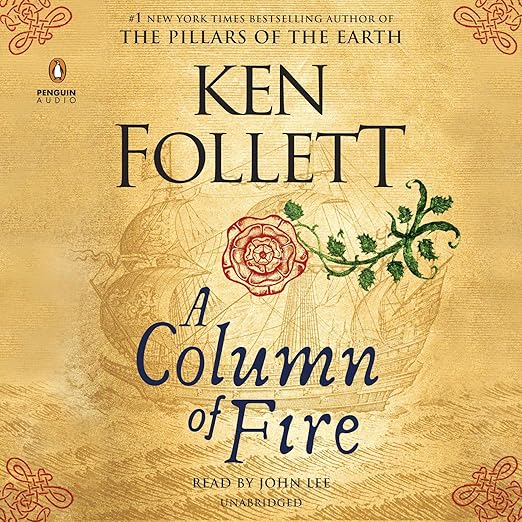
In Brief
- Narration: John Lee has been the voice of the Kingsbridge series from the beginning, and his ability to differentiate the sprawling cast across thirty hours of Elizabethan political drama is a genuine technical achievement.
- Themes: Religious tolerance versus fanaticism, espionage and statecraft, enduring love across divided allegiances
- Mood: Dense and sweeping, with a spy thriller's pulse beneath the historical panorama
- Verdict: Follett's most politically urgent Kingsbridge novel, the religious conflict at its center feels less like history than a recurring human problem, and that friction gives the story its staying power.
Thirty hours of audio is a serious commitment, and I thought carefully before starting A Column of Fire. I had read The Pillars of the Earth years ago and knew what Follett's historical novels demanded: patience with large casts, tolerance for plots that span decades, and a willingness to invest in characters you know will age and die within the same book. I started this one during a long drive, switched to earbuds in the evenings, and finished it over ten days. That is how you approach Follett: as a sustained companionship rather than a sprint.
A Column of Fire is the third novel in the Kingsbridge series, though it shares geography and DNA with Pillars of the Earth and World Without End rather than direct characters. It is set in 1558, the year Elizabeth I begins her reign, and the story belongs to Ned Willard, a young man from Kingsbridge who goes to work for the future queen and eventually helps build England's first intelligence network. The woman he loves, Margery Fitzgerald, is on the other side of the Protestant-Catholic divide that is tearing Europe apart.
The Verdict, Briefly
What Follett understands about historical fiction that many practitioners miss is that the ideological conflicts of the past are most compelling when rendered as personal costs. He does not ask you to care abstractly about the Reformation; he asks you to care whether Ned and Margery can find any version of a life together while the world around them demands that they choose sides. The result is that the theological battles, the Huguenots in France, the Spanish Inquisition, the plots to replace Elizabeth with Mary Queen of Scots, feel urgent rather than academic. One reviewer noted Follett's eye for how things worked in the period; the mechanics of sixteenth-century espionage are rendered with particular care, and the novel's depiction of Elizabeth's intelligence operation is vivid and plausible.
Why A Column of Fire Works as an Audiobook
John Lee has narrated the entire Kingsbridge series, and at thirty hours he faces a challenge few audiobook narrators encounter: differentiating a cast that spans multiple countries and fifty years of story time. He manages it through a combination of disciplined vocal restraint and genuine tonal variety. The villain of A Column of Fire, a fanatical Catholic who will sacrifice any life to impose orthodoxy, is among the most convincing antagonists in the series, and Lee finds a voice for him that is cold without being cartoonish. The love scenes between Ned and Margery are handled with comparable care, tender rather than saccharine, which matters over thirty hours.
Points to Consider
The novel's explicit argument, that the real enemy is not any religion but the impulse to impose belief by force, is stated clearly at the outset and demonstrated throughout. Readers expecting historical neutrality may find the thesis too legible. I would argue Follett earns the clarity: the history he is dramatizing is precisely the history of what happens when tolerance loses to absolutism, and making that argument subtly would serve neither the material nor the reader. The scale does create one genuine challenge: with multiple POV characters across England, France, the Netherlands, and Scotland, some storylines receive more investment than others. A few threads feel like obligations rather than interests. But Follett has always written at panoramic scale, and the trade-off is part of the experience.
Who Should Listen to A Column of Fire
If you have completed The Pillars of the Earth and World Without End, this is exactly what you want next. Listeners new to the Kingsbridge series can start here, the novels share a setting and thematic concerns but not characters, though the emotional payoff of Follett's worldbuilding accumulates across all three books. Skip it if thirty hours of Elizabethan political and religious history feels like a sentence rather than a pleasure. This is a novel for readers who want their historical fiction immersive and their villains properly monstrous.
How does John Lee's narration handle the international scope, French, Spanish, and Scottish characters alongside English ones?
Lee navigates the multilingual cast through consistent vocal differentiation rather than exaggerated accents. Reviewers consistently praise his ability to keep the sprawling cast distinguishable across thirty hours without caricature. It is one of the more technically demanding performances in the Kingsbridge series.
Is A Column of Fire more of a romance or a historical thriller?
Both, in roughly equal proportion. The love story between Ned and Margery provides the emotional spine, while the espionage and political conspiracy provide the plot engine. Readers who bounced off the romantic elements in Pillars of the Earth may find A Column of Fire's spy-thriller elements a useful counterweight.
Where does A Column of Fire sit in publication order versus reading order for the Kingsbridge series?
In publication order it is the third Kingsbridge novel, after Pillars of the Earth (1989) and World Without End (2007). Chronologically within the series, The Evening and the Morning (2020) serves as a prequel set in 997 CE, predating all three. Any order works for a new reader, but publication order is the most common recommendation.