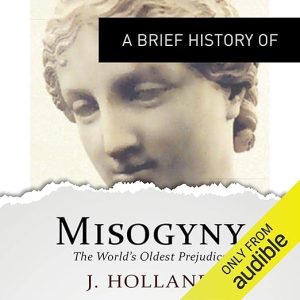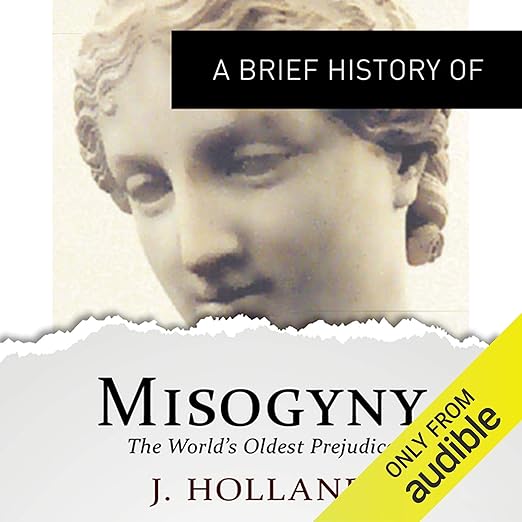
Jack Holland delivered this manuscript to his publisher and died of cancer in 2004, just weeks later. He never heard it become an audiobook, never saw it assigned in university courses, never received the letters from readers describing it as one of the most important books they had encountered. That biographical fact matters to how you receive the text, not because it should inflate your assessment of it, but because it provides context for the tone. Holland writes like a man who has decided to say exactly what he means, without hedging for a hostile reception.
I came to this one through a recommendation from a colleague who teaches Gender Studies and described it as the book she gives students who arrive with defensiveness already in place. That framing stuck with me as I listened. Holland's approach is deliberately non-polemical, but that restraint is not the same as neutrality. He has a clear argument, he just makes it through evidence and historical sequence rather than through rhetorical pressure.
The Verdict, Briefly
Holland's central question is enormous: how do you explain the systematic oppression of half the world's population by the other half across virtually every civilization in recorded history? What he refuses to do is answer it with ideology. He does not reach for a single explanatory framework and apply it to every era. Instead he moves through the Church, witch trials, Enlightenment philosophy, Nazism, and contemporary developing-world crises, showing how misogyny adapts to different cultural containers while maintaining certain structural consistencies.
The result, as reviewer George Desnoyers noted in placing it alongside Uta Ranke-Heinemann's Eunuchs for the Kingdom of Heaven on a short list of all-time favorites, is something that reads as scholarship without requiring scholarly credentials to absorb. Holland's journalism background keeps the prose from calcifying into academic distance. He understands that the most effective way to make readers confront something they may not want to look at is to make the looking itself engaging.
The Best Parts of A Brief History of Misogyny: the World's Oldest Prejudice
Cameron Stewart's narration suits the material well. He reads Holland's prose with a measured, serious quality that respects the subject without making it feel funereal. For nine hours and forty-two minutes of historical and sociological argument, the question of pacing and vocal variety matters considerably, and Stewart never lets the material become monotonous even when it is at its densest.
The book's argument that the treatment of women constitutes a human rights abuse on an unthinkable scale lands with more force as an audiobook because Stewart delivers the culminating statements without inflection that would soften them. Holland's conclusion is blunt, and the narration honors that bluntness.
Points to Consider
Reviewer Sharon Robideaux, who teaches Gender Studies, raised a substantive criticism worth noting. Holland, for all his analytical rigor, occasionally reveals assumptions of his own era around femininity and beauty that sit oddly against the book's overarching argument. She found his reference to women's relationship with makeup and beauty parlors as though it were a natural female concern rather than a culturally constructed one to be a revealing lapse. It is a minor thread in the larger tapestry, but it is real, and it suggests Holland was not entirely outside the cultural water he was analyzing.
The book was published in 2005 based on research completed before Holland's death in 2004. Some sections addressing contemporary issues will feel dated by now, particularly around digital dimensions of misogyny that did not exist in that form when the book was written.
Should You Listen to A Brief History of Misogyny: the World's Oldest Prejudice?
This is for readers who want historical perspective on gender inequality rather than contemporary policy argument, and who can engage with uncomfortable material presented as scholarship rather than advocacy. It works in academic settings, as the course adoption confirms, but it is equally suited to general readers who want an entry point into these questions that is rigorous without being exclusionary. Readers who already have deep familiarity with gender studies literature may find it covers familiar territory, but Holland's synthesis and his ability to connect the dots across civilizations gives even well-read listeners something to think with.
Quick Take
- Read by: Cameron Stewart delivers the material with measured authority, letting the historical evidence carry the weight rather than editorializing.
- At its heart: Historical and contemporary misogyny, religion and patriarchy, human rights framing of women's oppression
- Vibe: Scholarly and sobering, with the kind of clarity that makes difficult material approachable rather than overwhelming
- Short version: A serious, unusually well-balanced survey of misogyny across civilizations that earns its reputation as genuinely illuminating rather than merely confirmatory.
Is this book written from a feminist ideological position, or does it try to maintain analytical distance?
Holland explicitly frames it as a departure from what he calls feminist polemic, presenting the case through historical evidence and human rights language rather than through ideological advocacy. That said, the argument itself is unambiguous about the scale and severity of women's oppression.
How does the book handle religious institutions as drivers of misogyny without becoming anti-religious?
Holland examines the Church and other religious structures as historical actors whose doctrines and practices shaped women's status, but he is analytical rather than prosecutorial. He follows the evidence where it leads without editorializing toward a conclusion readers have not yet arrived at themselves.
Does Cameron Stewart's narration add anything specific to the listening experience compared to reading the text?
Stewart's measured delivery helps the book's cumulative argument build without becoming emotionally overwhelming. His restraint matches Holland's own tone and keeps the material accessible across the full nine-plus-hour runtime.
Is the book's analysis limited to Western civilization, or does it address misogyny globally?
Holland covers centuries and multiple continents, including the contemporary developing world where, he argues, women face compounded risks from religious radicalization, war, and disease. It is genuinely global in scope, not limited to the Western tradition.