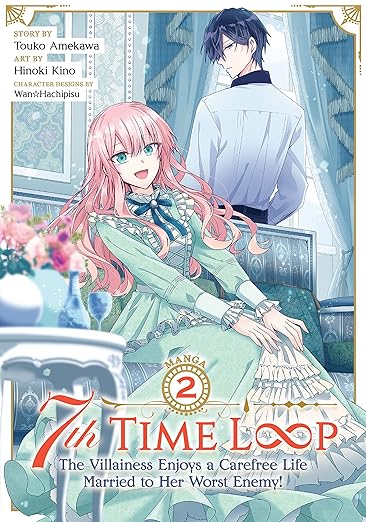
I picked up the 7th Time Loop manga series after watching the anime adaptation, and I will be honest about that sequence: seeing Rishe and Arnold's dynamic animated before reading their story on the page changes how you hear Sarah Gage's narration. But it also confirms something that matters about this series. The central relationship has enough substance that it survives translation across multiple formats without losing the quality that makes it interesting. Volume two deepens that substance.
The setup, for those arriving fresh, is that Rishe Irmgard Wesfalt has lived through six previous loops of her life, each ending at age twenty under different circumstances. In each loop she has accumulated a different skill set: she has been a merchant, a knight, a healer, and a pharmacist, among other things, which means she arrives in the seventh loop as a woman with a practical competence that makes her genuinely formidable despite appearing to be just another noblewoman. In this loop she has been engaged to Arnold, the crown prince of Galkhein and the man who killed her in a previous life. Her goal is to prevent the war she knows is coming. Volume two picks up the strategic challenge of how she manages that from within the royal villa, specifically through the improbable mechanism of training handmaidens.
The Review
The handmaiden training plot is one of those narrative choices that only works if you fully commit to it, and Touko Amekawa commits completely. Rishe's logic is coherent: she needs allies who can move through spaces she cannot, who have skills she can develop, and who will be loyal to her rather than to the institutional power of the court. The humor of the situation, which several reviewers describe as one of the series' defining qualities, comes from watching a woman with six lifetimes of experience apply military-level strategic thinking to the selection of household staff.
Arnold remains the more opaque of the two leads in this volume, which is the right choice. His attraction to Rishe is established through observation rather than declaration, and Amekawa is careful not to resolve the central tension of what he actually knows or suspects about her foreknowledge too quickly. Reviewers describe the Rishe and Arnold dynamic as beautiful, and volume two maintains the quality that makes it work: they are both operating with incomplete information about the other, and the romance develops in the gap between what each knows and what they reveal.
Sarah Gage's narration is particularly well-suited to the series' blend of practicality and warmth. Rishe is not a dreamer; she is an extremely organized woman who has spent multiple lifetimes figuring out how the world works and is now applying that knowledge systematically. Gage plays that quality without letting it become cold. The result is a protagonist who feels genuinely competent rather than conveniently capable, which is a harder distinction to maintain in narration than it sounds.
The world-building in volume two expands in productive directions without losing the relatively intimate scale that makes the series work. We learn more about the political geography of Galkhein and the forces driving it toward war, which gives Rishe's prevention project more specific obstacles to work against. The handmaiden training strand, while primarily comic, also functions as a demonstration of how Rishe thinks about structural problems, which makes her more interesting as a strategic actor in the larger plot.
Before You Commit to 7th Time Loop
This is emphatically a continuation rather than a standalone volume. Arriving here without volume one will mean missing the establishment of the central relationship, the explanation of Rishe's looping mechanic, and the specific texture of her accumulated knowledge. The narrative assumes you know who these people are and what they are to each other. Listeners who have not read volume one should begin there.
The volume is also relatively short at under 200 pages in print, which means the audio runs just over seven hours. Readers accustomed to the density of Western fantasy may find the pacing light and the chapters brief. This is a function of the shoujosei manga adaptation format and the source material's conventions rather than a failing of the audio production, but it is worth knowing that this is not an immersive doorstop in the tradition of Western secondary-world fantasy.
Who It's For
Listeners who have already committed to the series after volume one will find this a satisfying continuation that expands the world and deepens the central relationship without resolving it prematurely. It is also a reasonable entry point for listeners who have already seen the anime adaptation and want to experience the source material in audio form. Skip it as a starting point if you have not read volume one, and approach with adjusted expectations if Western high fantasy length and density are your baseline for the genre.
How does Sarah Gage's narration handle the contrast between Rishe's competence and the series' light comedic tone?
Gage plays Rishe's strategic intelligence straight rather than broadly, which is the right call. The humor comes from the situation rather than from exaggerated performance, and Gage's warmth keeps Rishe from reading as cold despite her accumulated lifetimes of calculated decision-making.
Does the romance between Rishe and Arnold develop significantly in volume two?
The relationship deepens through observation and implication rather than declaration. Arnold's attraction is demonstrated through his attention to Rishe rather than explicit statements, and Amekawa deliberately maintains the information asymmetry between them. This is slow-burn development that rewards patience rather than providing rapid emotional payoff.
Is the 7th Time Loop audiobook format an adaptation of the manga or the light novel?
The audiobook adapts the manga, which is itself an adaptation of the original light novel. The manga format gives the story its relatively brief chapters and intimate scale. Listeners familiar with the anime adaptation will find the content familiar, while the audio provides a different experience of the same material.