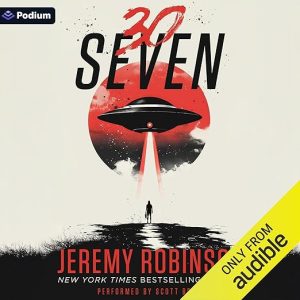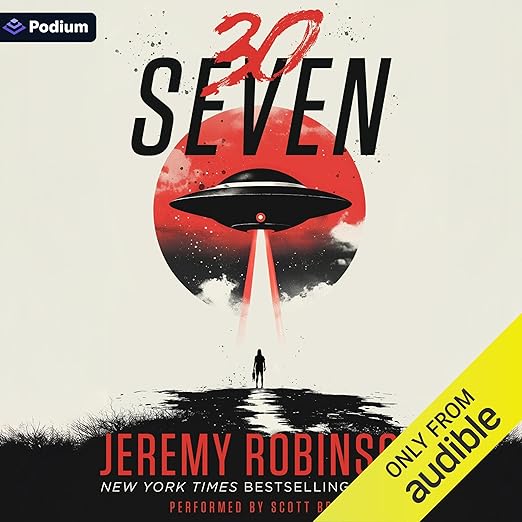
I finished 30Seven on a Saturday night when I probably should have started something lighter. Jeremy Robinson has a gift for the kind of premise that sounds almost absurd until you're ninety minutes in and genuinely unsettled, and this one arrives exactly as advertised: twenty-eight people abducted by a UFO, and one of them is a serial killer. The scenario is deranged in the best possible way, and Robinson commits to it with the kind of conviction that either wins you completely or loses you in the first act.
I was won. Mostly.
Scott Brick's narration helped considerably. He's a narrator who brings a particular kind of controlled intensity to thriller material, and 30Seven gives him a lot of tonal ground to cover.
Marcus Is Trapped With His Wife's Killer
The setup is Robinson's best in years. Marcus Lockwood is a man trying to heal after his wife Isabella was murdered by a serial killer with what the synopsis calls "an artistic flair," and he's retreated to Moose Hollow, a campground in backwoods Maine, with his son Elias. The campground is deliberately described as warm and nostalgic: fishing, canoeing, barbecues, the kind of place where healing seems possible. When the UFO arrives and the abduction happens, the switch from pastoral safety to claustrophobic horror is genuinely effective because Robinson earns the pastoral first.
The discovery that Isabella's killer is among the twenty-eight abductees is the moment the book fully reveals its hand, and it's a good moment. Marcus isn't just trying to survive an alien abduction; he's trapped with the person who destroyed his life. What Robinson does with that situation is clever and, at times, genuinely disturbing. Multiple reviewers noted that the book shifts registers: one described it moving from "creepy to goofy, then to serious thriller and horror, then to hard sci-fi," and that tonal range is both the book's greatest achievement and its most demanding aspect. Robinson is asking listeners to follow him through multiple genre modes, and not everyone will stay for all of them.
Brick Shifts From Comedy to Real Horror
Scott Brick handles the tonal shifts better than I expected. He's historically associated with thrillers that require sustained authority, but Robinson's darker comedy requires a lighter touch, and Brick finds it. The horror passages are genuinely uncomfortable in audio in a way they might not be on the page, which is either a recommendation or a warning depending on your tolerance for that kind of immersion. The audiobook runs nearly twelve hours, which is the right length: Robinson needs that time to develop both the human characters aboard the spacecraft and the alien ones, and the book doesn't feel padded.
One reviewer described it as "a fresh twist" on alien abduction narratives, which is accurate but undersells the ambition. Robinson isn't just doing something different with a familiar scenario; he's asking serious questions about predation, pattern, and whether violence is a property of species or of individuals. The alien serial killer who appears in the second half of the book is one of the more genuinely disturbing concepts in recent genre fiction.
Graphic Violence Here Is Not for Everyone
The graphic violence is real and it is not for everyone. One reviewer found the book "very dark and disturbing" and difficult to complete, describing the gore as excessive and the plot as feeling "forced." That response is fair. Robinson doesn't pull punches, and there are sequences involving the killer's work that some listeners will find gratuitously detailed. This is not a thriller that softens its violence for palatability.
The "hard sci-fi" elements in the third act require some suspension of disbelief even within the book's established rules, and Robinson resolves certain plot threads more neatly than the preceding chaos might warrant. A reviewer who noted being "halfway through" before abandoning their suspect was pleased to find they were wrong, which is exactly the right response to Robinson's plotting. He is genuinely good at misdirection.
Fans of The Others Get More UFOs
Horror fans who are bored with the current wave of atmospheric, slow-burn prestige horror will find this refreshing in its commitment to visceral storytelling. Science fiction readers who appreciate genre hybrids that take their premise seriously should consider it. Listeners who came to Robinson through The Others and want more of that UFO territory will find this a worthy follow-up. Anyone with a low tolerance for graphic violence should skip it without guilt. This is not a book that disguises what it is.
In Brief
- Voice: Scott Brick is exactly the right choice for Robinson's layered thriller, bringing controlled authority to the horror passages and dry precision to the moments of dark comedy that surface in unexpected places.
- Big ideas: Grief and paranoia aboard an alien vessel, serial killer psychology, the nature of predation across species
- Atmosphere: Unsettling and tonally restless, with genuine moments of bleak humor
- Worth it?: A horror-science fiction hybrid that earns its strangeness by taking the genre seriously, though the graphic violence will determine its audience more than the plotting will.