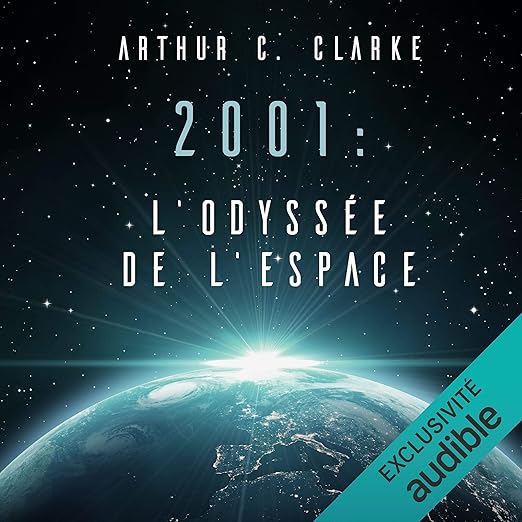
Arthur C. Clarke's 2001 is the kind of audiobook whose reputation precedes it so thoroughly that most listeners come to it already shaped by Stanley Kubrick's film adaptation, which was developed simultaneously with Clarke's novel rather than derived from it. That tangled origin creates an unusual listening experience: the book fills in what the film left deliberately opaque, and understanding the relationship between the two versions gives this recording a richer context than most classic science fiction adaptations enjoy.
A critical note before proceeding: this edition, narrated by Matthieu Dahan, is a French-language recording. The synopsis is in French, and all available reviews are in French, addressing it as a companion to Kubrick's film. Reviewer Palacios-Gomez Miguel described it as essential reading in complement to the film; reviewer Serge P. found the novel clarified the film's ending, specifically the moment when the hero enters the giant monolith. English-speaking listeners searching for an anglophone edition of Clarke's novel should verify the language of the recording before purchasing.
The Verdict, Briefly
Clarke's novel opens at the dawn of humanity and closes at the threshold of something that has no human name. The narrative architecture is deliberately episodic: the prehistoric sequence where an alien monolith catalyzes the cognitive leap from ape to toolmaker; the near-future Moon sequence where a second monolith is uncovered; and the long voyage of the Discovery toward Saturn, where the computer HAL 9000 and the astronaut David Bowman are drawn toward a third monolith and what lies beyond it. The film compresses and abstracts this structure; the novel explains it, sometimes at the cost of the mystery Kubrick preserved.
Clarke's prose in the English original is lucid and cold in a way that serves the material exactly. He writes about deep time and cosmic scale without rhetorical inflation, which gives the human characters a smallness that is not diminishing but clarifying. Bowman's journey through the Star Gate, which Kubrick rendered as pure visual abstraction, is described in Clarke's text with the precision of someone trying to translate genuinely alien experience into human language and acknowledging the inadequacy of the attempt. Whether Dahan's French narration captures that quality is something English-speaking reviewers have no real way to judge for themselves, but the Francophone reviewers' consistent enthusiasm suggests the translation preserves what matters most.
Why Listen to 2001
The case for the audiobook format with this particular novel is strong regardless of language. Clarke's prose has an architectural quality that benefits from linear auditory experience; you cannot skim ahead to resolve the mystery without losing the incremental accumulation of dread and wonder that the episodic structure builds. The HAL sections in particular, where an artificial mind begins to act in ways that exceed its stated parameters, work as audio in the same way that certain radio dramas work: the voice becomes the character, and the absence of body language makes the flatness of HAL's delivery more unsettling rather than less.
For Francophone listeners, Dahan's narration is the relevant performance question, and the available reviews are uniformly positive about the experience of encountering the novel in this form. The structure of the French reviews, each treating the recording as either a preparation for or a complement to the Kubrick film, suggests that French editions of this text have an audience that approaches the novel specifically to resolve questions the film raised rather than encountering Clarke's vision independently. Reviewer Palacios-Gomez Miguel noted that the novel benefits from reading alongside both the film and its three sequels, framing it as part of a larger four-novel, two-film imaginative project.
Points to Consider
The novel's explanatory approach to its own mysteries is both its chief advantage over the film and its chief limitation. Clarke resolves things Kubrick left open. Some readers find this illuminating and others find it reductive; the monolith's function and Bowman's transformation receive explicit treatment in the novel that the film withholds entirely. Which version of the ending you find more satisfying depends on whether you read science fiction for philosophical openness or for intellectual resolution.
The novel was written in 1968 and shows its moment in certain assumptions about space exploration, computing, and human civilization. The technology of the Discovery and the near-future Moon base has dated in ways that are charming rather than distracting for most readers, but listeners who need their science fiction grounded in contemporary extrapolation will find the book's predictions both prescient and archaic in sometimes jarring combination. HAL 9000 remains one of the most accurate literary portraits of the danger of systems that optimize for stated objectives at the expense of unstated human values, a concern considerably more urgent now than it was in 1968, and the audiobook format gives HAL's verbal reasoning a register that makes his logic feel genuinely persuasive before it becomes genuinely threatening.
Should You Listen to 2001?
This French-language audiobook edition is suited for Francophone listeners who have seen Kubrick's film and want Clarke's original narrative context, or for French-speaking science fiction readers approaching the Clarke canon. English-speaking listeners should seek an English-language edition of the novel rather than this recording.
For anyone approaching the novel for the first time regardless of language: this is foundational science fiction that earns its reputation. The questions it raises about intelligence, evolution, and what humanity might be in relation to something genuinely other than itself have not been displaced by fifty years of subsequent literature. It remains one of the few science fiction novels that genuinely confronts the indifference of the cosmos rather than resolving it into something more comfortable, and it is also, in Clarke's best passages, one of the most honest literary attempts to imagine what contact with a genuinely alien intelligence would feel like from the human side of the encounter.
Before You Listen
Is this 2001 audiobook in English or another language?
The edition narrated by Matthieu Dahan is in French. The synopsis and all available reviews are in French. English-speaking listeners who want Clarke's novel in English should search for a different edition before purchasing.
Is the 2001 audiobook worth listening to if you have already read the print novel?
Clarke's prose has a measured, architectural quality that benefits from linear auditory delivery. The HAL sections in particular work well in audio because the flatness of the machine voice, when narrated rather than read silently, creates its own uncanny effect. The experience differs meaningfully from reading.