At a Glance
- Narrator: Theo Solomon reads solo for Blackstone, and the job the text sets is explanation rather than menace, since most of the novel's weight sits in its passages about language.
- Subjects: Surveillance, language engineered as a tool of control, doomed private love inside a Party that reaches everywhere.
- Tone: Cold, procedural, quietly claustrophobic.
- Bottom line: A workable route into the novel, undercut by a listing that documents the print jacket more carefully than the recording.
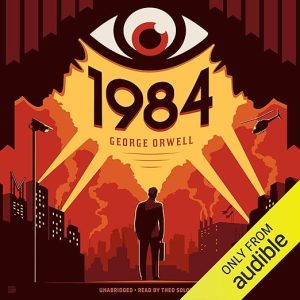
Choosing an edition of 1984 means choosing between things the product page barely describes. This one is Blackstone's 2024 audiobook, twelve hours and eighteen minutes, with Theo Solomon in the reading credit, and the description spends its whole length on the novel rather than on the recording. That is ordinary enough for a book this famous. What is less ordinary is how much of the page turns out to be describing a hardcover instead, right down to a jacket illustration credit sitting at the bottom of the copy.
Jacket Credits Reveal Unedited Print-Era Copy
Winston Smith alters newspapers at the Ministry of Truth, or Minitrue in Newspeak, and starts keeping a diary of doubts he knows will eventually kill him. He falls in love with Julia, a woman of the Party, and both of them understand the arrangement is temporary. Read aloud, the book's difficulty is not the plot but the register. Orwell wrote long stretches of explanation about how the language of Oceania works, and a reader has to keep those passages moving without turning them into a lecture or smoothing them into background noise.
Scott E. Amundsen's five-star assessment, filed in October 2013, is the most substantial thing anyone has written on this page, and it is entirely about the novel's place in a lineage. It argues that comparisons with Huxley's Brave New World have become something of a joke in literary circles, that Huxley predated Orwell by seventeen years, and that Zamyatin's We, written a decade before the Huxley, keeps getting dropped from the conversation. Genuinely useful context. It also predates this particular recording by more than a decade.
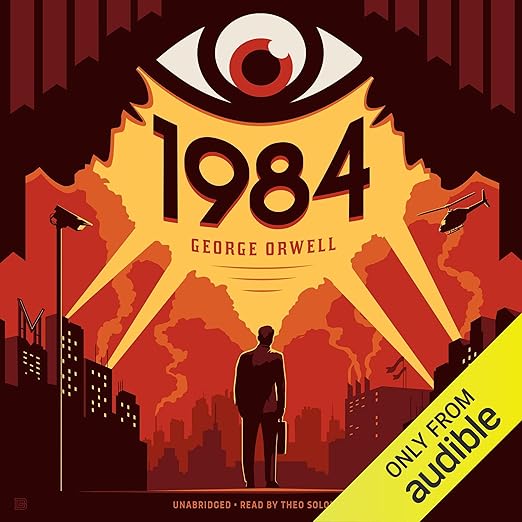
Two details deserve a buyer's attention before anything else. The series line reads The English Edition and puts 1984 at number three, which is not a sequence any reader of Orwell would recognize and not a number attached to this novel anywhere in the copy itself. And the description closes by crediting a cover illustration and design to Derek Anderson and Joel Anderson of Anderson Design Group. A jacket credit is a print artifact. It says the copy was written for a physical object and carried across without an editorial pass.
Hearing Newspeak's Coinages Before Their Definitions
Orwell's coinages are why the book survives as vocabulary and not only as plot. Big Brother, doublethink, newspeak, thoughtcrime: the description lists them, along with the later arrival of Orwellian to mean government deception and misleading terminology. Heard rather than read, those words land differently, because a listener meets them as speech first and as definition second, roughly the way Winston meets them. The two sentences the publisher pulls from the text work as speech too, one about how thoughtcrime cannot be hidden forever, the other Julia's distinction between what the Party can force you to say and what it can force you to believe.
A March 2026 five-star response says something more honest than most recommendations manage. The buyer shelved the book at home between Fahrenheit 451 and Animal Farm and admits, half joking, to having bought it in order to indoctrinate a son. That is the actual life of this title now, a book people acquire deliberately, usually for somebody else, as an act of private curriculum. Audio shifts that transaction slightly, since a file cannot be handed over or placed on a shelf, but the impulse behind the purchase is identical.
Twelve hours is a moderate commitment and a longer one than the book's compressed reputation suggests. Listeners who have only met 1984 through its afterlife, through the adjective and the borrowed vocabulary, tend to be surprised by how much of it is ordinary working life and administrative tedium before anything turns. Winston's actual job is document revision. He edits old newspapers so they agree with new instructions, over and over, as a salaried task. That texture is the novel's real argument, and it survives a reading far better than it survives a summary.
Theo Solomon Goes Unnamed in Every Review
Read the written responses on this page before trusting them as a guide to the recording. The most detailed of them, at five stars in September 2025, is a review of a hardcover: a slight curvature in the front cover, a photograph attached as evidence, and a complaint about warehouse handling. Two of the five describe a physical copy in hand. None of that reflects badly on the people who wrote them, who were reviewing what they bought. It is a warning about which product the star average is measuring.
Nobody here names Theo Solomon. Across all five written accounts the voice, the pacing and the sound of the file go undescribed, which leaves the reading credit as the most consequential thing on the page and simultaneously the least documented. Sample before committing, and give the sample a stretch of explanation rather than a scene, since explanation is where this text gets hard to carry. A scene of Winston and Julia will sound fine in almost any hands. The Newspeak passages are the ones that separate readers.
One four-star note from May 2023 reads as though it was assembled rather than written. It refers to the book twice as Boom 1984, discusses at length the value of writing a review about it, and never quite arrives at anything about the story. It also lands more than a year before this recording existed. Between that entry and the 2013 one, two of the five written responses on the page were filed before anybody could have listened to what is being sold here.
This Edition Suits Students More Than Purists
Anyone meeting the novel for the first time gets a reasonable route in, and the format suits the material: the book is largely interior, largely conversational through its middle stretch, and it does not lean on visual structure the way some literary fiction does. Students working through it for a class will find audio a workable companion to a print copy, because the prose is dense enough that hearing a paragraph a second time is often quicker than parsing it once on the page.
Purists who care which recording they own should treat this listing as insufficient rather than as a recommendation. It offers a name, a runtime, and a publisher, then stops. Anyone who annotates, who wants to mark the passages about language, will still want the text alongside. And the series line will steer a catalog search wrong, so hunt for this Blackstone version by its runtime and its reading credit rather than by whatever The English Edition is meant to denote.
Language is the instrument in this novel rather than its decoration, and language is precisely what a reading either serves or ruins. This edition puts a reader in front of that job and then declines to tell you a single thing about the reader, which is a strange way to sell the one decision that separates one recording of Orwell from the next.
Good to Know
Does the audiobook come with companion material for the Newspeak vocabulary?
No supplemental PDF is named anywhere on the listing. The description lists the words the novel put into common English, Big Brother, doublethink, newspeak and thoughtcrime, then leaves them there. If you want glossaries or the critical apparatus that many print editions carry, plan on sourcing a text edition separately.
Is 1984 a hard first listen if the only Orwell you know is the adjective?
Harder than expected, though not because of the plot. The opening stretch is mostly workplace routine and rationed dailiness, and the pressure builds slowly. Come in expecting a bureaucratic novel that turns, rather than a thriller, and the pacing stops feeling like a problem around the point Winston starts writing.
Do the written responses tell you anything about how this audiobook holds up?
Very little. The shortest entry, five stars from February 2026, runs to three words of endorsement and no detail at all. The remaining four discuss the novel, its lineage, or a physical copy. Treat the star average as a verdict on Orwell rather than on this particular production.
Is twelve hours and eighteen minutes a long sit for a novel this widely assigned?
It sits in the middle of the range for a literary classic, and it splits cleanly across a week of ordinary listening. Students pairing it with a print copy usually cover it faster, since rereading a paragraph on the page takes seconds while relocating it in a file takes longer.