The Short Version
- Performance: Ralph Cosham reads for Blackstone on a file that predates the anniversary paperbacks its buyers keep describing.
- What it covers: Revolution betrayed, propaganda and rewritten rules, the fable as political instrument
- Feel: Cold, quick and very short
- Our call: A clean three hours with Animal Farm; verify what else is in the file before counting on the second title.
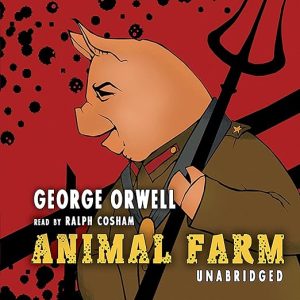
Napoleon, Squealer and Snowball turn Mr. Jones' Manor Farm into a republic of equals, and this audiobook carries that story in three hours and eleven minutes. The runtime is the first thing worth examining, because the title on the record promises two novels while the description underneath discusses exactly one. Every name it raises, the three pigs, the faithful horse Boxer, the founding slogan and its bloodstained revision, belongs to Animal Farm.
Taken on its own terms, the description is a competent and complete summary of one short novel. Manor Farm becomes Animal Farm, the credo that all animals are created equal takes hold, three pigs rise through what the copy calls a subtle evolution with an insidious familiarity, and the arc closes on the betrayal of Boxer and the amended slogan. It gives away the ending, which is unusual for sales copy, and it says nothing whatsoever about the second title on the cover. Not a character, not a setting, not a sentence.
Blackstone Audio published this recording on December 15, 1999, with Ralph Cosham credited as the reader, and the file runs three hours and eleven minutes in total. Three hours is a plausible length for one of these books and an implausible one for both together, which is the second signal pointing where the description already points. Anyone who needs both novels should treat the title as unverified and confirm the contents with the publisher before spending. Anyone who wants Animal Farm is looking at a page that describes it thoroughly.
One further field deserves a skeptical read. The average shown here is drawn from ninety-three ratings attached to a record whose title names two novels, whose description covers one, and whose written responses describe at least two different printed editions. Whatever that number measures, it is not a single object. Averages on classics tend to work this way, absorbing every format a title has ever been sold in, so a high score signals that the book is admired rather than that this particular file is good.
Ralph Cosham's Reading Predates Every Review Here
Animal Farm was built for the ear whether or not Orwell was thinking about one. It moves through speeches, chants, slogans and rumors, and its politics arrive as things animals say to each other and then quietly revise. Spoken aloud, those revisions land harder than they do on the page, because a listener cannot flick back to check what the commandment said last week and has to sit with the suspicion that it has changed. That length also keeps the whole shape of the thing in view at once.
One five-star filed in March 2026 puts it plainly, calling this a short read and a frightening one on the grounds that the present keeps matching it. That reaction has been reliable for decades, and it is a more honest reason to press play than any claim about literary importance, since the satire keeps finding new material without ever being updated.
Company is the other thing this length buys. Animal Farm is one of the few political books short enough to put on with someone else in the room, which is how many people first met it, and a spoken version handles the fable's flat, unhurried tone without the effort a longer novel would demand. The moment the commandments start changing is the moment listeners look at each other, and that only works if everyone reaches it together.
Ralph Cosham reads a recording that reached the catalog in December 1999, making the audio older than every response on this page by more than twenty-five years. The credit and the runtime are the only two fields here that describe the object you would be listening to, and they deserve more attention than the average precisely because everything else on the record has drifted toward paper.
Paperback Complaints Have No Place on This Recording
Written responses on this page grade printed books. One reports that the volume arrived new, that it is small enough to hold in one hand, and that the text is not too small. Another describes a seventy-fifth anniversary edition carrying a commentary at the front and advises reading the novel first and the commentary afterward. Neither is a poor response, and neither could have been written by a listener.
A four-star from August 2025 marks the anniversary paperback down for poor binding while rating an introduction by Tea Obreht highly, with a warning that the introduction spoils the plot. Both of those apparatus pieces, commentary and introduction, are print assets of a recent edition, and a recording published in 1999 cannot contain either. A fifth response awards five stars while stating outright that it has not read the book, having bought it for a school class. All five went up between August 2025 and March 2026, twenty-six years after this recording was published.
Two practical checks follow from that. Confirm what is actually in the file, since the title, the description and the runtime do not agree with one another. Then decide whether you want the plain novel or the anniversary package, because the commentary and the introduction described above exist only on paper and no audio edition of any vintage will hand them to you.
Came for 1984? The Title Field Is All You Get
Anyone who has never read Animal Farm and wants it finished in one sitting is well served here, and the three-hour length means a school assignment or a long evening covers the book with room left over to think about it. It works equally well as a reread for listeners who last met the pigs at fourteen and remember the plot without remembering how fast the language turns.
Approach with caution if the second title on the cover is what you came for, because nothing on this record supports it beyond the words in the title field itself. Look elsewhere if you want the anniversary edition's extras, which live in print. And if your objection to Animal Farm was always that the allegory is too neat, three spoken hours of it will not soften that view.