Quick Take
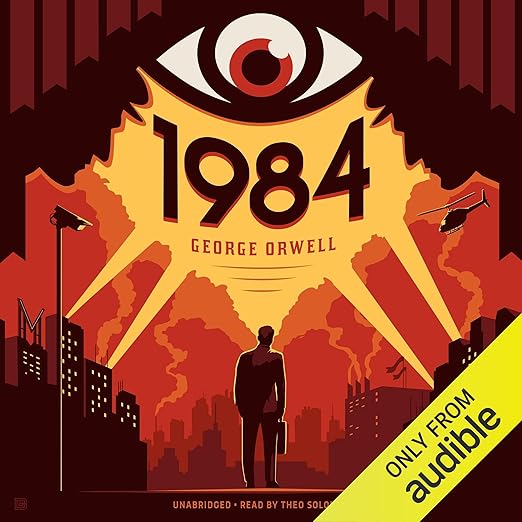
- Narration: Theo Solomon’s 2024 Blackstone recording brings clean, unhurried authority to Orwell’s text, neither dramatizing nor flattening the prose.
- Themes: Totalitarian surveillance, the destruction of objective truth, love as political resistance
- Mood: Cold, relentless, and politically urgent
- Verdict: This specific 2024 recording from Blackstone is a reliable choice for a text that rewards revisiting regardless of which edition you reach for.
Certain books arrive differently depending on when you encounter them. I first read 1984 in school, where it felt like historical cautionary fiction, something from a world that had already been survived. I listened to this 2024 Blackstone recording on a weekend when the news feed was particularly relentless, and the experience was different in ways that are hard to quantify but impossible to ignore.
George Orwell finished the novel in 1948, inverting the last two digits of the year for his title. He was dying of tuberculosis, writing about surveillance and propaganda while the Soviet model was busy demonstrating that such things were not purely imaginable. Seventy-six years later, as one reviewer noted, the book lands with accumulated resonance for anyone who last read it in a high school classroom.
Our Take on 1984
Winston Smith’s job at the Ministry of Truth is to rewrite history, to alter newspaper archives so that the Party’s past statements align with its current positions. It is unglamorous, systematic, and completely ordinary. Orwell’s genius was to make totalitarianism feel not like a theatrical horror but like bureaucratic routine. Winston does not rebel out of heroic impulse. He begins a diary. He falls in love. He makes the smallest possible gestures toward interior freedom, and the system finds them anyway.
The novel coined doublethink, newspeak, thoughtcrime, and Big Brother as concepts that have now fully detached from the text and colonized everyday political language. Listening to the original source material reminds you how precisely Orwell defined each of these. Doublethink is not simply believing two contradictory things. It is holding them simultaneously while knowing you are doing so, and suppressing the knowledge that you know. That degree of precision in the original language gets lost in casual usage.
Why Listen to This Edition
Theo Solomon’s narration for Blackstone, released July 2024, is clean and authoritative without being theatrical. At 12 hours and 18 minutes, it is a reasonable runtime for a novel of this weight. Solomon does not impose dramatic interpretation on Orwell’s deliberately flat prose, which is the correct call. The Ministry of Truth should sound like an office, not a dungeon. The love scenes between Winston and Julia carry the necessary fragility without melodrama. The later interrogation sequences, where the full machinery of the Party becomes explicit, build appropriately without escalating into performance.
There are many audio editions of this novel. This one is a recent, well-produced recording that handles the text with respect. If you have an Audible credit and are choosing between editions, the Blackstone 2024 version with Solomon is a safe choice.
What to Watch For in 1984
The middle section of the novel, in which Winston reads extensively from the prohibited book attributed to Goldstein, tests some listeners’ patience. It is deliberately written as a political pamphlet embedded within a novel, and it reads like one. That section exists to explain the mechanics of perpetual war and the purpose of the prole classes in maintaining the system’s stability. It is essential to the argument the novel is making, but it slows the emotional narrative significantly. Be prepared for it rather than surprised by it.
The ending, which remains one of the most discussed conclusions in twentieth-century fiction, is not ambiguous despite decades of competing interpretations. The Party wins. Orwell did not hedge. Some readers, particularly those encountering the book for the first time, find that shocking. That shock is the correct response.
Who Should Listen to 1984
Anyone who read this in school and has not returned to it since. The experience is genuinely different with adult context. Anyone interested in the origins of political language that has since become commonplace. First-time readers should know they are signing up for a novel that is rigorously bleak by design. If you come looking for a way out, Orwell will not provide one. That is not a weakness. It is the entire point.
What the Blackstone 2024 recording ultimately offers is a reliable, contemporary-sounding entry point to a text that has never stopped being necessary. Whether this is a first encounter or a return visit, Solomon’s narration serves the material without imposing on it. That restraint is exactly right for Orwell, who wrote in a style so deliberate and spare that theatrical narration would feel like an editorial intrusion. Here, the prose gets the space it demands.
Frequently Asked Questions
How does Theo Solomon’s 2024 Blackstone recording compare to the older Audible editions with different narrators?
Solomon’s recording is clean and contemporary without being stylistically intrusive. Older editions have their champions, particularly among readers who grew up with specific narrator voices. This one prioritizes clarity and textual fidelity over dramatic interpretation, which suits Orwell’s deliberately spare prose.
Is the Goldstein pamphlet section in Part 2 skippable for audio listeners?
It can be tempting to skip but doing so removes Orwell’s full explanation of how the system sustains itself. The political theory embedded in that section is load-bearing for understanding the novel’s final act. It is worth sitting with, even at the slower pace.
Does the novel feel different listening to it in 2024 versus reading it in school decades earlier?
Multiple reviewers have noted exactly this. Several who re-encountered it as adults found it considerably more unsettling than their school memories suggested, particularly around the concepts of memory manipulation and the relationship between language and thought.
Is this the unabridged edition?
Yes, the Blackstone Publishing 2024 release narrated by Theo Solomon at 12 hours and 18 minutes is the complete, unabridged text.